4RS7 | pdb_00004rs7

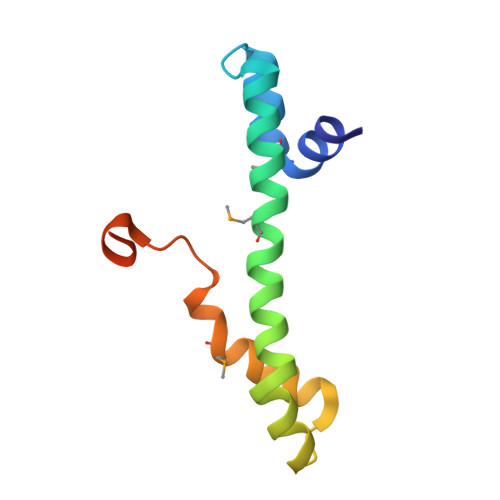
Structure of pNOB8 ParB-C


Experimental Data Snapshot

  • Method: X-RAY DIFFRACTION
  • Resolution: 1.90 Å
  • R-Value Free: 
    0.224 (Depositor), 0.194 (DCC) 
  • R-Value Work: 
    0.193 (Depositor), 0.191 (DCC) 
  • R-Value Observed: 
    0.195 (Depositor) 

wwPDB Validation 3D Report Full Report

Validation slider image for 4RS7

This is version 1.1 of the entry. See complete history

Literature

Structures of archaeal DNA segregation machinery reveal bacterial and eukaryotic linkages.

Schumacher, M.A.Tonthat, N.K.Lee, J.Rodriguez-Castaneda, F.A.Chinnam, N.B.Kalliomaa-Sanford, A.K.Ng, I.W.Barge, M.T.Shaw, P.L.Barilla, D.

(2015) Science 349: 1120-1124

  • DOI: https://doi.org/10.1126/science.aaa9046
  • Primary Citation Related Structures: 
    4RS7, 4RS8, 5K5A, 5K5D, 5K5O, 5K5Q, 5K5R, 5K5Z

  • PubMed Abstract: 

    Although recent studies have provided a wealth of information about archaeal biology, nothing is known about the molecular basis of DNA segregation in these organisms. Here, we unveil the machinery and assembly mechanism of the archaeal Sulfolobus pNOB8 partition system. This system uses three proteins: ParA; an atypical ParB adaptor; and a centromere-binding component, AspA. AspA utilizes a spreading mechanism to create a DNA superhelix onto which ParB assembles. This supercomplex links to the ParA motor, which contains a bacteria-like Walker motif. The C domain of ParB harbors structural similarity to CenpA, which dictates eukaryotic segregation. Thus, this archaeal system combines bacteria-like and eukarya-like components, which suggests the possible conservation of DNA segregation principles across the three domains of life.


  • Organizational Affiliation
    • Department of Biochemistry, Duke University School of Medicine, 243 Nanaline H. Duke, Box 3711, Durham, NC 27710, USA. maria.schumacher@duke.edu daniela.barilla@york.ac.uk.

Macromolecule Content 

  • Total Structure Weight: 46.9 kDa 
  • Atom Count: 3,353 
  • Modeled Residue Count: 349 
  • Deposited Residue Count: 384 
  • Unique protein chains: 1

Macromolecules

Find similar proteins by:|  3D Structure
Entity ID: 1
MoleculeChains  Sequence LengthOrganismDetailsImage
ParB-CA [auth R],
B [auth D],
C [auth A],
D [auth B]
96Sulfolobus sp. NOB8H2Mutation(s): 0 
UniProt
Find proteins for A0ACD6B9E6 (Sulfolobus sp. NOB8H2)
Explore A0ACD6B9E6 
Go to UniProtKB:  A0ACD6B9E6
Entity Groups
Sequence Clusters30% Identity50% Identity70% Identity90% Identity95% Identity100% Identity
UniProt GroupA0ACD6B9E6
Sequence Annotations
Expand
Reference Sequence

Small Molecules

Modified Residues  1 Unique
IDChains TypeFormula2D DiagramParent
MSE
Query on MSE
A [auth R],
B [auth D],
C [auth A],
D [auth B]
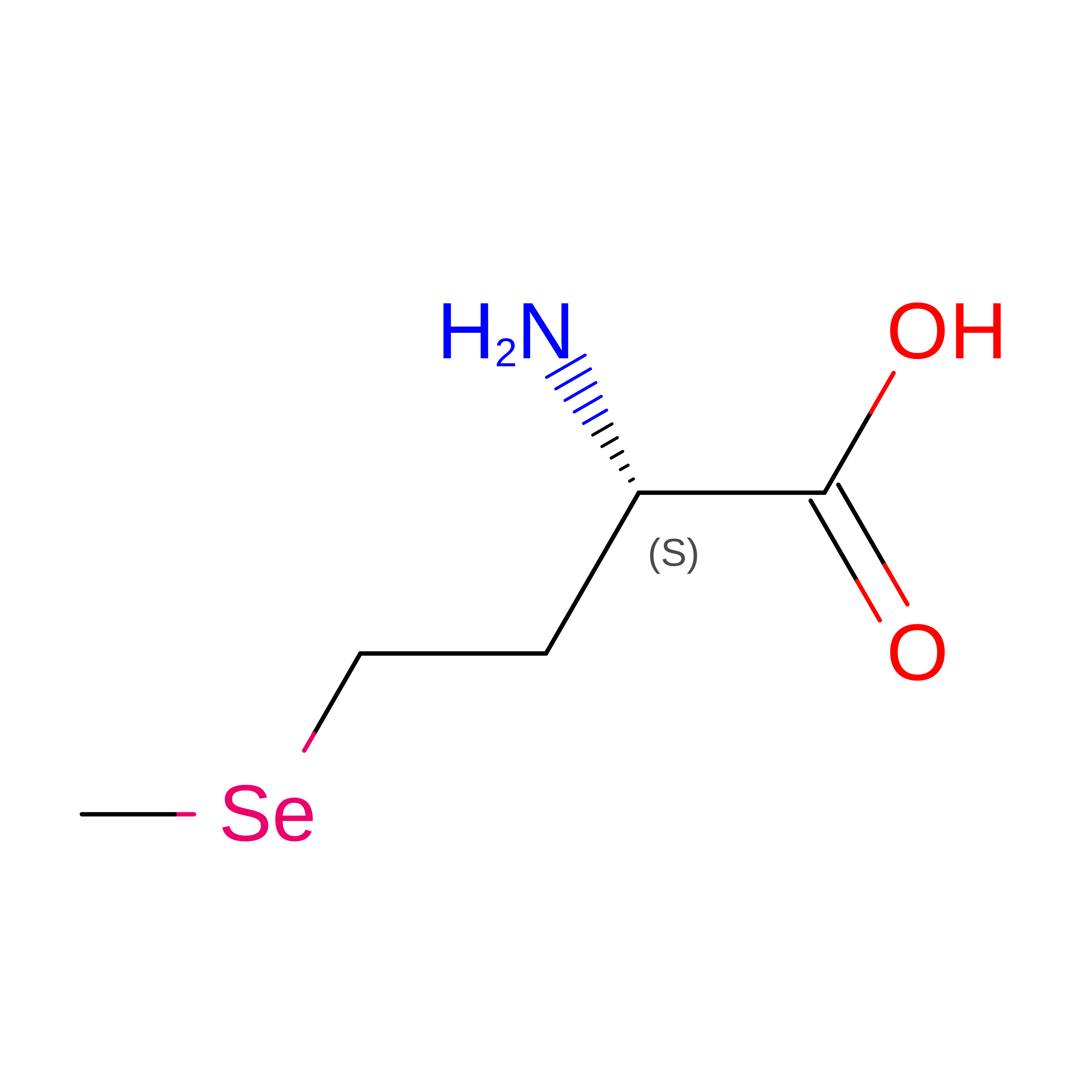
L-PEPTIDE LINKINGC5 H11 N O2 SeMET

Experimental Data & Validation

Experimental Data

  • Method: X-RAY DIFFRACTION
  • Resolution: 1.90 Å
  • R-Value Free:  0.224 (Depositor), 0.194 (DCC) 
  • R-Value Work:  0.193 (Depositor), 0.191 (DCC) 
  • R-Value Observed: 0.195 (Depositor) 
Space Group: P 1 21 1
Unit Cell:
Length ( Å )Angle ( ˚ )
a = 50.21α = 90
b = 56.06β = 94.4
c = 72.3γ = 90
Software Package:
Software NamePurpose
ADSCdata collection
SOLVEphasing
PHENIXrefinement
MOSFLMdata reduction
SCALAdata scaling

Structure Validation

View Full Validation Report


Entry History 

Deposition Data

Revision History  (Full details and data files)

  • Version 1.0: 2015-09-16
    Type: Initial release
  • Version 1.1: 2024-10-16
    Changes: Data collection, Database references, Derived calculations, Structure summary