4R75 | pdb_00004r75

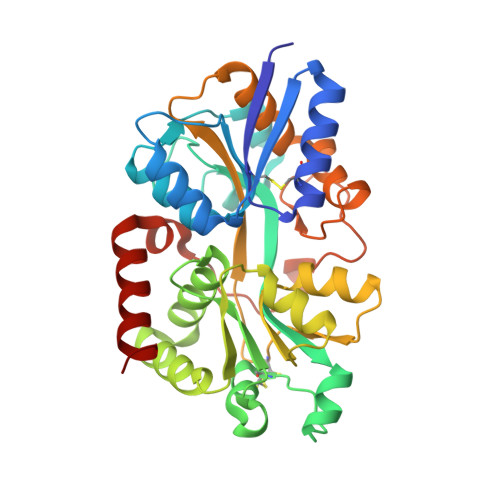
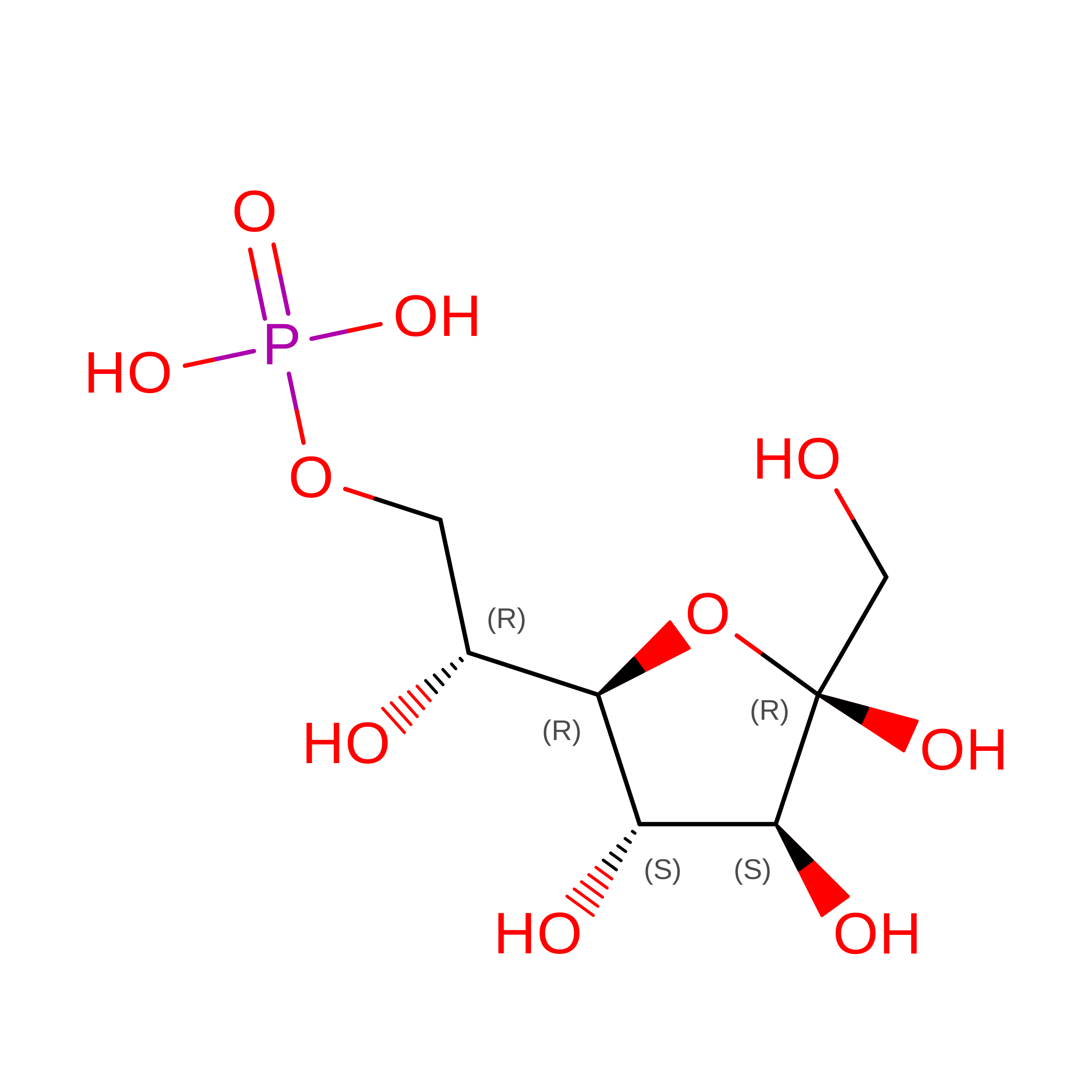
Structure of the periplasmic binding protein AfuA from Actinobacillus pleuropneumoniae (exogenous sedoheptulose-7-phosphate bound)


Experimental Data Snapshot

  • Method: X-RAY DIFFRACTION
  • Resolution: 1.28 Å
  • R-Value Free: 
    0.190 (Depositor), 0.191 (DCC) 
  • R-Value Work: 
    0.172 (Depositor), 0.174 (DCC) 
  • R-Value Observed: 
    0.173 (Depositor) 

wwPDB Validation 3D Report Full Report

Validation slider image for 4R75

Ligand Structure Quality Assessment 


This is version 2.2 of the entry. See complete history

Literature

Active Transport of Phosphorylated Carbohydrates Promotes Intestinal Colonization and Transmission of a Bacterial Pathogen.

Sit, B.Crowley, S.M.Bhullar, K.Lai, C.C.Tang, C.Hooda, Y.Calmettes, C.Khambati, H.Ma, C.Brumell, J.H.Schryvers, A.B.Vallance, B.A.Moraes, T.F.

(2015) PLoS Pathog 11: e1005107-e1005107

  • DOI: https://doi.org/10.1371/journal.ppat.1005107
  • Primary Citation Related Structures: 
    4R72, 4R73, 4R74, 4R75

  • PubMed Abstract: 

    Efficient acquisition of extracellular nutrients is essential for bacterial pathogenesis, however the identities and mechanisms for transport of many of these substrates remain unclear. Here, we investigate the predicted iron-binding transporter AfuABC and its role in bacterial pathogenesis in vivo. By crystallographic, biophysical and in vivo approaches, we show that AfuABC is in fact a cyclic hexose/heptose-phosphate transporter with high selectivity and specificity for a set of ubiquitous metabolites (glucose-6-phosphate, fructose-6-phosphate and sedoheptulose-7-phosphate). AfuABC is conserved across a wide range of bacterial genera, including the enteric pathogens EHEC O157:H7 and its murine-specific relative Citrobacter rodentium, where it lies adjacent to genes implicated in sugar sensing and acquisition. C. rodentium ΔafuA was significantly impaired in an in vivo murine competitive assay as well as its ability to transmit infection from an afflicted to a naïve murine host. Sugar-phosphates were present in normal and infected intestinal mucus and stool samples, indicating that these metabolites are available within the intestinal lumen for enteric bacteria to import during infection. Our study shows that AfuABC-dependent uptake of sugar-phosphates plays a critical role during enteric bacterial infection and uncovers previously unrecognized roles for these metabolites as important contributors to successful pathogenesis.


  • Organizational Affiliation
    • Department of Biochemistry, University of Toronto, Toronto, Ontario, Canada.

Macromolecule Content 

  • Total Structure Weight: 36.11 kDa 
  • Atom Count: 3,128 
  • Modeled Residue Count: 318 
  • Deposited Residue Count: 321 
  • Unique protein chains: 1

Macromolecules

Find similar proteins by:|  3D Structure
Entity ID: 1
MoleculeChains  Sequence LengthOrganismDetailsImage
ABC-type Fe3+ transport system, periplasmic component321Actinobacillus pleuropneumoniaeMutation(s): 0 
Gene Names: afuAAPL_1446
UniProt
Find proteins for A3N294 (Actinobacillus pleuropneumoniae serotype 5b (strain L20))
Explore A3N294 
Go to UniProtKB:  A3N294
Entity Groups
Sequence Clusters30% Identity50% Identity70% Identity90% Identity95% Identity100% Identity
UniProt GroupA3N294
Sequence Annotations
Expand
Reference Sequence

Experimental Data & Validation

Experimental Data

  • Method: X-RAY DIFFRACTION
  • Resolution: 1.28 Å
  • R-Value Free:  0.190 (Depositor), 0.191 (DCC) 
  • R-Value Work:  0.172 (Depositor), 0.174 (DCC) 
  • R-Value Observed: 0.173 (Depositor) 
Space Group: P 21 21 21
Unit Cell:
Length ( Å )Angle ( ˚ )
a = 47.405α = 90
b = 59.895β = 90
c = 106.014γ = 90
Software Package:
Software NamePurpose
SCALAdata scaling
PHENIXrefinement
PDB_EXTRACTdata extraction

Structure Validation

View Full Validation Report


Ligand Structure Quality Assessment 


Entry History 

Deposition Data

Revision History  (Full details and data files)

  • Version 1.0: 2015-08-12
    Type: Initial release
  • Version 1.1: 2015-09-02
    Changes: Database references
  • Version 2.0: 2020-05-13
    Changes: Atomic model, Database references
  • Version 2.1: 2020-07-29
    Type: Remediation
    Reason: Carbohydrate remediation
    Changes: Data collection, Derived calculations
  • Version 2.2: 2024-11-20
    Changes: Data collection, Database references, Structure summary