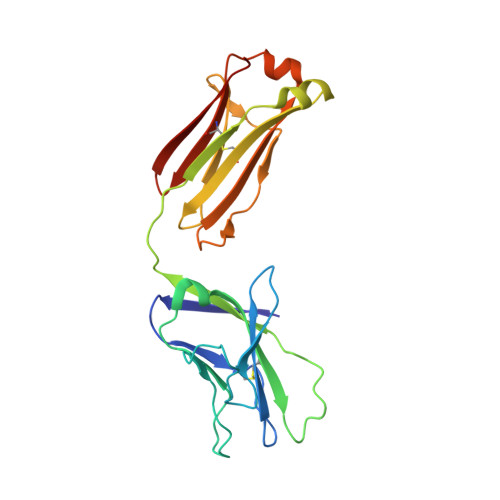
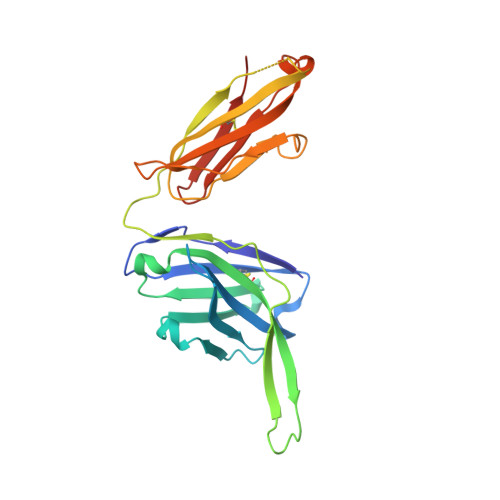
4R26 | pdb_00004r26

Crystal structure of human Fab PGT124, a broadly neutralizing and potent HIV-1 neutralizing antibody


Experimental Data Snapshot

  • Method: X-RAY DIFFRACTION
  • Resolution: 2.50 Å
  • R-Value Free: 
    0.267 (Depositor), 0.271 (DCC) 
  • R-Value Work: 
    0.233 (Depositor), 0.238 (DCC) 
  • R-Value Observed: 
    0.235 (Depositor) 

wwPDB Validation 3D Report Full Report

Validation slider image for 4R26

This is version 1.2 of the entry. See complete history

Literature

Structural Evolution of Glycan Recognition by a Family of Potent HIV Antibodies.

Garces, F.Sok, D.Kong, L.McBride, R.Kim, H.J.Saye-Francisco, K.F.Julien, J.P.Hua, Y.Cupo, A.Moore, J.P.Paulson, J.C.Ward, A.B.Burton, D.R.Wilson, I.A.

(2014) Cell 159: 69-79

  • DOI: https://doi.org/10.1016/j.cell.2014.09.009
  • Primary Citation Related Structures: 
    4R26, 4R2G

  • PubMed Abstract: 

    The HIV envelope glycoprotein (Env) is densely covered with self-glycans that should help shield it from recognition by the human immune system. Here, we examine how a particularly potent family of broadly neutralizing antibodies (Abs) has evolved common and distinct structural features to counter the glycan shield and interact with both glycan and protein components of HIV Env. The inferred germline antibody already harbors potential binding pockets for a glycan and a short protein segment. Affinity maturation then leads to divergent evolutionary branches that either focus on a single glycan and protein segment (e.g., Ab PGT124) or engage multiple glycans (e.g., Abs PGT121-123). Furthermore, other surrounding glycans are avoided by selecting an appropriate initial antibody shape that prevents steric hindrance. Such molecular recognition lessons are important for engineering proteins that can recognize or accommodate glycans.


  • Organizational Affiliation
    • Department of Integrative Structural and Computational Biology, The Scripps Research Institute, La Jolla, CA 92037, USA; International AIDS Vaccine Initiative Neutralizing Antibody Center, The Scripps Research Institute, La Jolla, CA 92037, USA; Scripps Center for HIV/AIDS Vaccine Immunology & Immunogen Discovery, The Scripps Research Institute, La Jolla, CA 92037, USA.

Macromolecule Content 

  • Total Structure Weight: 48.79 kDa 
  • Atom Count: 3,398 
  • Modeled Residue Count: 436 
  • Deposited Residue Count: 450 
  • Unique protein chains: 2

Macromolecules

Find similar proteins by:|  3D Structure
Entity ID: 1
MoleculeChains  Sequence LengthOrganismDetailsImage
PGR124-Light ChainA [auth L]214Nomascus leucogenysHomo sapiens
This entity is chimeric
Mutation(s): 0 
UniProt & NIH Common Fund Data Resources
Find proteins for P0DOY3 (Homo sapiens)
Explore P0DOY3 
Go to UniProtKB:  P0DOY3
GTEx:  ENSG00000211679 
Entity Groups
Sequence Clusters30% Identity50% Identity70% Identity90% Identity95% Identity100% Identity
UniProt GroupP0DOY3
Sequence Annotations
Expand
Reference Sequence
Find similar proteins by:|  3D Structure
Entity ID: 2
MoleculeChains  Sequence LengthOrganismDetailsImage
PGT124-Heavy ChainB [auth H]236Homo sapiensMutation(s): 0 
Gene Names: IGH@
UniProt
Find proteins for P0DOX5 (Homo sapiens)
Explore P0DOX5 
Go to UniProtKB:  P0DOX5
Entity Groups
Sequence Clusters30% Identity50% Identity70% Identity90% Identity95% Identity100% Identity
UniProt GroupP0DOX5
Sequence Annotations
Expand
Reference Sequence

Experimental Data & Validation

Experimental Data

  • Method: X-RAY DIFFRACTION
  • Resolution: 2.50 Å
  • R-Value Free:  0.267 (Depositor), 0.271 (DCC) 
  • R-Value Work:  0.233 (Depositor), 0.238 (DCC) 
  • R-Value Observed: 0.235 (Depositor) 
Space Group: P 1 21 1
Unit Cell:
Length ( Å )Angle ( ˚ )
a = 62.686α = 90
b = 40.331β = 91.67
c = 84.457γ = 90
Software Package:
Software NamePurpose
PHENIXmodel building
PHENIXrefinement
HKL-2000data reduction
HKL-2000data scaling
PHENIXphasing

Structure Validation

View Full Validation Report


Entry History 

Deposition Data

Revision History  (Full details and data files)

  • Version 1.0: 2014-10-08
    Type: Initial release
  • Version 1.1: 2017-06-21
    Changes: Database references, Source and taxonomy, Structure summary
  • Version 1.2: 2024-11-06
    Changes: Data collection, Database references, Derived calculations, Structure summary