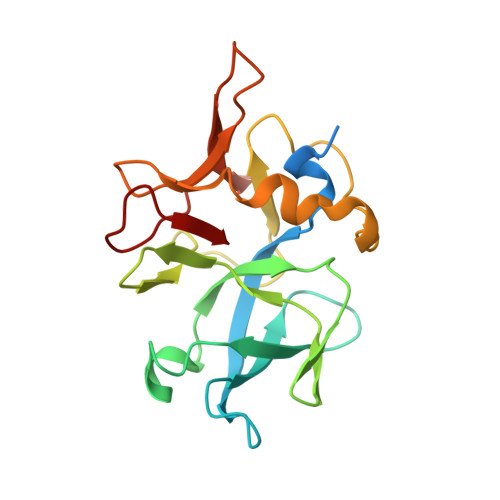
4R1J | pdb_00004r1j

Crystal structure of Arc1p-C


Experimental Data Snapshot

  • Method: X-RAY DIFFRACTION
  • Resolution: 1.40 Å
  • R-Value Free: 
    0.201 (Depositor), 0.200 (DCC) 
  • R-Value Work: 
    0.177 (Depositor), 0.178 (DCC) 
  • R-Value Observed: 
    0.178 (Depositor) 

Starting Model: experimental
View more details

wwPDB Validation 3D Report Full Report

Validation slider image for 4R1J

This is version 1.2 of the entry. See complete history

Literature

A Synthetic Adenylation-Domain-Based tRNA-Aminoacylation Catalyst.

Giessen, T.W.Altegoer, F.Nebel, A.J.Steinbach, R.M.Bange, G.Marahiel, M.A.

(2015) Angew Chem Int Ed Engl 54: 2492-2496

  • DOI: https://doi.org/10.1002/anie.201410047
  • Primary Citation Related Structures: 
    4R1J

  • PubMed Abstract: 

    The incorporation of non-proteinogenic amino acids represents a major challenge for the creation of functionalized proteins. The ribosomal pathway is limited to the 20-22 proteinogenic amino acids while nonribosomal peptide synthetases (NRPSs) are able to select from hundreds of different monomers. Introduced herein is a fusion-protein-based design for synthetic tRNA-aminoacylation catalysts based on combining NRPS adenylation domains and a small eukaryotic tRNA-binding domain (Arc1p-C). Using rational design, guided by structural insights and molecular modeling, the adenylation domain PheA was fused with Arc1p-C using flexible linkers and achieved tRNA-aminoacylation with both proteinogenic and non-proteinogenic amino acids. The resulting aminoacyl-tRNAs were functionally validated and the catalysts showed broad substrate specificity towards the acceptor tRNA. Our strategy shows how functional tRNA-aminoacylation catalysts can be created for bridging the ribosomal and nonribosomal worlds. This opens up new avenues for the aminoacylation of tRNAs with functional non-proteinogenic amino acids.


  • Organizational Affiliation
    • Department of Chemistry, Philipps-University Marburg, Hans-Meerwein-Strasse 4, 35032 Marburg (Germany); LOEWE Center for Synthetic Microbiology (Synmikro), Philipps-University Marburg, Hans-Meerwein-Strasse, 35032 Marburg (Germany). tobias.giessen@chemie.uni-marburg.de.

Macromolecule Content 

  • Total Structure Weight: 22.15 kDa 
  • Atom Count: 1,652 
  • Modeled Residue Count: 174 
  • Deposited Residue Count: 197 
  • Unique protein chains: 1

Macromolecules

Find similar proteins by:|  3D Structure
Entity ID: 1
MoleculeChains  Sequence LengthOrganismDetailsImage
GU4 nucleic-binding protein 1197Saccharomyces cerevisiae S288CMutation(s): 0 
Gene Names: ARC1G4P1YGL105WG3085
EC: 3.1.1
UniProt
Find proteins for P46672 (Saccharomyces cerevisiae (strain ATCC 204508 / S288c))
Explore P46672 
Go to UniProtKB:  P46672
Entity Groups
Sequence Clusters30% Identity50% Identity70% Identity90% Identity95% Identity100% Identity
UniProt GroupP46672
Sequence Annotations
Expand
Reference Sequence

Small Molecules

Ligands 1 Unique
IDChains Name / Formula / InChI Key2D Diagram3D Interactions
GOL

Query on GOL


Download:Ideal Coordinates CCD File
B [auth A]GLYCEROL
C3 H8 O3
PEDCQBHIVMGVHV-UHFFFAOYSA-N

Experimental Data & Validation

Experimental Data

  • Method: X-RAY DIFFRACTION
  • Resolution: 1.40 Å
  • R-Value Free:  0.201 (Depositor), 0.200 (DCC) 
  • R-Value Work:  0.177 (Depositor), 0.178 (DCC) 
  • R-Value Observed: 0.178 (Depositor) 
Space Group: P 21 21 21
Unit Cell:
Length ( Å )Angle ( ˚ )
a = 42.658α = 90
b = 49.961β = 90
c = 82.941γ = 90
Software Package:
Software NamePurpose
DNAdata collection
PHASERphasing
PHENIXrefinement
XDSdata reduction
SCALAdata scaling

Structure Validation

View Full Validation Report


Entry History 

Deposition Data

Revision History  (Full details and data files)

  • Version 1.0: 2015-02-18
    Type: Initial release
  • Version 1.1: 2015-03-11
    Changes: Database references
  • Version 1.2: 2023-09-20
    Changes: Data collection, Database references, Derived calculations, Refinement description