4QWD | pdb_00004qwd

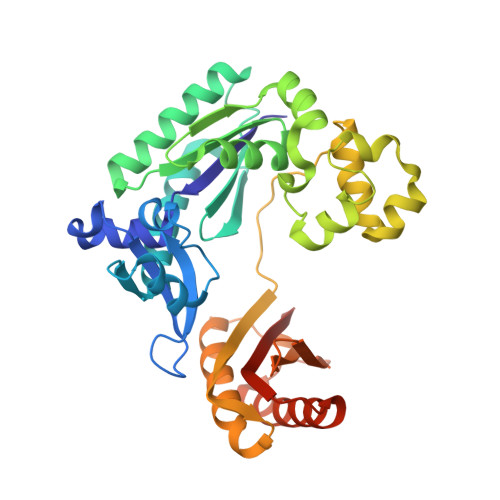
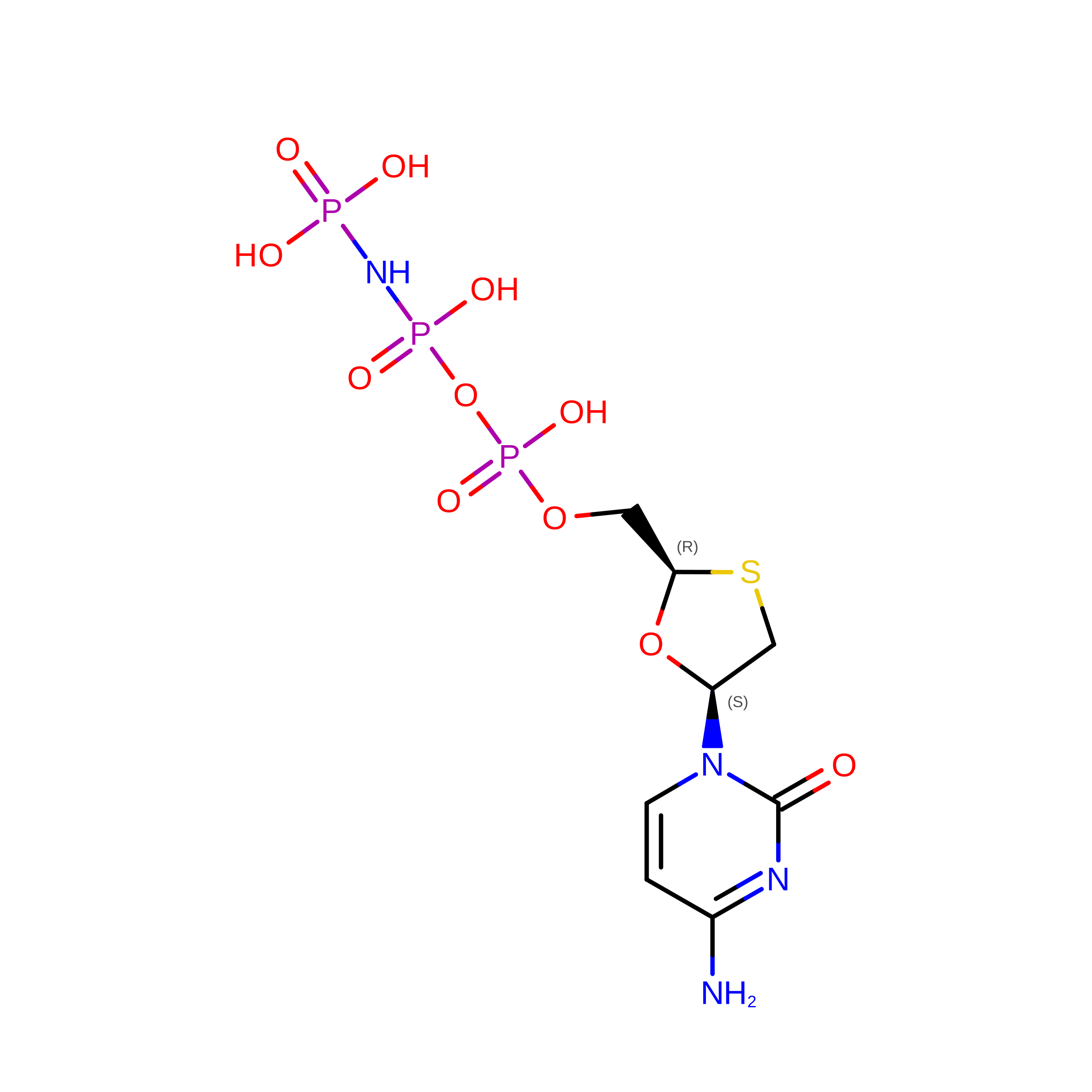
TERNARY CRYSTAL STRUCTURES of A Y-FAMILY DNA POLYMERASE DPO4 FROM SULFOLOBUS SOLFATARICUS IN COMPLEX WITH DNA AND (-)3TC-PPNP


Experimental Data Snapshot

  • Method: X-RAY DIFFRACTION
  • Resolution: 2.05 Å
  • R-Value Free: 
    0.262 (Depositor), 0.263 (DCC) 
  • R-Value Work: 
    0.225 (Depositor), 0.224 (DCC) 
  • R-Value Observed: 
    0.229 (Depositor) 

wwPDB Validation 3D Report Full Report

Validation slider image for 4QWD

Ligand Structure Quality Assessment 


This is version 1.2 of the entry. See complete history

Literature

Structural and kinetic insights into binding and incorporation of L-nucleotide analogs by a Y-family DNA polymerase.

Gaur, V.Vyas, R.Fowler, J.D.Efthimiopoulos, G.Feng, J.Y.Suo, Z.

(2014) Nucleic Acids Res 42: 9984-9995

  • DOI: https://doi.org/10.1093/nar/gku709
  • Primary Citation Related Structures: 
    4QW8, 4QW9, 4QWA, 4QWB, 4QWC, 4QWD, 4QWE

  • PubMed Abstract: 

    Considering that all natural nucleotides (D-dNTPs) and the building blocks (D-dNMPs) of DNA chains possess D-stereochemistry, DNA polymerases and reverse transcriptases (RTs) likely possess strongD-stereoselectivity by preferably binding and incorporating D-dNTPs over unnatural L-dNTPs during DNA synthesis. Surprisingly, a structural basis for the discrimination against L-dNTPs by DNA polymerases or RTs has not been established although L-deoxycytidine analogs (lamivudine and emtricitabine) and L-thymidine (telbivudine) have been widely used as antiviral drugs for years. Here we report seven high-resolution ternary crystal structures of a prototype Y-family DNA polymerase, DNA, and D-dCTP, D-dCDP, L-dCDP, or the diphosphates and triphosphates of lamivudine and emtricitabine. These structures reveal that relative to D-dCTP, each of these L-nucleotides has its sugar ring rotated by 180° with an unusual O4'-endo sugar puckering and exhibits multiple triphosphate-binding conformations within the active site of the polymerase. Such rare binding modes significantly decrease the incorporation rates and efficiencies of these L-nucleotides catalyzed by the polymerase.


  • Organizational Affiliation
    • Department of Chemistry and Biochemistry, The Ohio State University, Columbus, OH 43210, USA.

Macromolecule Content 

  • Total Structure Weight: 49.59 kDa 
  • Atom Count: 3,638 
  • Modeled Residue Count: 370 
  • Deposited Residue Count: 378 
  • Unique protein chains: 1
  • Unique nucleic acid chains: 2

Macromolecules


Find similar proteins by:|  3D Structure
Entity ID: 1
MoleculeChains  Sequence LengthOrganismDetailsImage
DNA polymerase IV349Saccharolobus solfataricus P2Mutation(s): 0 
Gene Names: dbhdpo4SSO2448
EC: 2.7.7.7
UniProt
Find proteins for Q97W02 (Saccharolobus solfataricus (strain ATCC 35092 / DSM 1617 / JCM 11322 / P2))
Explore Q97W02 
Go to UniProtKB:  Q97W02
Entity Groups
Sequence Clusters30% Identity50% Identity70% Identity90% Identity95% Identity100% Identity
UniProt GroupQ97W02
Sequence Annotations
Expand
Reference Sequence
Find similar nucleic acids by:  Sequence
Entity ID: 2
MoleculeChains LengthOrganismImage
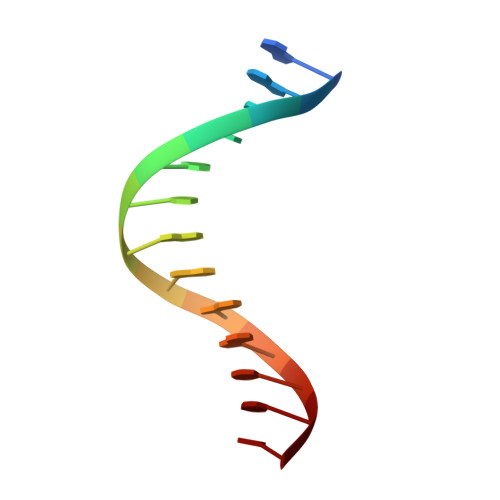
DNA (5'-D(P*GP*GP*CP*TP*AP*CP*AP*GP*GP*AP*CP*TP*C)-3')B [auth C]13N/A
Sequence Annotations
Expand
Reference Sequence
Find similar nucleic acids by:  Sequence
Entity ID: 3
MoleculeChains LengthOrganismImage
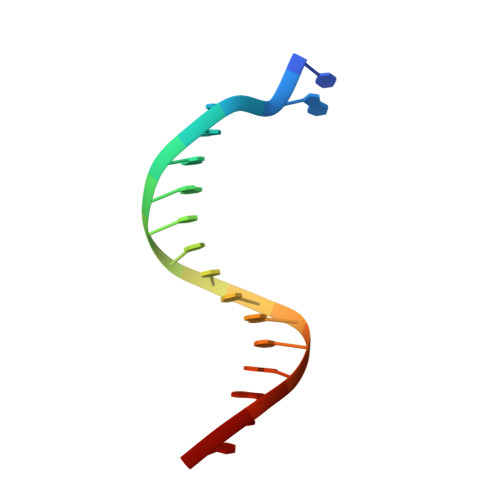
DNA (5'-D(P*CP*AP*GP*GP*AP*GP*TP*CP*CP*TP*GP*TP*AP*GP*CP*C)-3')C [auth D]16N/A
Sequence Annotations
Expand
Reference Sequence

Experimental Data & Validation

Experimental Data

  • Method: X-RAY DIFFRACTION
  • Resolution: 2.05 Å
  • R-Value Free:  0.262 (Depositor), 0.263 (DCC) 
  • R-Value Work:  0.225 (Depositor), 0.224 (DCC) 
  • R-Value Observed: 0.229 (Depositor) 
Space Group: P 21 21 2
Unit Cell:
Length ( Å )Angle ( ˚ )
a = 96.544α = 90
b = 102.483β = 90
c = 52.375γ = 90
Software Package:
Software NamePurpose
MOLREPphasing
REFMACrefinement
MOSFLMdata reduction
SCALAdata scaling

Structure Validation

View Full Validation Report


Ligand Structure Quality Assessment 


Entry History 

Deposition Data

Revision History  (Full details and data files)

  • Version 1.0: 2014-08-27
    Type: Initial release
  • Version 1.1: 2014-09-17
    Changes: Database references
  • Version 1.2: 2024-02-28
    Changes: Data collection, Database references, Derived calculations