4QQY | pdb_00004qqy

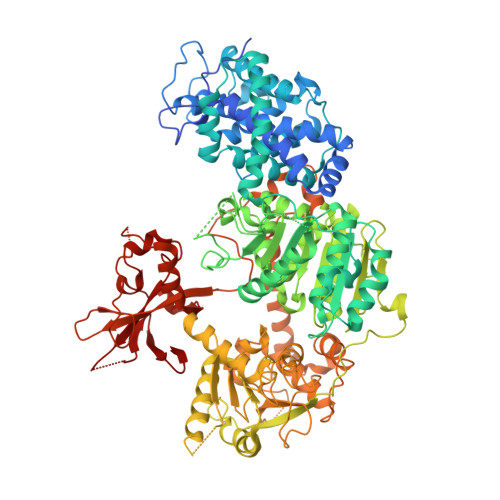
Crystal structure of T. fusca Cas3-ADP


Experimental Data Snapshot

  • Method: X-RAY DIFFRACTION
  • Resolution: 3.12 Å
  • R-Value Free: 
    0.236 (Depositor), 0.237 (DCC) 
  • R-Value Work: 
    0.170 (Depositor), 0.175 (DCC) 
  • R-Value Observed: 
    0.171 (Depositor) 

wwPDB Validation 3D Report Full Report

Validation slider image for 4QQY

Ligand Structure Quality Assessment 


This is version 1.2 of the entry. See complete history

Literature

Structures of CRISPR Cas3 offer mechanistic insights into Cascade-activated DNA unwinding and degradation.

Huo, Y.Nam, K.H.Ding, F.Lee, H.Wu, L.Xiao, Y.Farchione, M.D.Zhou, S.Rajashankar, K.Kurinov, I.Zhang, R.Ke, A.

(2014) Nat Struct Mol Biol 21: 771-777

  • DOI: https://doi.org/10.1038/nsmb.2875
  • Primary Citation Related Structures: 
    4QQW, 4QQX, 4QQY, 4QQZ

  • PubMed Abstract: 

    CRISPR drives prokaryotic adaptation to invasive nucleic acids such as phages and plasmids, using an RNA-mediated interference mechanism. Interference in type I CRISPR-Cas systems requires a targeting Cascade complex and a degradation machine, Cas3, which contains both nuclease and helicase activities. Here we report the crystal structures of Thermobifida fusca Cas3 bound to single-stranded (ss) DNA substrate and show that it is an obligate 3'-to-5' ssDNase that preferentially accepts substrate directly from the helicase moiety. Conserved residues in the HD-type nuclease coordinate two irons for ssDNA cleavage. We demonstrate ATP coordination and conformational flexibility of the SF2-type helicase domain. Cas3 is specifically guided toward Cascade-bound target DNA by a PAM sequence, through physical interactions with both the nontarget substrate strand and the CasA protein. The sequence of recognition events ensures well-controlled DNA targeting and degradation of foreign DNA by Cascade and Cas3.


  • Organizational Affiliation
    • 1] Department of Molecular Biology and Genetics, Cornell University, Ithaca, New York, USA. [2].

Macromolecule Content 

  • Total Structure Weight: 441.85 kDa 
  • Atom Count: 28,826 
  • Modeled Residue Count: 3,638 
  • Deposited Residue Count: 3,904 
  • Unique protein chains: 1
  • Unique nucleic acid chains: 1

Macromolecules


Find similar proteins by:|  3D Structure
Entity ID: 1
MoleculeChains  Sequence LengthOrganismDetailsImage
CRISPR-associated helicase, Cas3 family
A, C, E, G
964Thermobifida fusca YXMutation(s): 0 
Gene Names: Tfu_1593
UniProt
Find proteins for Q47PJ0 (Thermobifida fusca (strain YX))
Explore Q47PJ0 
Go to UniProtKB:  Q47PJ0
Entity Groups
Sequence Clusters30% Identity50% Identity70% Identity90% Identity95% Identity100% Identity
UniProt GroupQ47PJ0
Sequence Annotations
Expand
Reference Sequence
Find similar nucleic acids by:  Sequence
Entity ID: 2
MoleculeChains LengthOrganismImage
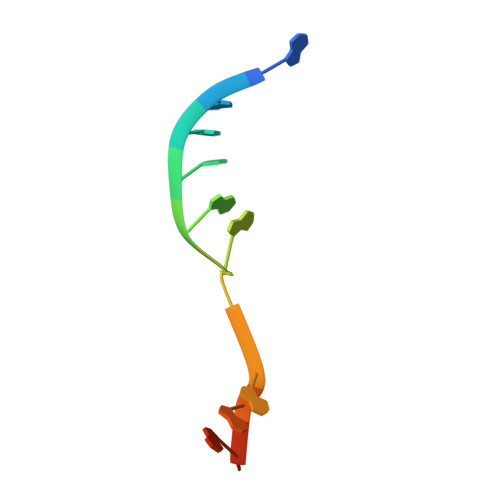
HD nuclease
B, D, F, H
12N/A
Sequence Annotations
Expand
Reference Sequence

Small Molecules

Ligands 2 Unique
IDChains Name / Formula / InChI Key2D Diagram3D Interactions
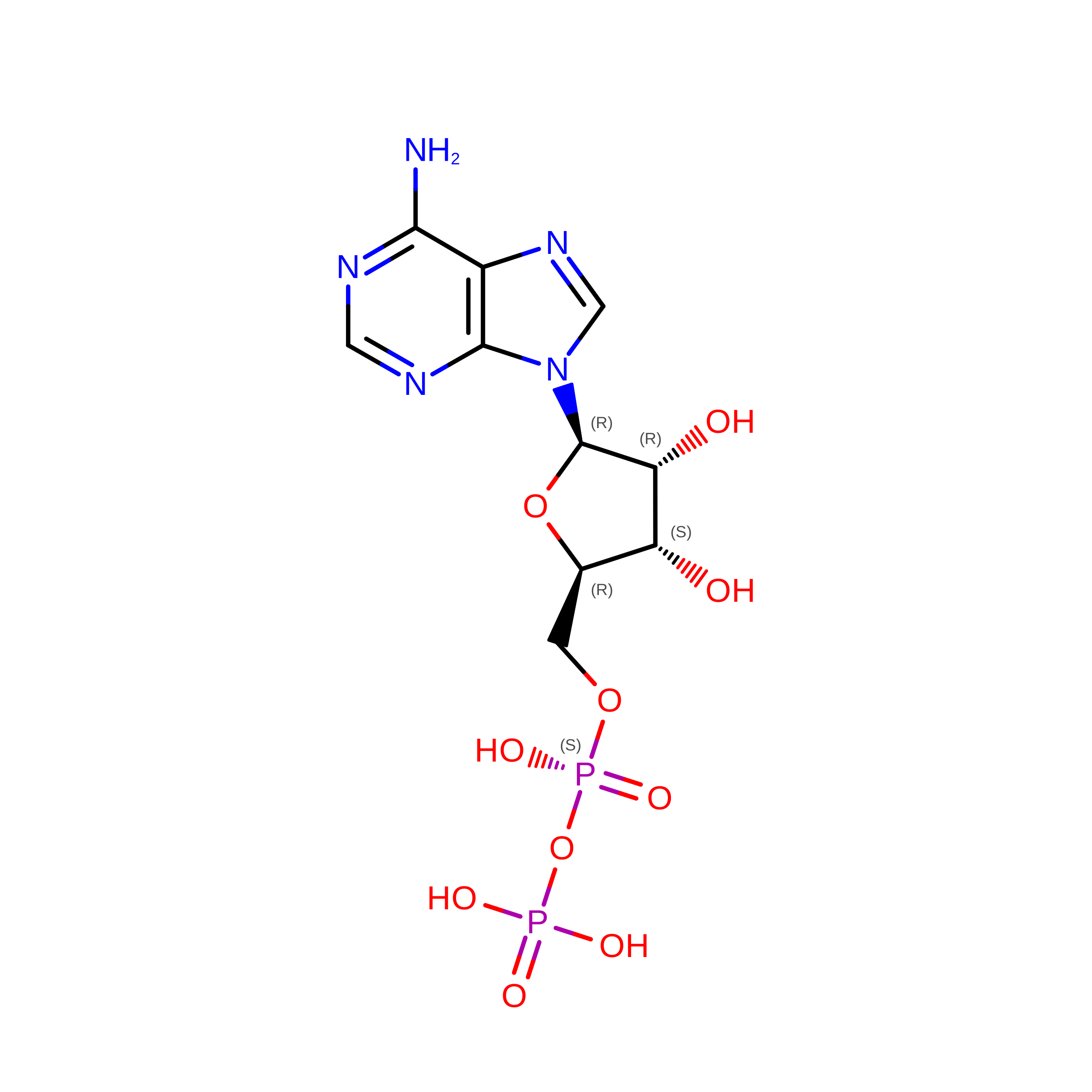
ADP

Query on ADP


Download:Ideal Coordinates CCD File
K [auth A],
N [auth C],
Q [auth E],
T [auth G]
ADENOSINE-5'-DIPHOSPHATE
C10 H15 N5 O10 P2
XTWYTFMLZFPYCI-KQYNXXCUSA-N
FE

Query on FE


Download:Ideal Coordinates CCD File
I [auth A]
J [auth A]
L [auth C]
M [auth C]
O [auth E]
I [auth A],
J [auth A],
L [auth C],
M [auth C],
O [auth E],
P [auth E],
R [auth G],
S [auth G]
FE (III) ION
Fe
VTLYFUHAOXGGBS-UHFFFAOYSA-N

Experimental Data & Validation

Experimental Data

  • Method: X-RAY DIFFRACTION
  • Resolution: 3.12 Å
  • R-Value Free:  0.236 (Depositor), 0.237 (DCC) 
  • R-Value Work:  0.170 (Depositor), 0.175 (DCC) 
  • R-Value Observed: 0.171 (Depositor) 
Space Group: P 1 21 1
Unit Cell:
Length ( Å )Angle ( ˚ )
a = 87.206α = 90
b = 222.607β = 104.07
c = 124.847γ = 90
Software Package:
Software NamePurpose
PHENIXrefinement
PDB_EXTRACTdata extraction
HKL-2000data collection
HKL-2000data reduction
HKL-2000data scaling
PHENIXphasing

Structure Validation

View Full Validation Report


Ligand Structure Quality Assessment 


Entry History 

Deposition Data

Revision History  (Full details and data files)

  • Version 1.0: 2014-08-27
    Type: Initial release
  • Version 1.1: 2014-09-24
    Changes: Database references
  • Version 1.2: 2024-02-28
    Changes: Data collection, Database references, Derived calculations