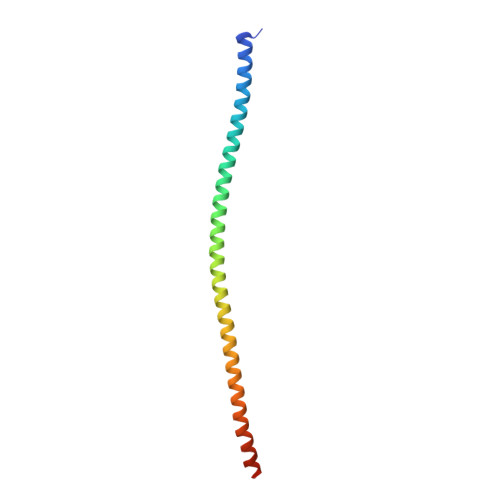
4QKW | pdb_00004qkw

Crystal structure of the zebrafish cavin4a HR1 domain


Experimental Data Snapshot

  • Method: X-RAY DIFFRACTION
  • Resolution: 1.70 Å
  • R-Value Free: 
    0.245 (Depositor), 0.256 (DCC) 
  • R-Value Work: 
    0.212 (Depositor), 0.222 (DCC) 
  • R-Value Observed: 
    0.214 (Depositor) 

wwPDB Validation 3D Report Full Report

Validation slider image for 4QKW

This is version 1.1 of the entry. See complete history

Literature

Structural insights into the organization of the cavin membrane coat complex

Kovtun, O.Tillu, V.A.Jung, W.Leneva, N.Ariotti, N.Chaudhary, N.Mandyam, R.A.Ferguson, C.Morgan, G.P.Johnston, W.A.Harrop, S.J.Alexandrov, K.Parton, R.G.Collins, B.M.

(2014) Dev Cell 31: 405-419

  • DOI: https://doi.org/10.1016/j.devcel.2014.10.002
  • Primary Citation Related Structures: 
    4QKV, 4QKW

  • PubMed Abstract: 

    Caveolae are cell-surface membrane invaginations that play critical roles in cellular processes including signaling and membrane homeostasis. The cavin proteins, in cooperation with caveolins, are essential for caveola formation. Here we show that a minimal N-terminal domain of the cavins, termed HR1, is required and sufficient for their homo- and hetero-oligomerization. Crystal structures of the mouse cavin1 and zebrafish cavin4a HR1 domains reveal highly conserved trimeric coiled-coil architectures, with intersubunit interactions that determine the specificity of cavin-cavin interactions. The HR1 domain contains a basic surface patch that interacts with polyphosphoinositides and coordinates with additional membrane-binding sites within the cavin C terminus to facilitate membrane association and remodeling. Electron microscopy of purified cavins reveals the existence of large assemblies, composed of a repeating rod-like structural element, and we propose that these structures polymerize through membrane-coupled interactions to form the unique striations observed on the surface of caveolae in vivo.


  • Organizational Affiliation
    • Institute for Molecular Bioscience, The University of Queensland, St. Lucia, QLD 4072, Australia.

Macromolecule Content 

  • Total Structure Weight: 36.58 kDa 
  • Atom Count: 2,585 
  • Modeled Residue Count: 297 
  • Deposited Residue Count: 324 
  • Unique protein chains: 1

Macromolecules

Find similar proteins by:|  3D Structure
Entity ID: 1
MoleculeChains  Sequence LengthOrganismDetailsImage
Muscle-related coiled-coil protein
A, B, C
108Danio rerioMutation(s): 0 
Gene Names: murczgc:158664
UniProt
Find proteins for A1L260 (Danio rerio)
Explore A1L260 
Go to UniProtKB:  A1L260
Entity Groups
Sequence Clusters30% Identity50% Identity70% Identity90% Identity95% Identity100% Identity
UniProt GroupA1L260
Sequence Annotations
Expand
Reference Sequence

Small Molecules

Ligands 1 Unique
IDChains Name / Formula / InChI Key2D Diagram3D Interactions
CL

Query on CL


Download:Ideal Coordinates CCD File
D [auth A]CHLORIDE ION
Cl
VEXZGXHMUGYJMC-UHFFFAOYSA-M

Experimental Data & Validation

Experimental Data

  • Method: X-RAY DIFFRACTION
  • Resolution: 1.70 Å
  • R-Value Free:  0.245 (Depositor), 0.256 (DCC) 
  • R-Value Work:  0.212 (Depositor), 0.222 (DCC) 
  • R-Value Observed: 0.214 (Depositor) 
Space Group: C 1 2 1
Unit Cell:
Length ( Å )Angle ( ˚ )
a = 114.861α = 90
b = 31.961β = 94.46
c = 84.764γ = 90
Software Package:
Software NamePurpose
Blu-Icedata collection
PHASERphasing
PHENIXrefinement
MOSFLMdata reduction
SCALAdata scaling

Structure Validation

View Full Validation Report


Entry History 

Deposition Data

Revision History  (Full details and data files)

  • Version 1.0: 2015-03-18
    Type: Initial release
  • Version 1.1: 2024-03-20
    Changes: Data collection, Database references, Derived calculations