4QJ2 | pdb_00004qj2

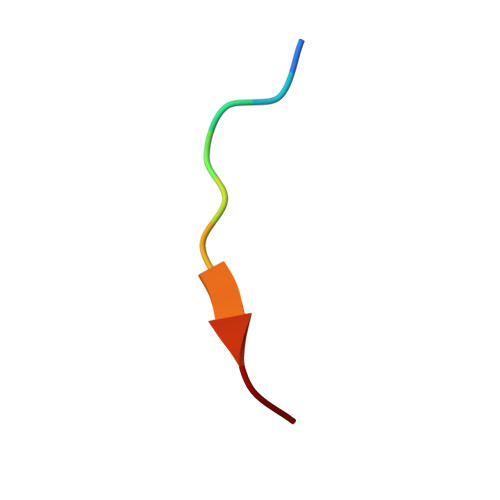
Crystal structure of inactive HIV-1 protease variant (I50V/A71V) in complex with WT p1-p6 substrate


Experimental Data Snapshot

  • Method: X-RAY DIFFRACTION
  • Resolution: 2.13 Å
  • R-Value Free: 
    0.238 (Depositor), 0.242 (DCC) 
  • R-Value Work: 
    0.183 (Depositor), 0.192 (DCC) 
  • R-Value Observed: 
    0.186 (Depositor) 

wwPDB Validation 3D Report Full Report

Validation slider image for 4QJ2

This is version 1.4 of the entry. See complete history

Literature

Structural basis and distal effects of Gag substrate coevolution in drug resistance to HIV-1 protease.

Ozen, A.Lin, K.H.Kurt Yilmaz, N.Schiffer, C.A.

(2014) Proc Natl Acad Sci U S A 111: 15993-15998

  • DOI: https://doi.org/10.1073/pnas.1414063111
  • Primary Citation Related Structures: 
    4QJ2, 4QJ6, 4QJ7, 4QJ8, 4QJ9, 4QJA

  • PubMed Abstract: 

    Drug resistance mutations in response to HIV-1 protease inhibitors are selected not only in the drug target but elsewhere in the viral genome, especially at the protease cleavage sites in the precursor protein Gag. To understand the molecular basis of this protease-substrate coevolution, we solved the crystal structures of drug resistant I50V/A71V HIV-1 protease with p1-p6 substrates bearing coevolved mutations. Analyses of the protease-substrate interactions reveal that compensatory coevolved mutations in the substrate do not restore interactions lost due to protease mutations, but instead establish other interactions that are not restricted to the site of mutation. Mutation of a substrate residue has distal effects on other residues' interactions as well, including through the induction of a conformational change in the protease. Additionally, molecular dynamics simulations suggest that restoration of active site dynamics is an additional constraint in the selection of coevolved mutations. Hence, protease-substrate coevolution permits mutational, structural, and dynamic changes via molecular mechanisms that involve distal effects contributing to drug resistance.


  • Organizational Affiliation
    • Department of Biochemistry and Molecular Pharmacology, University of Massachusetts Medical School, Worcester, MA 01605.

Macromolecule Content 

  • Total Structure Weight: 45.95 kDa 
  • Atom Count: 3,501 
  • Modeled Residue Count: 416 
  • Deposited Residue Count: 416 
  • Unique protein chains: 2

Macromolecules

Find similar proteins by:|  3D Structure
Entity ID: 1
MoleculeChains  Sequence LengthOrganismDetailsImage
Protease
A, B, C, D
99Human immunodeficiency virus 1Mutation(s): 4 
Gene Names: pol
UniProt
Find proteins for P03369 (Human immunodeficiency virus type 1 group M subtype B (isolate ARV2/SF2))
Explore P03369 
Go to UniProtKB:  P03369
Entity Groups
Sequence Clusters30% Identity50% Identity70% Identity90% Identity95% Identity100% Identity
UniProt GroupP03369
Sequence Annotations
Expand
Reference Sequence
Find similar proteins by:  Sequence   |   3D Structure  
Entity ID: 2
MoleculeChains  Sequence LengthOrganismDetailsImage
p1-p6 peptideE [auth F],
F [auth G]
10Human immunodeficiency virus 1Mutation(s): 0 
UniProt
Find proteins for P04591 (Human immunodeficiency virus type 1 group M subtype B (isolate HXB2))
Explore P04591 
Go to UniProtKB:  P04591
Entity Groups
Sequence Clusters30% Identity50% Identity70% Identity90% Identity95% Identity100% Identity
UniProt GroupP04591
Sequence Annotations
Expand
Reference Sequence

Experimental Data & Validation

Experimental Data

  • Method: X-RAY DIFFRACTION
  • Resolution: 2.13 Å
  • R-Value Free:  0.238 (Depositor), 0.242 (DCC) 
  • R-Value Work:  0.183 (Depositor), 0.192 (DCC) 
  • R-Value Observed: 0.186 (Depositor) 
Space Group: P 1 21 1
Unit Cell:
Length ( Å )Angle ( ˚ )
a = 52.185α = 90
b = 63.341β = 98.27
c = 58.769γ = 90
Software Package:
Software NamePurpose
HKL-2000data collection
PHASERphasing
REFMACrefinement
HKL-2000data reduction
HKL-2000data scaling

Structure Validation

View Full Validation Report


Entry History 

Deposition Data

Revision History  (Full details and data files)

  • Version 1.0: 2014-10-29
    Type: Initial release
  • Version 1.1: 2014-11-26
    Changes: Database references
  • Version 1.2: 2014-12-03
    Changes: Database references
  • Version 1.3: 2017-05-31
    Changes: Structure summary
  • Version 1.4: 2024-02-28
    Changes: Data collection, Database references, Derived calculations