4Q7I | pdb_00004q7i

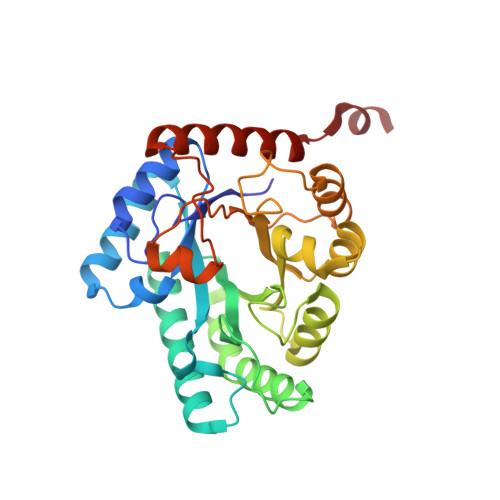
Crystal structure of engineered thermostable D-tagatose 3-epimerase PcDTE-Var8


Experimental Data Snapshot

  • Method: X-RAY DIFFRACTION
  • Resolution: 1.80 Å
  • R-Value Free: 
    0.208 (Depositor), 0.211 (DCC) 
  • R-Value Work: 
    0.176 (Depositor), 0.186 (DCC) 
  • R-Value Observed: 
    0.178 (Depositor) 

Starting Model: experimental
View more details

wwPDB Validation 3D Report Full Report

Validation slider image for 4Q7I

This is version 1.3 of the entry. See complete history

Literature

Directed Divergent Evolution of a Thermostable D-Tagatose Epimerase towards Improved Activity for Two Hexose Substrates.

Bosshart, A.Hee, C.S.Bechtold, M.Schirmer, T.Panke, S.

(2015) Chembiochem 16: 592-601

  • DOI: https://doi.org/10.1002/cbic.201402620
  • Primary Citation Related Structures: 
    4PFH, 4PGL, 4Q7I

  • PubMed Abstract: 

    Functional promiscuity of enzymes can often be harnessed as the starting point for the directed evolution of novel biocatalysts. Here we describe the divergent morphing of an engineered thermostable variant (Var8) of a promiscuous D-tagatose epimerase (DTE) into two efficient catalysts for the C3 epimerization of D-fructose to D-psicose and of L-sorbose to L-tagatose. Iterative single-site randomization and screening of 48 residues in the first and second shells around the substrate-binding site of Var8 yielded the eight-site mutant IDF8 (ninefold improved kcat for the epimerization of D-fructose) and the six-site mutant ILS6 (14-fold improved epimerization of L-sorbose), compared to Var8. Structure analysis of IDF8 revealed a charged patch at the entrance of its active site; this presumably facilitates entry of the polar substrate. The improvement in catalytic activity of variant ILS6 is thought to relate to subtle changes in the hydration of the bound substrate. The structures can now be used to select additional sites for further directed evolution of the ketohexose epimerase.


  • Organizational Affiliation
    • Department of Biosystems Science and Engineering, ETH Zürich, Mattenstrasse 26, 4058 Basel (Switzerland).

Macromolecule Content 

  • Total Structure Weight: 68.33 kDa 
  • Atom Count: 5,198 
  • Modeled Residue Count: 588 
  • Deposited Residue Count: 596 
  • Unique protein chains: 1

Macromolecules

Find similar proteins by:|  3D Structure
Entity ID: 1
MoleculeChains  Sequence LengthOrganismDetailsImage
D-tagatose 3-epimerase
A, B
298Escherichia coli K-12Mutation(s): 0 
Gene Names: D-tagatose 3-epimerase
UniProt
Find proteins for A0A0A6YVN8 (Escherichia coli (strain K12))
Explore A0A0A6YVN8 
Go to UniProtKB:  A0A0A6YVN8
Entity Groups
Sequence Clusters30% Identity50% Identity70% Identity90% Identity95% Identity100% Identity
UniProt GroupA0A0A6YVN8
Sequence Annotations
Expand
Reference Sequence

Small Molecules

Ligands 3 Unique
IDChains Name / Formula / InChI Key2D Diagram3D Interactions
GOL

Query on GOL


Download:Ideal Coordinates CCD File
D [auth A],
E [auth A],
J [auth B],
K [auth B]
GLYCEROL
C3 H8 O3
PEDCQBHIVMGVHV-UHFFFAOYSA-N
IMD

Query on IMD


Download:Ideal Coordinates CCD File
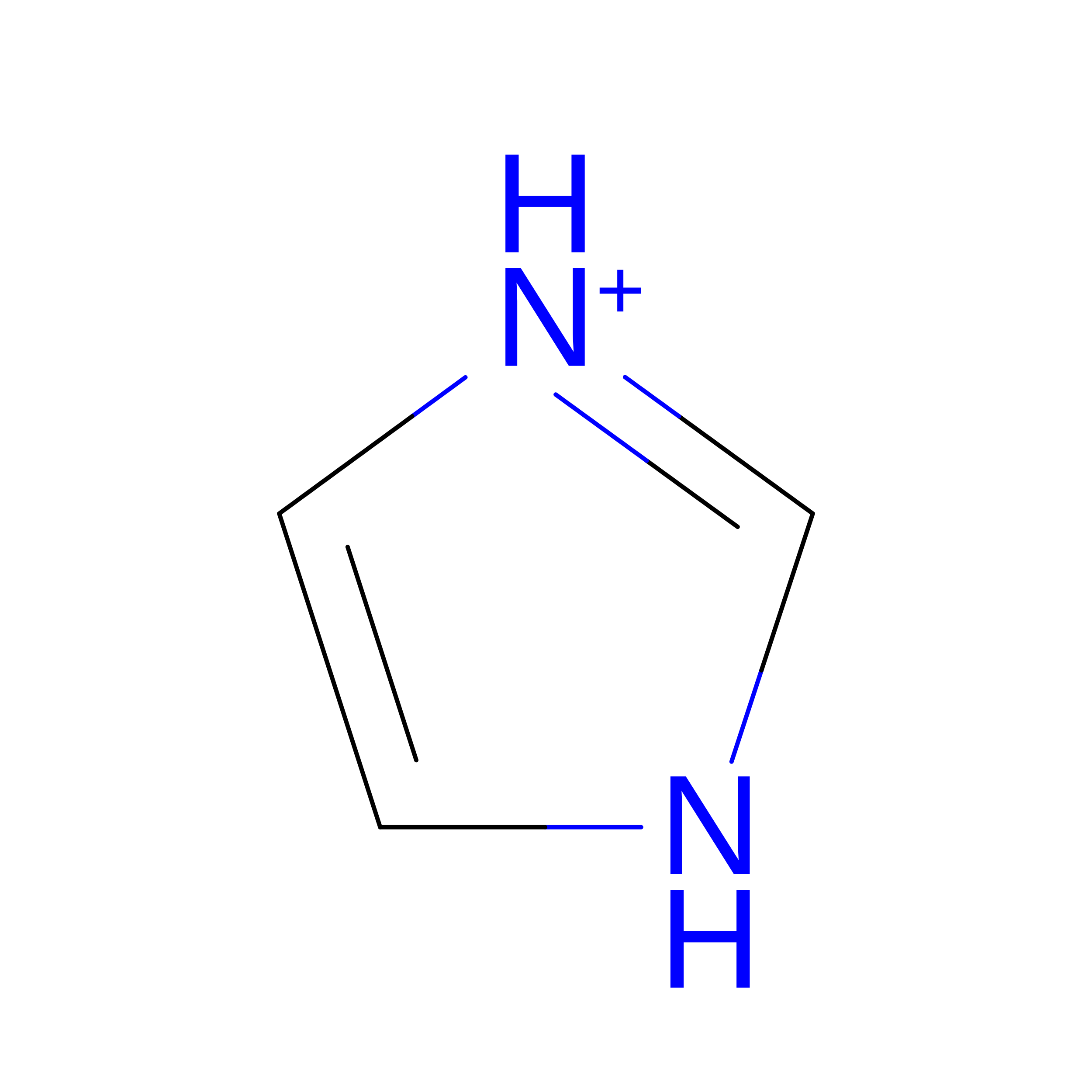
G [auth A]IMIDAZOLE
C3 H5 N2
RAXXELZNTBOGNW-UHFFFAOYSA-O
MN

Query on MN


Download:Ideal Coordinates CCD File
C [auth A],
F [auth A],
H [auth A],
I [auth B]
MANGANESE (II) ION
Mn
WAEMQWOKJMHJLA-UHFFFAOYSA-N

Experimental Data & Validation

Experimental Data

  • Method: X-RAY DIFFRACTION
  • Resolution: 1.80 Å
  • R-Value Free:  0.208 (Depositor), 0.211 (DCC) 
  • R-Value Work:  0.176 (Depositor), 0.186 (DCC) 
  • R-Value Observed: 0.178 (Depositor) 
Space Group: C 1 2 1
Unit Cell:
Length ( Å )Angle ( ˚ )
a = 110.47α = 90
b = 47.5β = 103.68
c = 124.73γ = 90
Software Package:
Software NamePurpose
Aimlessdata scaling
PHASERphasing
REFMACrefinement
PDB_EXTRACTdata extraction
MOSFLMdata reduction

Structure Validation

View Full Validation Report


Entry History 

Deposition Data

Revision History  (Full details and data files)

  • Version 1.0: 2014-10-22
    Type: Initial release
  • Version 1.1: 2015-02-18
    Changes: Database references
  • Version 1.2: 2015-03-18
    Changes: Database references
  • Version 1.3: 2023-09-20
    Changes: Data collection, Database references, Derived calculations, Refinement description