Download Mendeley
Pressure adaptation is linked to thermal adaptation in salt-saturated marine habitats.
Alcaide, M., Stogios, P.J., Lafraya, A., Tchigvintsev, A., Flick, R., Bargiela, R., Chernikova, T.N., Reva, O.N., Hai, T., Leggewie, C.C., Katzke, N., La Cono, V., Matesanz, R., Jebbar, M., Jaeger, K.E., Yakimov, M.M., Yakunin, A.F., Golyshin, P.N., Golyshina, O.V., Savchenko, A., Ferrer, M.(2015) Environ Microbiol 17: 332-345
- PubMed: 25330254 Search on PubMed
- DOI: https://doi.org/10.1111/1462-2920.12660
- Primary Citation Related Structures:
4Q3K, 4Q3L, 4Q3M, 4Q3N, 4Q3O - PubMed Abstract:
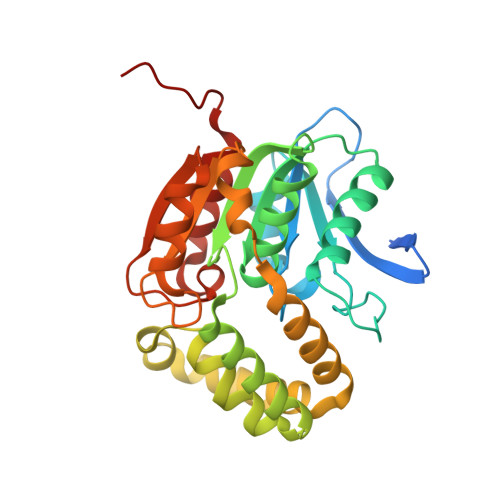
The present study provides a deeper view of protein functionality as a function of temperature, salt and pressure in deep-sea habitats. A set of eight different enzymes from five distinct deep-sea (3040-4908 m depth), moderately warm (14.0-16.5°C) biotopes, characterized by a wide range of salinities (39-348 practical salinity units), were investigated for this purpose. An enzyme from a 'superficial' marine hydrothermal habitat (65°C) was isolated and characterized for comparative purposes. We report here the first experimental evidence suggesting that in salt-saturated deep-sea habitats, the adaptation to high pressure is linked to high thermal resistance (P value = 0.0036). Salinity might therefore increase the temperature window for enzyme activity, and possibly microbial growth, in deep-sea habitats. As an example, Lake Medee, the largest hypersaline deep-sea anoxic lake of the Eastern Mediterranean Sea, where the water temperature is never higher than 16°C, was shown to contain halopiezophilic-like enzymes that are most active at 70°C and with denaturing temperatures of 71.4°C. The determination of the crystal structures of five proteins revealed unknown molecular mechanisms involved in protein adaptation to poly-extremes as well as distinct active site architectures and substrate preferences relative to other structurally characterized enzymes.
- Institute of Catalysis, Consejo Superior de Investigaciones Científicas (CSIC), Madrid, 28049, Spain.
Organizational Affiliation: