4Q0K | pdb_00004q0k

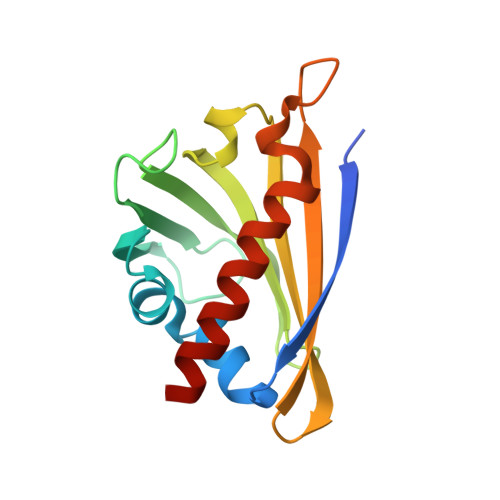
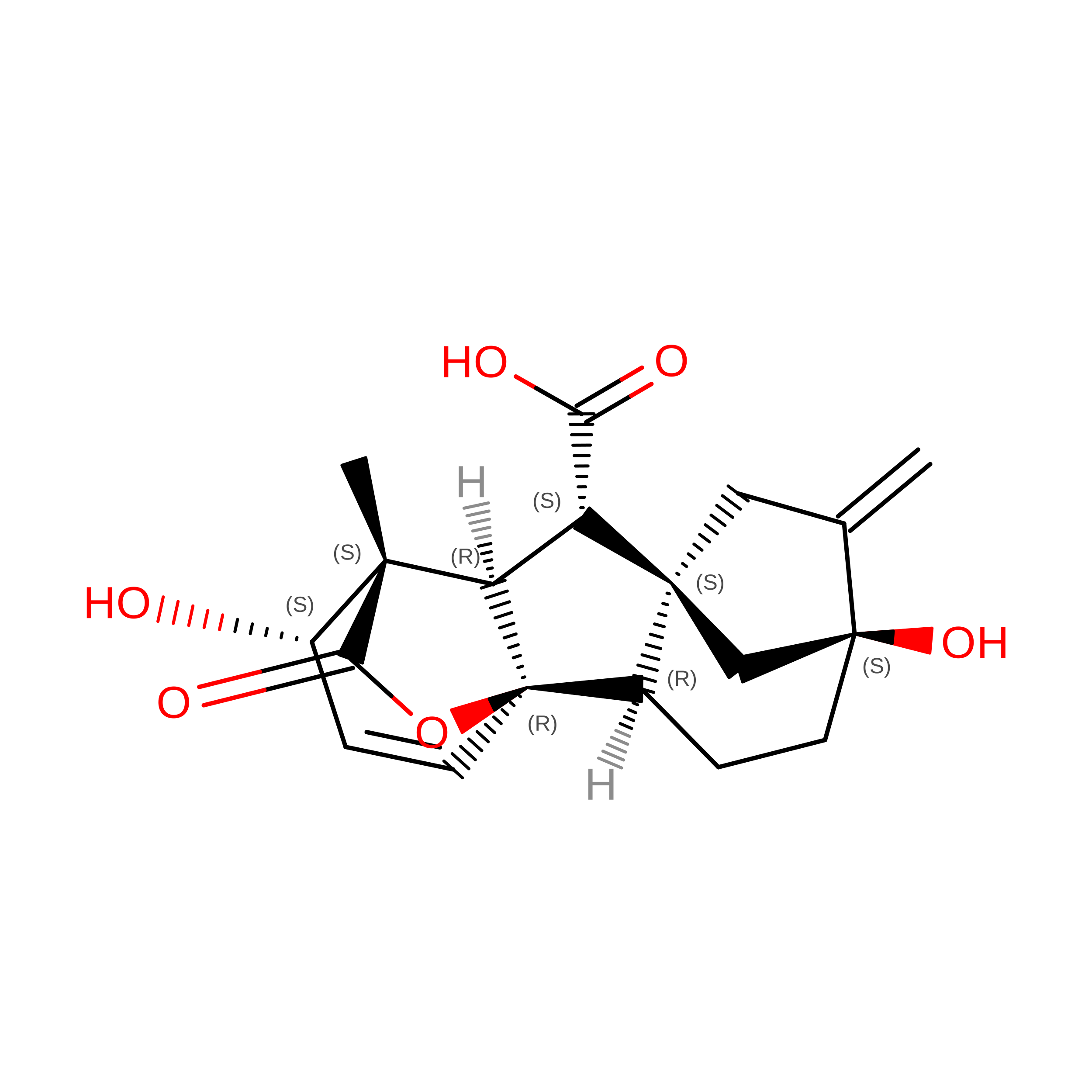
Crystal Structure of Phytohormone Binding Protein from Medicago truncatula in complex with gibberellic acid (GA3)


Experimental Data Snapshot

  • Method: X-RAY DIFFRACTION
  • Resolution: 1.34 Å
  • R-Value Free: 
    0.157 (Depositor), 0.166 (DCC) 
  • R-Value Work: 
    0.123 (Depositor), 0.139 (DCC) 
  • R-Value Observed: 
    0.124 (Depositor) 

Starting Model: experimental
View more details

wwPDB Validation 3D Report Full Report

Validation slider image for 4Q0K

Ligand Structure Quality Assessment 


This is version 1.3 of the entry. See complete history

Literature

Specific binding of gibberellic acid by Cytokinin-Specific Binding Proteins: a new aspect of plant hormone-binding proteins with the PR-10 fold.

Ruszkowski, M.Sliwiak, J.Ciesielska, A.Barciszewski, J.Sikorski, M.Jaskolski, M.

(2014) Acta Crystallogr D Biol Crystallogr 70: 2032-2041

  • DOI: https://doi.org/10.1107/S1399004714010578
  • Primary Citation Related Structures: 
    4PSB, 4Q0K

  • PubMed Abstract: 

    Pathogenesis-related proteins of class 10 (PR-10) are a family of plant proteins with the same fold characterized by a large hydrophobic cavity that allows them to bind various ligands, such as phytohormones. A subfamily with only ~20% sequence identity but with a conserved canonical PR-10 fold have previously been recognized as Cytokinin-Specific Binding Proteins (CSBPs), although structurally the binding mode of trans-zeatin (a cytokinin phytohormone) was found to be quite diversified. Here, it is shown that two CSBP orthologues from Medicago truncatula and Vigna radiata bind gibberellic acid (GA3), which is an entirely different phytohormone, in a conserved and highly specific manner. In both cases a single GA3 molecule is found in the internal cavity of the protein. The structural data derived from high-resolution crystal structures are corroborated by isothermal titration calorimetry (ITC), which reveals a much stronger interaction with GA3 than with trans-zeatin and pH dependence of the binding profile. As a conclusion, it is postulated that the CSBP subfamily of plant PR-10 proteins should be more properly linked with general phytohormone-binding properties and termed phytohormone-binding proteins (PhBP).


  • Organizational Affiliation
    • Center for Biocrystallographic Research, Institute of Bioorganic Chemistry, Polish Academy of Sciences, Poznan, Poland.

Macromolecule Content 

  • Total Structure Weight: 18.83 kDa 
  • Atom Count: 1,517 
  • Modeled Residue Count: 154 
  • Deposited Residue Count: 162 
  • Unique protein chains: 1

Macromolecules

Find similar proteins by:|  3D Structure
Entity ID: 1
MoleculeChains  Sequence LengthOrganismDetailsImage
PHYTOHORMONE BINDING PROTEIN MTPHBP162Medicago truncatulaMutation(s): 0 
Gene Names: mtphbpMTR_3g055120
UniProt
Find proteins for G7J032 (Medicago truncatula)
Explore G7J032 
Go to UniProtKB:  G7J032
Entity Groups
Sequence Clusters30% Identity50% Identity70% Identity90% Identity95% Identity100% Identity
UniProt GroupG7J032
Sequence Annotations
Expand
Reference Sequence

Experimental Data & Validation

Experimental Data

  • Method: X-RAY DIFFRACTION
  • Resolution: 1.34 Å
  • R-Value Free:  0.157 (Depositor), 0.166 (DCC) 
  • R-Value Work:  0.123 (Depositor), 0.139 (DCC) 
  • R-Value Observed: 0.124 (Depositor) 
Space Group: P 65
Unit Cell:
Length ( Å )Angle ( ˚ )
a = 55.8α = 90
b = 55.8β = 90
c = 99.96γ = 120
Software Package:
Software NamePurpose
XSCALEdata scaling
PHENIXrefinement
PDB_EXTRACTdata extraction
MxCuBEdata collection
XDSdata reduction
PHASERphasing

Structure Validation

View Full Validation Report


Ligand Structure Quality Assessment 


Entry History 

Deposition Data

Revision History  (Full details and data files)

  • Version 1.0: 2014-04-23
    Type: Initial release
  • Version 1.1: 2014-05-28
    Changes: Structure summary
  • Version 1.2: 2014-07-23
    Changes: Database references
  • Version 1.3: 2023-09-20
    Changes: Data collection, Database references, Derived calculations, Refinement description, Structure summary