4POZ | pdb_00004poz

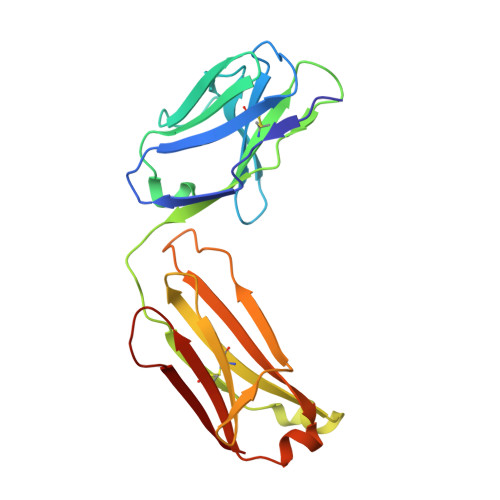
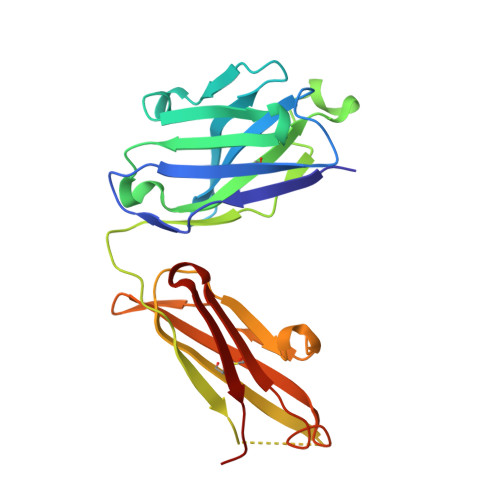
Fab fragment of Der p 1 specific antibody 10B9


Experimental Data Snapshot

  • Method: X-RAY DIFFRACTION
  • Resolution: 1.75 Å
  • R-Value Free: 
    0.206 (Depositor), 0.215 (DCC) 
  • R-Value Work: 
    0.169 (Depositor), 0.179 (DCC) 
  • R-Value Observed: 
    0.171 (Depositor) 

Starting Model: experimental
View more details

wwPDB Validation 3D Report Full Report

Validation slider image for 4POZ

This is version 1.5 of the entry. See complete history. 

Literature

Structural Analysis of Der p 1-Antibody Complexes and Comparison with Complexes of Proteins or Peptides with Monoclonal Antibodies.

Osinski, T., Pomes, A., Majorek, K.A., Glesner, J., Offermann, L.R., Vailes, L.D., Chapman, M.D., Minor, W., Chruszcz, M.

(2015) J Immunol 195: 307-316

  • DOI: https://doi.org/10.4049/jimmunol.1402199
  • Primary Citation Related Structures: 
    4POZ, 5VCN, 5VCO

  • PubMed Abstract: 

    Der p 1 is a major allergen from the house dust mite, Dermatophagoides pteronyssinus, that belongs to the papain-like cysteine protease family. To investigate the antigenic determinants of Der p 1, we determined two crystal structures of Der p 1 in complex with the Fab fragments of mAbs 5H8 or 10B9. Epitopes for these two Der p 1-specific Abs are located in different, nonoverlapping parts of the Der p 1 molecule. Nevertheless, surface area and identity of the amino acid residues involved in hydrogen bonds between allergen and Ab are similar. The epitope for mAb 10B9 only showed a partial overlap with the previously reported epitope for mAb 4C1, a cross-reactive mAb that binds Der p 1 and its homolog Der f 1 from Dermatophagoides farinae. Upon binding to Der p 1, the Fab fragment of mAb 10B9 was found to form a very rare α helix in its third CDR of the H chain. To provide an overview of the surface properties of the interfaces formed by the complexes of Der p 1-10B9 and Der p 1-5H8, along with the complexes of 4C1 with Der p 1 and Der f 1, a broad analysis of the surfaces and hydrogen bonds of all complexes of Fab-protein or Fab-peptide was performed. This work provides detailed insight into the cross-reactive and specific allergen-Ab interactions in group 1 mite allergens. The surface data of Fab-protein and Fab-peptide interfaces can be used in the design of conformational epitopes with reduced Ab binding for immunotherapy.


  • Organizational Affiliation: 
    • University of Virginia, Charlottesville, VA 22908; Adam Mickiewicz University, 61-712 Poznan, Poland;

Macromolecule Content 

  • Total Structure Weight: 47.42 kDa 
  • Atom Count: 3,813 
  • Modeled Residue Count: 426 
  • Deposited Residue Count: 433 
  • Unique protein chains: 2

Macromolecules

Find similar proteins by:|  3D Structure
Entity ID: 1
MoleculeChains  Sequence LengthOrganismDetailsImage
light chain of Fab fragment of 10B9 antibodyA [auth C]211Mus musculusMutation(s): 0 
Entity Groups
Sequence Clusters30% Identity50% Identity70% Identity90% Identity95% Identity100% Identity
Sequence Annotations
Expand
Reference Sequence
Find similar proteins by:|  3D Structure
Entity ID: 2
MoleculeChains  Sequence LengthOrganismDetailsImage
heavy chain of Fab fragment of 10B9 antibodyB [auth D]222Mus musculusMutation(s): 0 
Entity Groups
Sequence Clusters30% Identity50% Identity70% Identity90% Identity95% Identity100% Identity
Sequence Annotations
Expand
Reference Sequence

Experimental Data & Validation

Experimental Data

  • Method: X-RAY DIFFRACTION
  • Resolution: 1.75 Å
  • R-Value Free:  0.206 (Depositor), 0.215 (DCC) 
  • R-Value Work:  0.169 (Depositor), 0.179 (DCC) 
  • R-Value Observed: 0.171 (Depositor) 
Space Group: P 21 21 2
Unit Cell:
Length ( Å )Angle ( ˚ )
a = 67.02α = 90
b = 121.829β = 90
c = 55.041γ = 90
Software Package:
Software NamePurpose
HKL-3000data collection
HKL-3000phasing
MOLREPphasing
REFMACrefinement
Cootmodel building
HKL-3000data reduction
HKL-3000data scaling

Structure Validation

View Full Validation Report


Entry History 

Deposition Data

Revision History  (Full details and data files)

  • Version 1.0: 2015-04-08
    Type: Initial release
  • Version 1.1: 2017-08-09
    Changes: Database references
  • Version 1.2: 2017-11-22
    Changes: Refinement description
  • Version 1.3: 2022-04-13
    Changes: Database references, Structure summary
  • Version 1.4: 2023-09-20
    Changes: Data collection, Refinement description
  • Version 1.5: 2024-11-06
    Changes: Structure summary