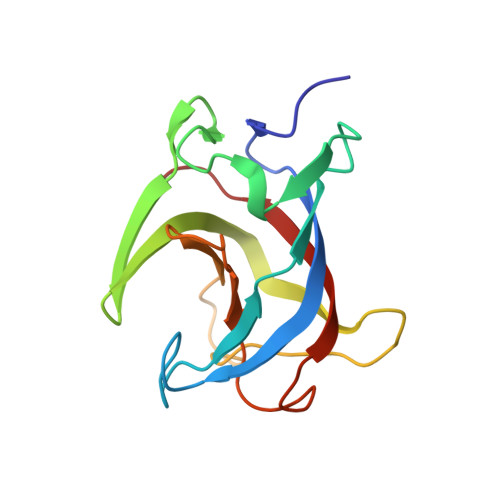
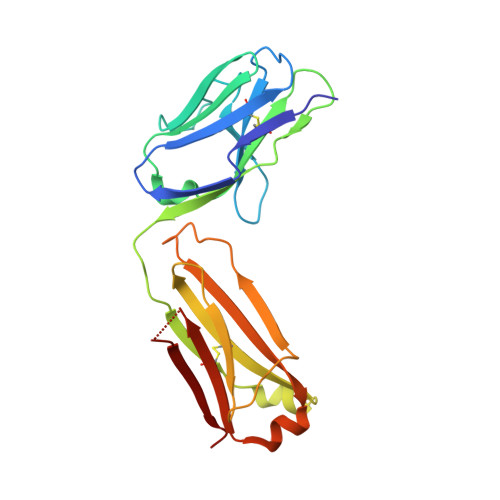
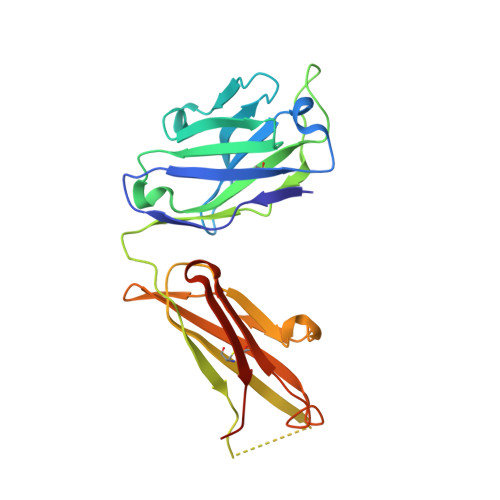
4PLK | pdb_00004plk

Hepatitis E Virus E2s domain (Genotype I) in complex with a neutralizing antibody 8G12


Experimental Data Snapshot

  • Method: X-RAY DIFFRACTION
  • Resolution: 4.00 Å
  • R-Value Free: 
    0.296 (Depositor), 0.294 (DCC) 
  • R-Value Work: 
    0.264 (Depositor), 0.273 (DCC) 
  • R-Value Observed: 
    0.266 (Depositor) 

wwPDB Validation 3D Report Full Report

Validation slider image for 4PLK

This is version 1.2 of the entry. See complete history

Literature

Structural basis for the neutralization of hepatitis E virus by a cross-genotype antibody

Gu, Y.Tang, X.Zhang, X.Song, C.Zheng, M.Wang, K.Zhang, J.Ng, M.H.Hew, C.L.Li, S.Xia, N.Sivaraman, J.

(2015) Cell Res 25: 604-620

  • DOI: https://doi.org/10.1038/cr.2015.34
  • Primary Citation Related Structures: 
    4PLJ, 4PLK

  • PubMed Abstract: 

    Hepatitis E virus (HEV), a non-enveloped, positive-sense, single-stranded RNA virus, is a major cause of enteric hepatitis. Classified into the family Hepeviridae, HEV comprises four genotypes (genotypes 1-4), which belong to a single serotype. We describe a monoclonal antibody (mAb), 8G12, which equally recognizes all four genotypes of HEV, with ∼ 2.53-3.45 nM binding affinity. The mAb 8G12 has a protective, neutralizing capacity, which can significantly block virus infection in host cells. Animal studies with genotypes 1, 3 and 4 confirmed the cross-genotype neutralizing capacity of 8G12 and its effective prevention of hepatitis E disease. The complex crystal structures of 8G12 with the HEV E2s domain (the most protruded region of the virus capsid) of the abundant genotypes 1 and 4 were determined at 4.0 and 2.3 Å resolution, respectively. These structures revealed that 8G12 recognizes both genotypes through the epitopes in the E2s dimerization region. Structure-based mutagenesis and cell-model assays with virus-like particles identified several conserved residues (Glu549, Lys554 and Gly591) that are essential for 8G12 neutralization. Moreover, the epitope of 8G12 is identified as a key epitope involved in virus-host interactions. These findings will help develop a common strategy for the prevention of the most abundant form of HEV infection.


  • Organizational Affiliation
    • 1] State Key Laboratory of Molecular Vaccinology and Molecular Diagnostics, School of Life Sciences, Xiamen University, Xiamen, Fujian 361005, China [2] National Institute of Diagnostics and Vaccine Development in Infectious Disease, School of Public Health, Xiamen University, Xiamen, Fujian 361005, China.

Macromolecule Content 

  • Total Structure Weight: 255.25 kDa 
  • Atom Count: 17,362 
  • Modeled Residue Count: 2,268 
  • Deposited Residue Count: 2,352 
  • Unique protein chains: 3

Macromolecules

Find similar proteins by:|  3D Structure
Entity ID: 1
MoleculeChains  Sequence LengthOrganismDetailsImage
Capsid proteinA,
B,
G [auth E],
H [auth F]
147Paslahepevirus balayaniMutation(s): 0 
UniProt
Find proteins for L0L7P5 (Hepatitis E virus)
Explore L0L7P5 
Go to UniProtKB:  L0L7P5
Entity Groups
Sequence Clusters30% Identity50% Identity70% Identity90% Identity95% Identity100% Identity
UniProt GroupL0L7P5
Sequence Annotations
Expand
Reference Sequence
Find similar proteins by:|  3D Structure
Entity ID: 2
MoleculeChains  Sequence LengthOrganismDetailsImage
8G12 light chainC [auth L],
E [auth C],
I [auth K],
K [auth G]
212Mus musculusMutation(s): 0 
Find similar proteins by:|  3D Structure
Entity ID: 3
MoleculeChains  Sequence LengthOrganismDetailsImage
8G12 heavy chainD [auth H],
F [auth D],
J,
L [auth I]
229Mus musculusMutation(s): 0 

Experimental Data & Validation

Experimental Data

  • Method: X-RAY DIFFRACTION
  • Resolution: 4.00 Å
  • R-Value Free:  0.296 (Depositor), 0.294 (DCC) 
  • R-Value Work:  0.264 (Depositor), 0.273 (DCC) 
  • R-Value Observed: 0.266 (Depositor) 
Space Group: P 1 21 1
Unit Cell:
Length ( Å )Angle ( ˚ )
a = 54.196α = 90
b = 191.993β = 90.03
c = 192.584γ = 90
Software Package:
Software NamePurpose
PHENIXrefinement
HKL-2000data processing

Structure Validation

View Full Validation Report


Entry History 

Deposition Data

Revision History  (Full details and data files)

  • Version 1.0: 2015-04-08
    Type: Initial release
  • Version 1.1: 2015-05-13
    Changes: Database references
  • Version 1.2: 2024-11-06
    Changes: Data collection, Database references, Derived calculations, Source and taxonomy, Structure summary