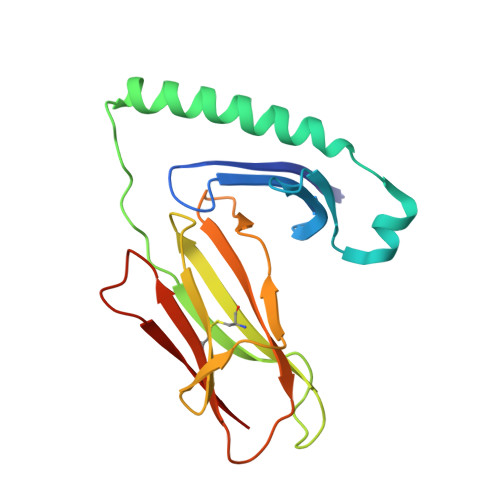
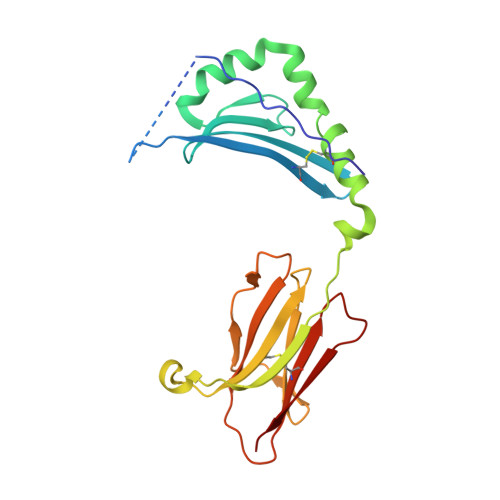
4P5M | pdb_00004p5m

Structural Basis of Chronic Beryllium Disease: Bridging the Gap Between Allergic Hypersensitivity and Autoimmunity


Experimental Data Snapshot

  • Method: X-RAY DIFFRACTION
  • Resolution: 1.70 Å
  • R-Value Free: 
    0.204 (Depositor), 0.213 (DCC) 
  • R-Value Work: 
    0.168 (Depositor), 0.178 (DCC) 
  • R-Value Observed: 
    0.170 (Depositor) 

wwPDB Validation 3D Report Full Report

Validation slider image for 4P5M

Ligand Structure Quality Assessment 


This is version 2.2 of the entry. See complete history

Literature

Structural basis of chronic beryllium disease: linking allergic hypersensitivity and autoimmunity.

Clayton, G.M.Wang, Y.Crawford, F.Novikov, A.Wimberly, B.T.Kieft, J.S.Falta, M.T.Bowerman, N.A.Marrack, P.Fontenot, A.P.Dai, S.Kappler, J.W.

(2014) Cell 158: 132-142

  • DOI: https://doi.org/10.1016/j.cell.2014.04.048
  • Primary Citation Related Structures: 
    4P4K, 4P4R, 4P57, 4P5K, 4P5M

  • PubMed Abstract: 

    T-cell-mediated hypersensitivity to metal cations is common in humans. How the T cell antigen receptor (TCR) recognizes these cations bound to a major histocompatibility complex (MHC) protein and self-peptide is unknown. Individuals carrying the MHCII allele, HLA-DP2, are at risk for chronic beryllium disease (CBD), a debilitating inflammatory lung condition caused by the reaction of CD4 T cells to inhaled beryllium. Here, we show that the T cell ligand is created when a Be(2+) cation becomes buried in an HLA-DP2/peptide complex, where it is coordinated by both MHC and peptide acidic amino acids. Surprisingly, the TCR does not interact with the Be(2+) itself, but rather with surface changes induced by the firmly bound Be(2+) and an accompanying Na(+) cation. Thus, CBD, by creating a new antigen by indirectly modifying the structure of preexisting self MHC-peptide complex, lies on the border between allergic hypersensitivity and autoimmunity.


  • Organizational Affiliation
    • Howard Hughes Medical Institute, National Jewish Health, Denver, CO 80206, USA; Department of Biomedical Research, National Jewish Health, Denver, CO 80206, USA; Department of Immunology and Microbiology, University of Colorado Denver School of Medicine, Aurora, CO 80045, USA.

Macromolecule Content 

  • Total Structure Weight: 186.42 kDa 
  • Atom Count: 14,385 
  • Modeled Residue Count: 1,499 
  • Deposited Residue Count: 1,580 
  • Unique protein chains: 2

Macromolecules

Find similar proteins by:|  3D Structure
Entity ID: 1
MoleculeChains  Sequence LengthOrganismDetailsImage
HLA class II histocompatibility antigen, DP alpha 1 chain
A, C, E, G
183Homo sapiensMutation(s): 0 
Gene Names: HLA-DPA1HLA-DP1AHLASB
UniProt & NIH Common Fund Data Resources
Find proteins for P20036 (Homo sapiens)
Explore P20036 
Go to UniProtKB:  P20036
PHAROS:  P20036
GTEx:  ENSG00000231389 
Entity Groups
Sequence Clusters30% Identity50% Identity70% Identity90% Identity95% Identity100% Identity
UniProt GroupP20036
Glycosylation
Glycosylation Sites: 1Go to GlyGen: P20036-1
Sequence Annotations
Expand
Reference Sequence
Find similar proteins by:|  3D Structure
Entity ID: 2
MoleculeChains  Sequence LengthOrganismDetailsImage
peptide,HLA class II histocompatibility antigen, DP beta 1 chain
B, D, F, H
212Homo sapiensMutation(s): 1 
UniProt & NIH Common Fund Data Resources
Find proteins for P04440 (Homo sapiens)
Explore P04440 
Go to UniProtKB:  P04440
PHAROS:  P04440
GTEx:  ENSG00000223865 
Entity Groups
Sequence Clusters30% Identity50% Identity70% Identity90% Identity95% Identity100% Identity
UniProt GroupP04440
Glycosylation
Glycosylation Sites: 1Go to GlyGen: P04440-1
Sequence Annotations
Expand
Reference Sequence

Oligosaccharides

Help  
Entity ID: 3
MoleculeChains Length2D Diagram GlycosylationD Interactions
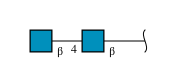
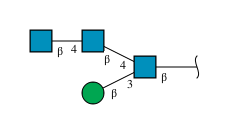
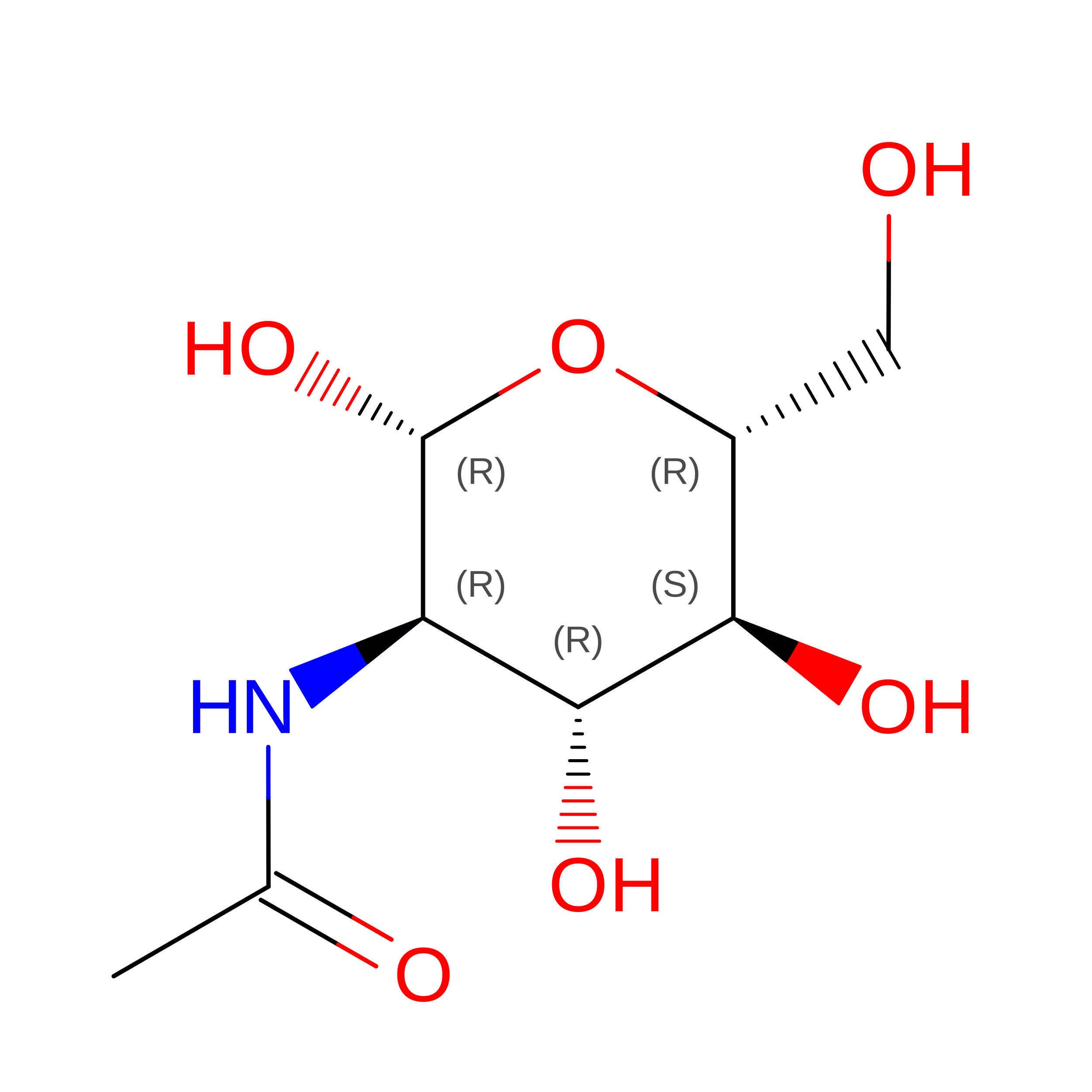
2-acetamido-2-deoxy-beta-D-glucopyranose-(1-4)-2-acetamido-2-deoxy-beta-D-glucopyranose
I, K, N
2N-Glycosylation
Glycosylation Resources
GlyTouCan: G42666HT
GlyCosmos: G42666HT
GlyGen: G42666HT
Entity ID: 4
MoleculeChains Length2D Diagram GlycosylationD Interactions
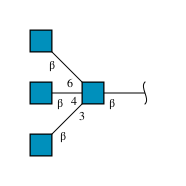
2-acetamido-2-deoxy-beta-D-glucopyranose-(1-3)-[2-acetamido-2-deoxy-beta-D-glucopyranose-(1-4)][2-acetamido-2-deoxy-beta-D-glucopyranose-(1-6)]2-acetamido-2-deoxy-beta-D-glucopyranose
J
4N-Glycosylation
Glycosylation Resources
GlyTouCan: G57331KL
GlyCosmos: G57331KL
GlyGen: G57331KL
Entity ID: 5
MoleculeChains Length2D Diagram GlycosylationD Interactions
2-acetamido-2-deoxy-beta-D-glucopyranose-(1-3)-[2-acetamido-2-deoxy-beta-D-glucopyranose-(1-4)]2-acetamido-2-deoxy-beta-D-glucopyranose
L
3N-Glycosylation
Glycosylation Resources
GlyTouCan: G26744ZJ
GlyCosmos: G26744ZJ
GlyGen: G26744ZJ
Entity ID: 6
MoleculeChains Length2D Diagram GlycosylationD Interactions
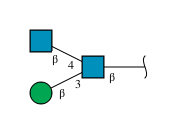
2-acetamido-2-deoxy-beta-D-glucopyranose-(1-4)-2-acetamido-2-deoxy-beta-D-glucopyranose-(1-4)-[beta-D-mannopyranose-(1-3)]2-acetamido-2-deoxy-beta-D-glucopyranose
M
4N-Glycosylation
Glycosylation Resources
GlyTouCan: G59760RN
GlyCosmos: G59760RN
GlyGen: G59760RN
Entity ID: 7
MoleculeChains Length2D Diagram GlycosylationD Interactions
beta-D-mannopyranose-(1-3)-[2-acetamido-2-deoxy-beta-D-glucopyranose-(1-4)]2-acetamido-2-deoxy-beta-D-glucopyranose
O
3N-Glycosylation
Glycosylation Resources
GlyTouCan: G29706YY
GlyCosmos: G29706YY
GlyGen: G29706YY

Experimental Data & Validation

Experimental Data

  • Method: X-RAY DIFFRACTION
  • Resolution: 1.70 Å
  • R-Value Free:  0.204 (Depositor), 0.213 (DCC) 
  • R-Value Work:  0.168 (Depositor), 0.178 (DCC) 
  • R-Value Observed: 0.170 (Depositor) 
Space Group: P 1 21 1
Unit Cell:
Length ( Å )Angle ( ˚ )
a = 81.631α = 90
b = 130.468β = 107.16
c = 107.994γ = 90
Software Package:
Software NamePurpose
REFMACrefinement

Structure Validation

View Full Validation Report


Ligand Structure Quality Assessment 


Entry History 

Deposition Data

Revision History  (Full details and data files)

  • Version 1.0: 2014-08-27
    Type: Initial release
  • Version 1.1: 2015-01-14
    Changes: Derived calculations
  • Version 1.2: 2015-10-14
    Changes: Data collection
  • Version 2.0: 2020-07-29
    Type: Remediation
    Reason: Carbohydrate remediation
    Changes: Atomic model, Data collection, Derived calculations, Structure summary
  • Version 2.1: 2023-12-27
    Changes: Data collection, Database references, Derived calculations, Structure summary
  • Version 2.2: 2024-10-23
    Changes: Structure summary