4P3X | pdb_00004p3x

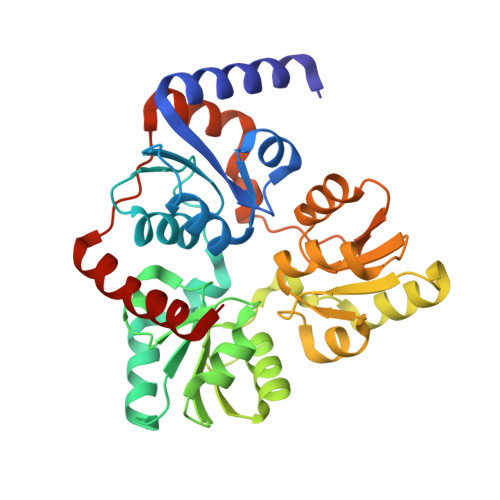
Structure of the Fe4S4 quinolinate synthase NadA from Thermotoga maritima


Experimental Data Snapshot

  • Method: X-RAY DIFFRACTION
  • Resolution: 1.65 Å
  • R-Value Free: 
    0.239 (Depositor), 0.236 (DCC) 
  • R-Value Work: 
    0.189 (Depositor), 0.191 (DCC) 
  • R-Value Observed: 
    0.191 (Depositor) 

Starting Model: experimental
View more details

wwPDB Validation 3D Report Full Report

Validation slider image for 4P3X

This is version 1.3 of the entry. See complete history

Literature

The crystal structure of Fe4S4 quinolinate synthase unravels an enzymatic dehydration mechanism that uses tyrosine and a hydrolase-type triad.

Cherrier, M.V.Chan, A.Darnault, C.Reichmann, D.Amara, P.Ollagnier de Choudens, S.Fontecilla-Camps, J.C.

(2014) J Am Chem Soc 136: 5253-5256

  • DOI: https://doi.org/10.1021/ja501431b
  • Primary Citation Related Structures: 
    4P3X

  • PubMed Abstract: 

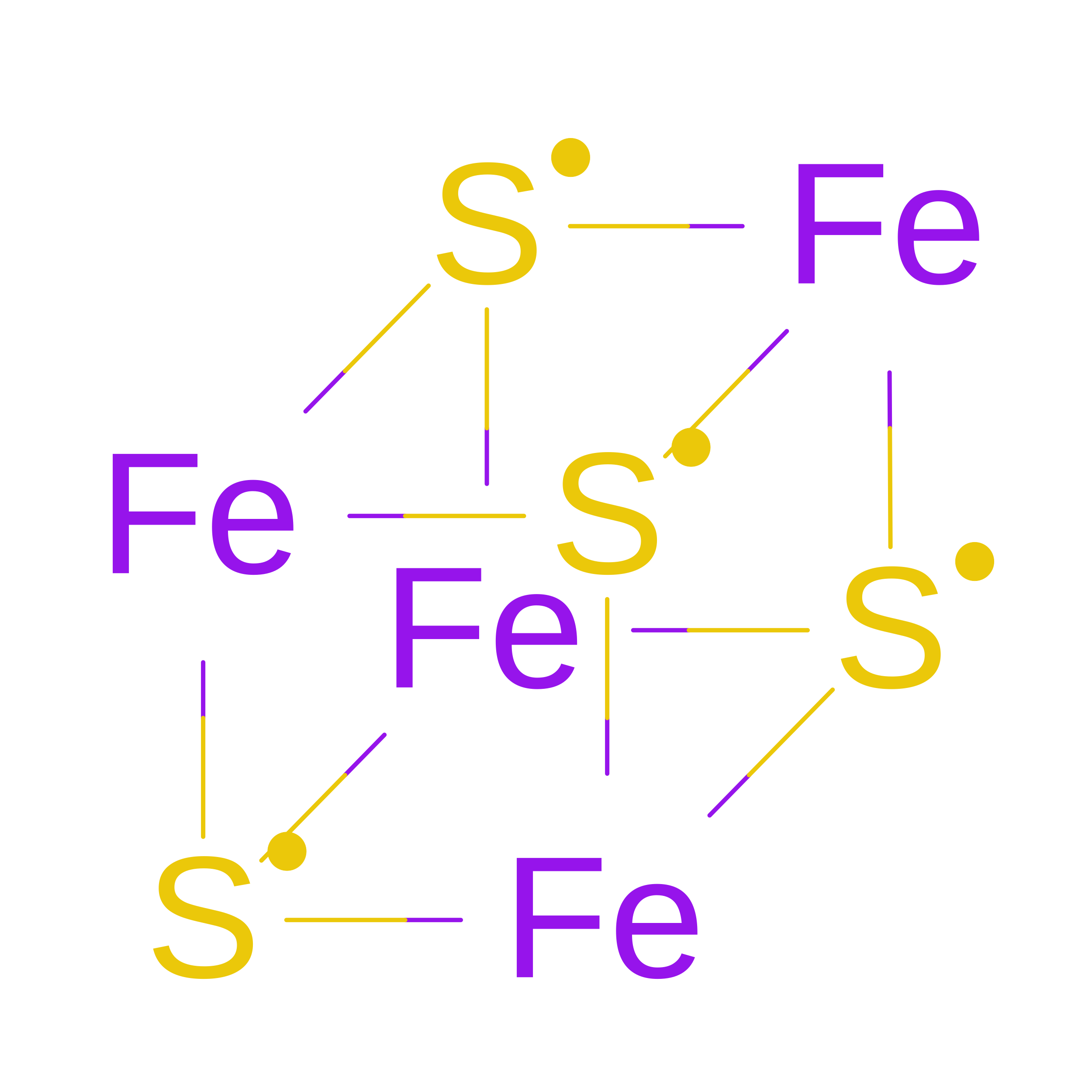
    Quinolinate synthase (NadA) is a Fe4S4 cluster-containing dehydrating enzyme involved in the synthesis of quinolinic acid (QA), the universal precursor of the essential nicotinamide adenine dinucleotide (NAD) coenzyme. A previously determined apo NadA crystal structure revealed the binding of one substrate analog, providing partial mechanistic information. Here, we report on the holo X-ray structure of NadA. The presence of the Fe4S4 cluster generates an internal tunnel and a cavity in which we have docked the last precursor to be dehydrated to form QA. We find that the only suitably placed residue to initiate this process is the conserved Tyr21. Furthermore, Tyr21 is close to a conserved Thr-His-Glu triad reminiscent of those found in proteases and other hydrolases. Our mutagenesis data show that all of these residues are essential for activity and strongly suggest that Tyr21 deprotonation, to form the reactive nucleophilic phenoxide anion, is mediated by the triad. NadA displays a dehydration mechanism significantly different from the one found in archetypical dehydratases such as aconitase, which use a serine residue deprotonated by an oxyanion hole. The X-ray structure of NadA will help us unveil its catalytic mechanism, the last step in the understanding of NAD biosynthesis.


  • Organizational Affiliation
    • Metalloproteins Unit, Institut de Biologie Structurale, Commissariat à l'Energie Atomique-Centre National de la Recherche Scientifique, Université Grenoble-Alpes , 6 rue Jules Horowitz, 38000 Grenoble, France.

Macromolecule Content 

  • Total Structure Weight: 35.31 kDa 
  • Atom Count: 2,741 
  • Modeled Residue Count: 305 
  • Deposited Residue Count: 305 
  • Unique protein chains: 1

Macromolecules

Find similar proteins by:|  3D Structure
Entity ID: 1
MoleculeChains  Sequence LengthOrganismDetailsImage
Quinolinate synthase A305Thermotoga maritima MSB8Mutation(s): 1 
Gene Names: nadATM_1644
EC: 2.5.1.72
UniProt
Find proteins for Q9X1X7 (Thermotoga maritima (strain ATCC 43589 / DSM 3109 / JCM 10099 / NBRC 100826 / MSB8))
Explore Q9X1X7 
Go to UniProtKB:  Q9X1X7
Entity Groups
Sequence Clusters30% Identity50% Identity70% Identity90% Identity95% Identity100% Identity
UniProt GroupQ9X1X7
Sequence Annotations
Expand
Reference Sequence

Experimental Data & Validation

Experimental Data

  • Method: X-RAY DIFFRACTION
  • Resolution: 1.65 Å
  • R-Value Free:  0.239 (Depositor), 0.236 (DCC) 
  • R-Value Work:  0.189 (Depositor), 0.191 (DCC) 
  • R-Value Observed: 0.191 (Depositor) 
Space Group: C 2 2 21
Unit Cell:
Length ( Å )Angle ( ˚ )
a = 42.92α = 90
b = 157.21β = 90
c = 93.94γ = 90
Software Package:
Software NamePurpose
XDSdata scaling
PHASERphasing
PHENIXrefinement

Structure Validation

View Full Validation Report


Entry History 

& Funding Information

Deposition Data


Funding OrganizationLocationGrant Number
ANRFranceANR-12-BS07-0018-01
FRISBIFranceANR-10-INSB-05-02

Revision History  (Full details and data files)

  • Version 1.0: 2014-04-02
    Type: Initial release
  • Version 1.1: 2014-10-01
    Changes: Database references
  • Version 1.2: 2017-11-22
    Changes: Advisory, Derived calculations, Other, Refinement description, Source and taxonomy
  • Version 1.3: 2023-09-27
    Changes: Advisory, Data collection, Database references, Derived calculations, Refinement description