4OU0 | pdb_00004ou0

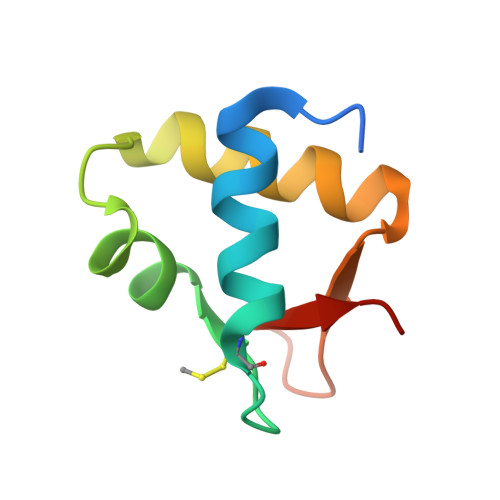
Crystal Structure of RPA32C


Experimental Data Snapshot

  • Method: X-RAY DIFFRACTION
  • Resolution: 1.40 Å
  • R-Value Free: 
    0.238 (Depositor), 0.245 (DCC) 
  • R-Value Work: 
    0.197 (Depositor), 0.204 (DCC) 
  • R-Value Observed: 
    0.199 (Depositor) 

Starting Model: experimental
View more details

wwPDB Validation 3D Report Full Report

Validation slider image for 4OU0

This is version 1.3 of the entry. See complete history

Literature

Structural Analysis of Replication Protein A Recruitment of the DNA Damage Response Protein SMARCAL1.

Feldkamp, M.D.Mason, A.C.Eichman, B.F.Chazin, W.J.

(2014) Biochemistry 53: 3052-3061

  • DOI: https://doi.org/10.1021/bi500252w
  • Primary Citation Related Structures: 
    4OU0

  • PubMed Abstract: 

    SWI/SNF-related, matrix-associated, actin-dependent regulator of chromatin, subfamily A-like1 (SMARCAL1) is a recently identified DNA damage response protein involved in remodeling stalled replication forks. The eukaryotic single-strand DNA binding protein replication protein A (RPA) recruits SMARCAL1 to stalled forks in vivo and facilitates regression of forks containing leading strand gaps. Both activities are mediated by a direct interaction between an RPA binding motif (RBM) at the N-terminus of SMARCAL1 and the C-terminal winged-helix domain of the RPA 32 kDa subunit (RPA32C). Here we report a biophysical and structural characterization of the SMARCAL1-RPA interaction. Isothermal titration calorimetry and circular dichroism spectroscopy revealed that RPA32C binds SMARCAL1-RBM with a Kd of 2.5 μM and induces a disorder-to-helix transition. The crystal structure of RPA32C was refined to 1.4 Å resolution, and the SMARCAL1-RBM binding site was mapped on the structure on the basis of nuclear magnetic resonance chemical shift perturbations. Conservation of the interaction surface to other RBM-containing proteins allowed construction of a model for the RPA32C/SMARCAL1-RBM complex. The implications of our results are discussed with respect to the recruitment of SMARCAL1 and other DNA damage response and repair proteins to stalled replication forks.


  • Organizational Affiliation
    • Department of Biochemistry, ‡Department of Biological Sciences, §Department of Chemistry, and ∥Center for Structural Biology, Vanderbilt University , Nashville, Tennessee 37232, United States.

Macromolecule Content 

  • Total Structure Weight: 8 kDa 
  • Atom Count: 581 
  • Modeled Residue Count: 66 
  • Deposited Residue Count: 73 
  • Unique protein chains: 1

Macromolecules

Find similar proteins by:|  3D Structure
Entity ID: 1
MoleculeChains  Sequence LengthOrganismDetailsImage
Replication protein A 32 kDa subunit73Homo sapiensMutation(s): 0 
Gene Names: REPA2RFA2RPA2RPA32RPA34
UniProt & NIH Common Fund Data Resources
Find proteins for P15927 (Homo sapiens)
Explore P15927 
Go to UniProtKB:  P15927
PHAROS:  P15927
GTEx:  ENSG00000117748 
Entity Groups
Sequence Clusters30% Identity50% Identity70% Identity90% Identity95% Identity100% Identity
UniProt GroupP15927
Sequence Annotations
Expand
Reference Sequence

Small Molecules

Modified Residues  1 Unique
IDChains TypeFormula2D DiagramParent
SCH
Query on SCH
A
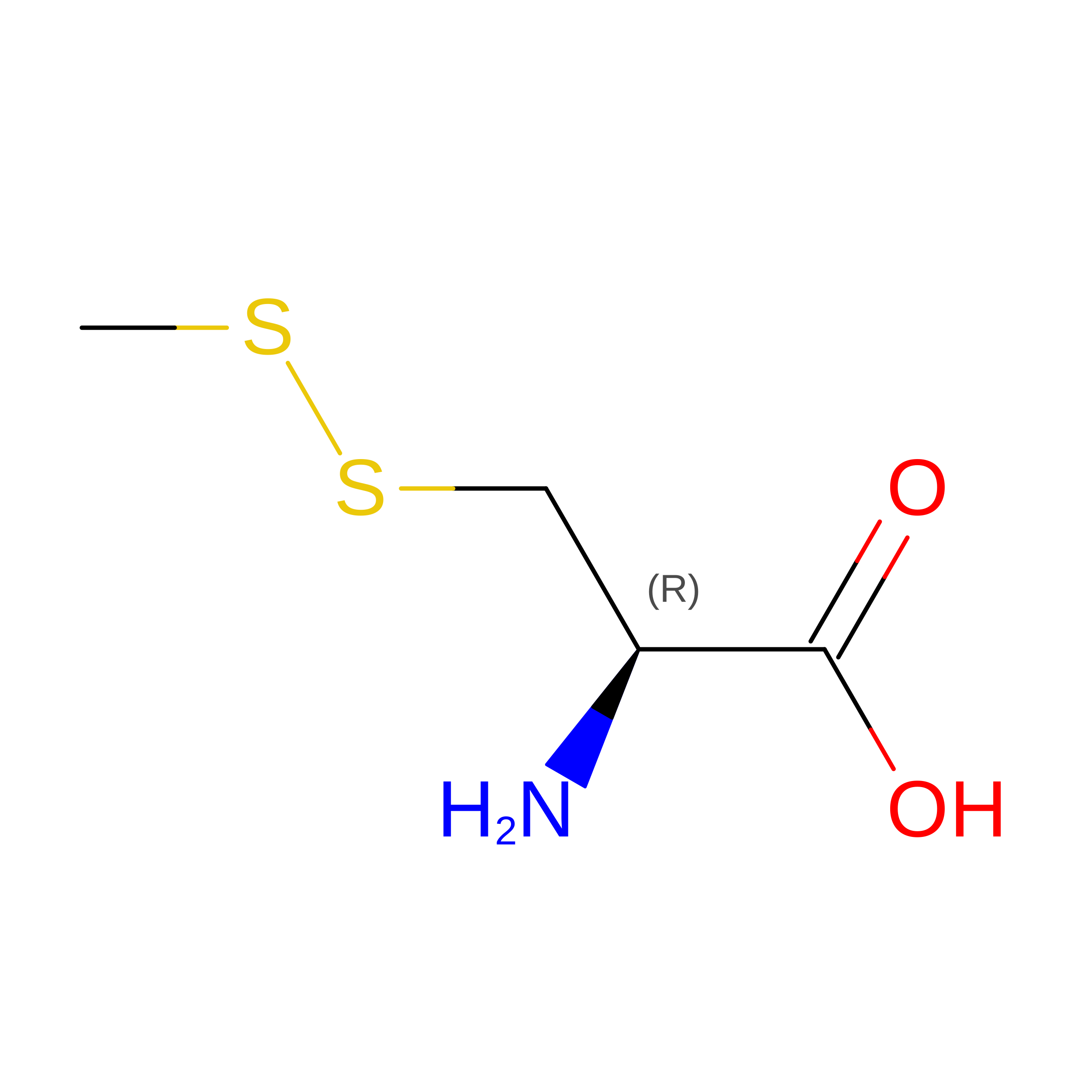
L-PEPTIDE LINKINGC4 H9 N O2 S2CYS

Experimental Data & Validation

Experimental Data

  • Method: X-RAY DIFFRACTION
  • Resolution: 1.40 Å
  • R-Value Free:  0.238 (Depositor), 0.245 (DCC) 
  • R-Value Work:  0.197 (Depositor), 0.204 (DCC) 
  • R-Value Observed: 0.199 (Depositor) 
Space Group: P 65
Unit Cell:
Length ( Å )Angle ( ˚ )
a = 69.556α = 90
b = 69.556β = 90
c = 23.567γ = 120
Software Package:
Software NamePurpose
HKL-2000data collection
PHENIXmodel building
PHENIXrefinement
HKL-2000data reduction
HKL-2000data scaling
PHENIXphasing

Structure Validation

View Full Validation Report


Entry History 

Deposition Data

Revision History  (Full details and data files)

  • Version 1.0: 2014-04-30
    Type: Initial release
  • Version 1.1: 2014-06-04
    Changes: Database references
  • Version 1.2: 2015-12-09
    Changes: Structure summary
  • Version 1.3: 2023-09-20
    Changes: Data collection, Database references, Derived calculations, Refinement description