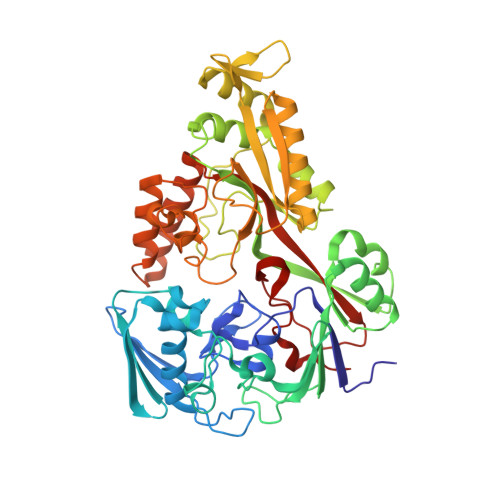
4OET | pdb_00004oet

Crystal structure of NikZ from Campylobacter jejuni, unliganded form


Experimental Data Snapshot

  • Method: X-RAY DIFFRACTION
  • Resolution: 2.40 Å
  • R-Value Free: 
    0.220 (Depositor), 0.220 (DCC) 
  • R-Value Work: 
    0.179 (Depositor), 0.179 (DCC) 
  • R-Value Observed: 
    0.181 (Depositor) 

Starting Model: experimental
View more details

wwPDB Validation 3D Report Full Report

Validation slider image for 4OET

This is version 1.3 of the entry. See complete history

Literature

Promiscuous nickel import in human pathogens: structure, thermodynamics, and evolution of extracytoplasmic nickel-binding proteins.

Lebrette, H.Brochier-Armanet, C.Zambelli, B.de Reuse, H.Borezee-Durant, E.Ciurli, S.Cavazza, C.

(2014) Structure 22: 1421-1432

  • DOI: https://doi.org/10.1016/j.str.2014.07.012
  • Primary Citation Related Structures: 
    4OER, 4OES, 4OET, 4OEU, 4OEV, 4OFL, 4OFO

  • PubMed Abstract: 

    In human pathogenic bacteria, nickel is required for the activation of two enzymes, urease and [NiFe]-hydrogenase, necessary for host infection. Acquisition of Ni(II) is mediated by either permeases or ABC-importers, the latter including a subclass that involves an extracytoplasmic nickel-binding protein, Ni-BP. This study reports on the structure of three Ni-BPs from a diversity of human pathogens and on the existence of three new nickel-binding motifs. These are different from that previously described for Escherichia coli Ni-BP NikA, known to bind nickel via a nickelophore, and indicate a variegated ligand selectivity for Ni-BPs. The structures are consistent with ligand affinities measured in solution by calorimetry and challenge the hypothesis of a general requirement of nickelophores for nickel uptake by canonical ABC importers. Phylogenetic analyses showed that Ni-BPs have different evolutionary origins and emerged independently from peptide-binding proteins, possibly explaining the promiscuous behavior of this class of Ni(II) carriers.


  • Organizational Affiliation
    • University Grenoble Alpes, Institut de Biologie Structurale (IBS), 38044 Grenoble, France; CNRS, IBS, 38044 Grenoble, France; CEA, IBS, 38044 Grenoble, France.

Macromolecule Content 

  • Total Structure Weight: 114.37 kDa 
  • Atom Count: 8,530 
  • Modeled Residue Count: 988 
  • Deposited Residue Count: 988 
  • Unique protein chains: 1

Macromolecules

Find similar proteins by:|  3D Structure
Entity ID: 1
MoleculeChains  Sequence LengthOrganismDetailsImage
Putative peptide ABC-transport system periplasmic peptide-binding protein
A, B
494Campylobacter jejuni subsp. jejuni NCTC 11168 = ATCC 700819Mutation(s): 0 
Gene Names: Cj1584c
UniProt
Find proteins for Q0P844 (Campylobacter jejuni subsp. jejuni serotype O:2 (strain ATCC 700819 / NCTC 11168))
Explore Q0P844 
Go to UniProtKB:  Q0P844
Entity Groups
Sequence Clusters30% Identity50% Identity70% Identity90% Identity95% Identity100% Identity
UniProt GroupQ0P844
Sequence Annotations
Expand
Reference Sequence

Experimental Data & Validation

Experimental Data

  • Method: X-RAY DIFFRACTION
  • Resolution: 2.40 Å
  • R-Value Free:  0.220 (Depositor), 0.220 (DCC) 
  • R-Value Work:  0.179 (Depositor), 0.179 (DCC) 
  • R-Value Observed: 0.181 (Depositor) 
Space Group: P 21 21 21
Unit Cell:
Length ( Å )Angle ( ˚ )
a = 81.06α = 90
b = 85.21β = 90
c = 148.46γ = 90
Software Package:
Software NamePurpose
PHENIXrefinement
XDSdata reduction
XSCALEdata scaling

Structure Validation

View Full Validation Report


Entry History 

Deposition Data

Revision History  (Full details and data files)

  • Version 1.0: 2014-10-01
    Type: Initial release
  • Version 1.1: 2014-11-19
    Changes: Database references
  • Version 1.2: 2018-04-18
    Changes: Advisory, Data collection
  • Version 1.3: 2023-09-20
    Changes: Advisory, Data collection, Database references, Derived calculations, Refinement description