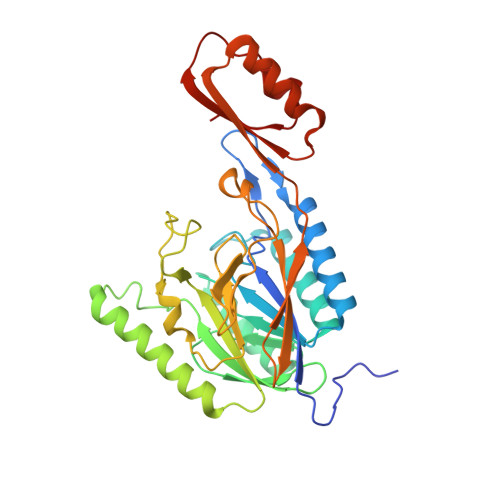
4O4K | pdb_00004o4k

DNA Double-Strand Break Repair Pathway Choice Is Directed by Distinct MRE11 Nuclease Activities


Experimental Data Snapshot

  • Method: X-RAY DIFFRACTION
  • Resolution: 2.10 Å
  • R-Value Free: 
    0.240 (Depositor), 0.240 (DCC) 
  • R-Value Work: 
    0.193 (Depositor), 0.196 (DCC) 
  • R-Value Observed: 
    0.196 (Depositor) 

Starting Model: experimental
View more details

wwPDB Validation 3D Report Full Report

Validation slider image for 4O4K

Ligand Structure Quality Assessment 


This is version 2.1 of the entry. See complete history

Literature

DNA Double-Strand Break Repair Pathway Choice Is Directed by Distinct MRE11 Nuclease Activities.

Shibata, A.Moiani, D.Arvai, A.S.Perry, J.Harding, S.M.Genois, M.M.Maity, R.van Rossum-Fikkert, S.Kertokalio, A.Romoli, F.Ismail, A.Ismalaj, E.Petricci, E.Neale, M.J.Bristow, R.G.Masson, J.Y.Wyman, C.Jeggo, P.A.Tainer, J.A.

(2014) Mol Cell 53: 7-18

  • DOI: https://doi.org/10.1016/j.molcel.2013.11.003
  • Primary Citation Related Structures: 
    4NZV, 4O24, 4O43, 4O4K, 4O5G

  • PubMed Abstract: 

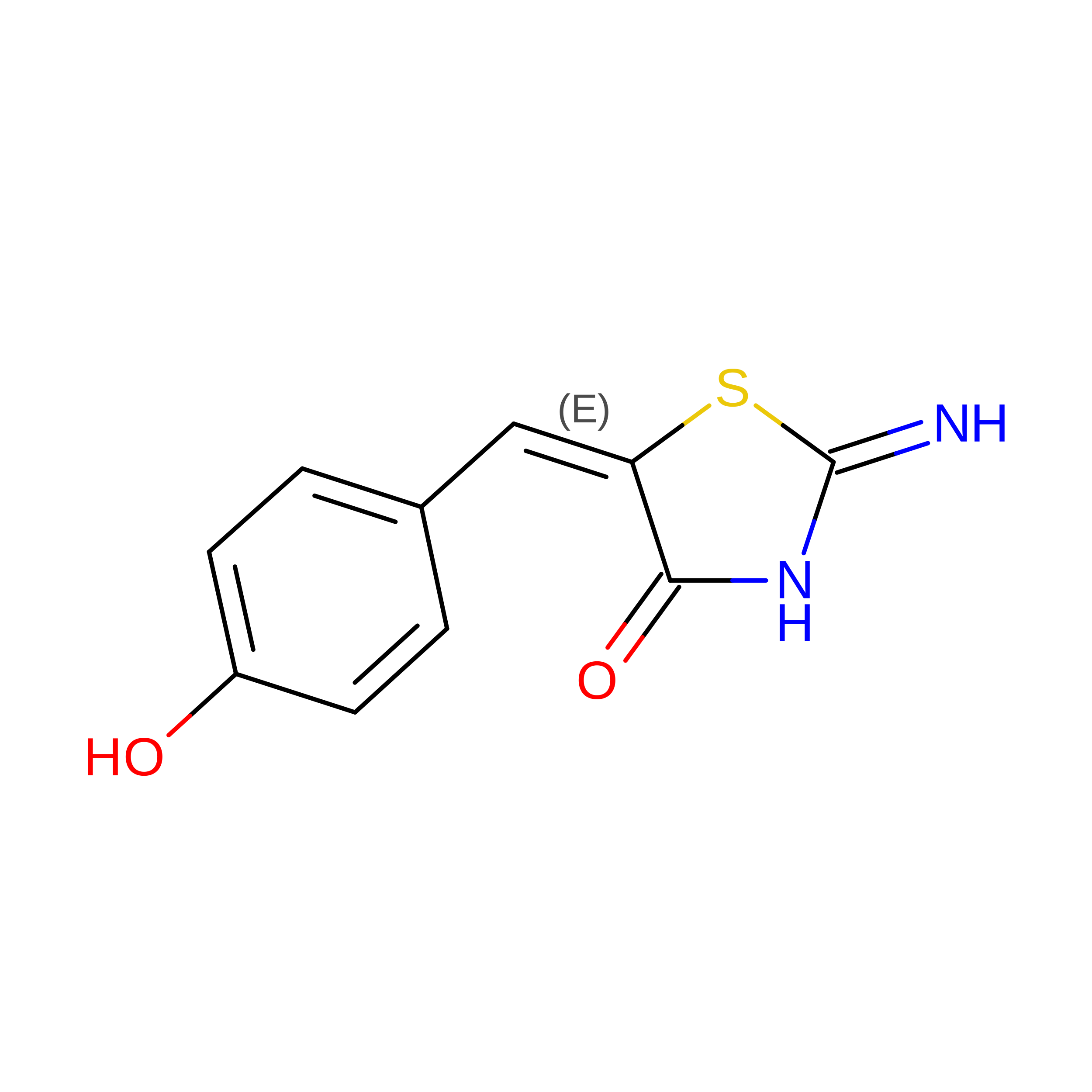
    MRE11 within the MRE11-RAD50-NBS1 (MRN) complex acts in DNA double-strand break repair (DSBR), detection, and signaling; yet, how its endo- and exonuclease activities regulate DSBR by nonhomologous end-joining (NHEJ) versus homologous recombination (HR) remains enigmatic. Here, we employed structure-based design with a focused chemical library to discover specific MRE11 endo- or exonuclease inhibitors. With these inhibitors, we examined repair pathway choice at DSBs generated in G2 following radiation exposure. While nuclease inhibition impairs radiation-induced replication protein A (RPA) chromatin binding, suggesting diminished resection, the inhibitors surprisingly direct different repair outcomes. Endonuclease inhibition promotes NHEJ in lieu of HR, while exonuclease inhibition confers a repair defect. Collectively, the results describe nuclease-specific MRE11 inhibitors, define distinct nuclease roles in DSB repair, and support a mechanism whereby MRE11 endonuclease initiates resection, thereby licensing HR followed by MRE11 exonuclease and EXO1/BLM bidirectional resection toward and away from the DNA end, which commits to HR.


  • Organizational Affiliation
    • Genome Damage and Stability Centre, University of Sussex, Brighton BN1 9RQ, UK; Advanced Scientific Research Leaders Development Unit, Gunma University, Maebashi, Gunma 371-8511, Japan.

Macromolecule Content 

  • Total Structure Weight: 77.81 kDa 
  • Atom Count: 5,318 
  • Modeled Residue Count: 652 
  • Deposited Residue Count: 672 
  • Unique protein chains: 1

Macromolecules

Find similar proteins by:|  3D Structure
Entity ID: 1
MoleculeChains  Sequence LengthOrganismDetailsImage
Exonuclease, putative
A, B
336Thermotoga maritima MSB8Mutation(s): 0 
Gene Names: TM_1635
EC: 3.1
UniProt
Find proteins for Q9X1X0 (Thermotoga maritima (strain ATCC 43589 / DSM 3109 / JCM 10099 / NBRC 100826 / MSB8))
Explore Q9X1X0 
Go to UniProtKB:  Q9X1X0
Entity Groups
Sequence Clusters30% Identity50% Identity70% Identity90% Identity95% Identity100% Identity
UniProt GroupQ9X1X0
Sequence Annotations
Expand
Reference Sequence

Experimental Data & Validation

Experimental Data

  • Method: X-RAY DIFFRACTION
  • Resolution: 2.10 Å
  • R-Value Free:  0.240 (Depositor), 0.240 (DCC) 
  • R-Value Work:  0.193 (Depositor), 0.196 (DCC) 
  • R-Value Observed: 0.196 (Depositor) 
Space Group: P 1 21 1
Unit Cell:
Length ( Å )Angle ( ˚ )
a = 47.769α = 90
b = 113.154β = 101.47
c = 80.891γ = 90
Software Package:
Software NamePurpose
Blu-Icedata collection
PHASERphasing
PHENIXrefinement
HKL-2000data reduction
SCALEPACKdata scaling

Structure Validation

View Full Validation Report


Ligand Structure Quality Assessment 


Entry History 

Revision History  (Full details and data files)

  • Version 1.0: 2014-01-08
    Type: Initial release
  • Version 1.1: 2014-02-05
    Changes: Database references
  • Version 2.0: 2020-02-19
    Changes: Advisory, Database references, Derived calculations, Non-polymer description, Structure summary
  • Version 2.1: 2023-09-20
    Changes: Data collection, Database references, Derived calculations, Refinement description