Download Mendeley
Cross-class metallo-beta-lactamase inhibition by bisthiazolidines reveals multiple binding modes.
Hinchliffe, P., Gonzalez, M.M., Mojica, M.F., Gonzalez, J.M., Castillo, V., Saiz, C., Kosmopoulou, M., Tooke, C.L., Llarrull, L.I., Mahler, G., Bonomo, R.A., Vila, A.J., Spencer, J.(2016) Proc Natl Acad Sci U S A 113: E3745-E3754
- PubMed: 27303030 Search on PubMedSearch on PubMed Central
- DOI: https://doi.org/10.1073/pnas.1601368113
- Primary Citation Related Structures:
4NQ6, 5EV6, 5EV8, 5EVB, 5EVD, 5EVK, 5EW0, 5EWA - PubMed Abstract:
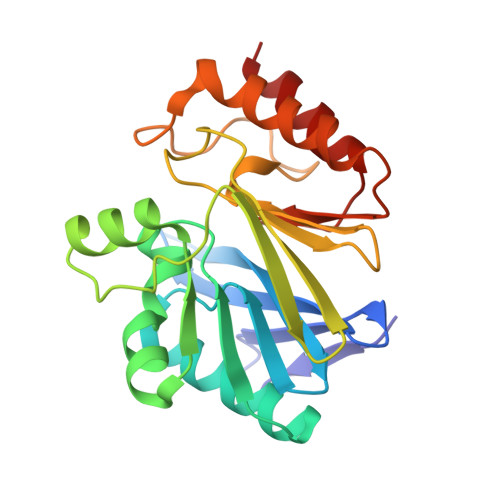
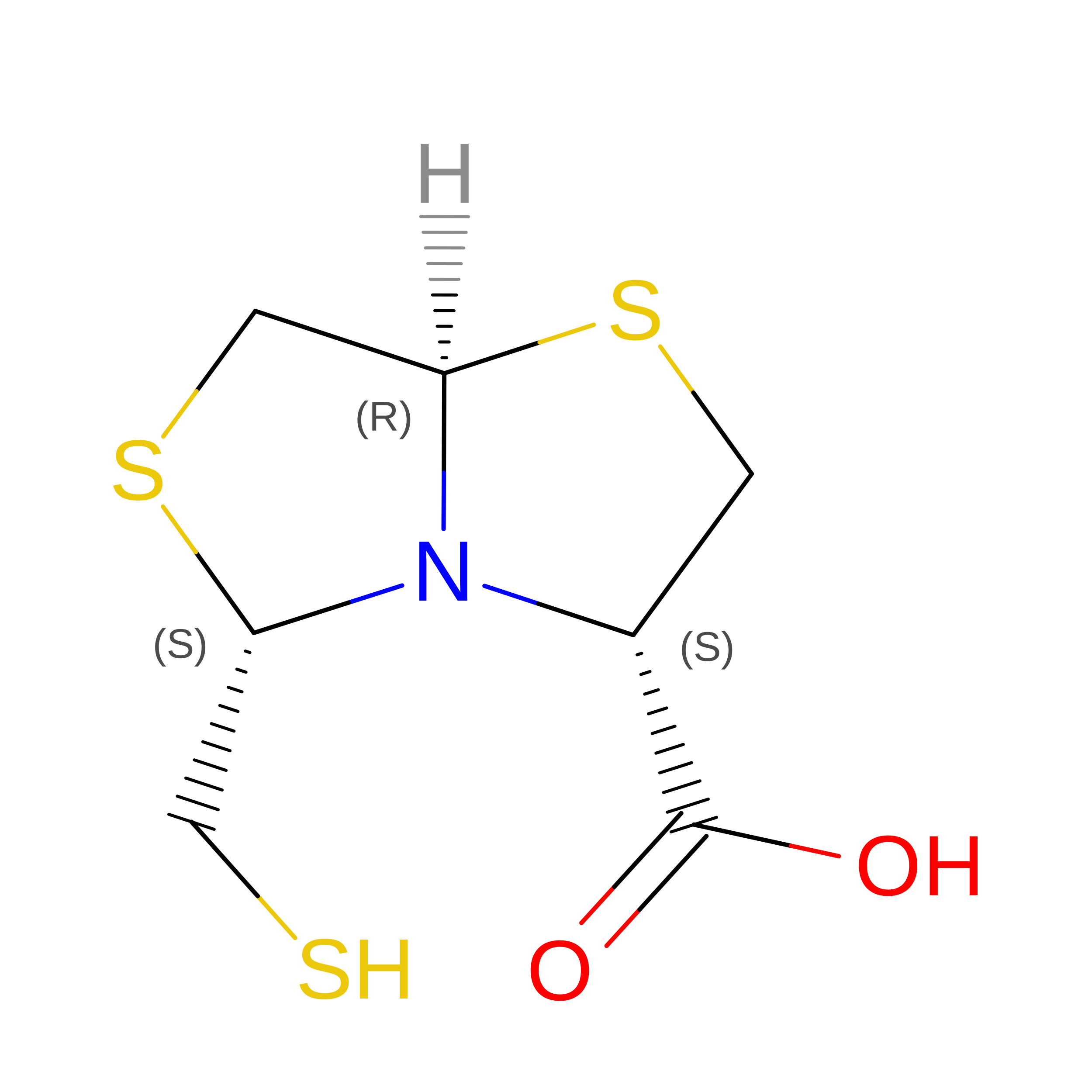
Metallo-β-lactamases (MBLs) hydrolyze almost all β-lactam antibiotics and are unaffected by clinically available β-lactamase inhibitors (βLIs). Active-site architecture divides MBLs into three classes (B1, B2, and B3), complicating development of βLIs effective against all enzymes. Bisthiazolidines (BTZs) are carboxylate-containing, bicyclic compounds, considered as penicillin analogs with an additional free thiol. Here, we show both l- and d-BTZ enantiomers are micromolar competitive βLIs of all MBL classes in vitro, with Kis of 6-15 µM or 36-84 µM for subclass B1 MBLs (IMP-1 and BcII, respectively), and 10-12 µM for the B3 enzyme L1. Against the B2 MBL Sfh-I, the l-BTZ enantiomers exhibit 100-fold lower Kis (0.26-0.36 µM) than d-BTZs (26-29 µM). Importantly, cell-based time-kill assays show BTZs restore β-lactam susceptibility of Escherichia coli-producing MBLs (IMP-1, Sfh-1, BcII, and GOB-18) and, significantly, an extensively drug-resistant Stenotrophomonas maltophilia clinical isolate expressing L1. BTZs therefore inhibit the full range of MBLs and potentiate β-lactam activity against producer pathogens. X-ray crystal structures reveal insights into diverse BTZ binding modes, varying with orientation of the carboxylate and thiol moieties. BTZs bind the di-zinc centers of B1 (IMP-1; BcII) and B3 (L1) MBLs via the free thiol, but orient differently depending upon stereochemistry. In contrast, the l-BTZ carboxylate dominates interactions with the monozinc B2 MBL Sfh-I, with the thiol uninvolved. d-BTZ complexes most closely resemble β-lactam binding to B1 MBLs, but feature an unprecedented disruption of the D120-zinc interaction. Cross-class MBL inhibition therefore arises from the unexpected versatility of BTZ binding.
- School of Cellular and Molecular Medicine, Biomedical Sciences Building, University of Bristol, Bristol BS8 1TD, United Kingdom;
Organizational Affiliation: