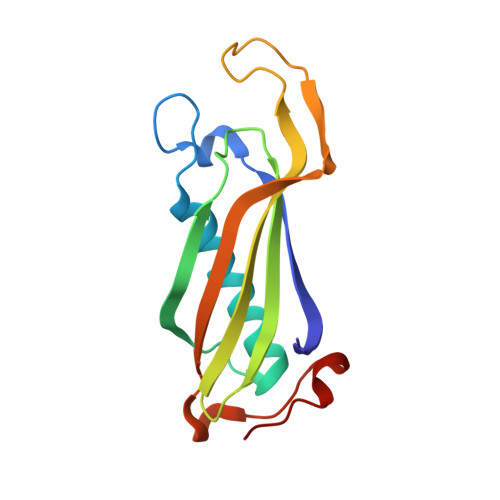
4MTU | pdb_00004mtu

beta-Alanyl-CoA:Ammonia Lyase from Clostridium propionicum


Experimental Data Snapshot

  • Method: X-RAY DIFFRACTION
  • Resolution: 0.97 Å
  • R-Value Free: 
    0.159 (Depositor), 0.156 (DCC) 
  • R-Value Work: 
    0.146 (Depositor), 0.141 (DCC) 
  • R-Value Observed: 
    0.146 (Depositor) 

wwPDB Validation 3D Report Full Report

Validation slider image for 4MTU

This is version 1.3 of the entry. See complete history

Literature

High resolution crystal structure of Clostridium propionicum beta-alanyl-CoA:ammonia lyase, a new member of the "hot dog fold" protein superfamily.

Heine, A.Herrmann, G.Selmer, T.Terwesten, F.Buckel, W.Reuter, K.

(2014) Proteins 82: 2041-2053

  • DOI: https://doi.org/10.1002/prot.24557
  • Primary Citation Related Structures: 
    4MTU, 4MZQ

  • PubMed Abstract: 

    Clostridium propionicum is the only organism known to ferment β-alanine, a constituent of coenzyme A (CoA) and the phosphopantetheinyl prosthetic group of holo-acyl carrier protein. The first step in the fermentation is a CoA-transfer to β-alanine. Subsequently, the resulting β-alanyl-CoA is deaminated by the enzyme β-alanyl-CoA:ammonia lyase (Acl) to reversibly form ammonia and acrylyl-CoA. We have determined the crystal structure of Acl in its apo-form at a resolution of 0.97 Å as well as in complex with CoA at a resolution of 1.59 Å. The structures reveal that the enyzme belongs to a superfamily of proteins exhibiting a so called "hot dog fold" which is characterized by a five-stranded antiparallel β-sheet with a long α-helix packed against it. The functional unit of all "hot dog fold" proteins is a homodimer containing two equivalent substrate binding sites which are established by the dimer interface. In the case of Acl, three functional dimers combine to a homohexamer strongly resembling the homohexamer formed by YciA-like acyl-CoA thioesterases. Here, we propose an enzymatic mechanism based on the crystal structure of the Acl·CoA complex and molecular docking.


  • Organizational Affiliation
    • Institut für Pharmazeutische Chemie, Fachbereich Pharmazie, Philipps-Universität Marburg, Marbacher Weg 6, D-35032, Marburg, Germany.

Macromolecule Content 

  • Total Structure Weight: 16.19 kDa 
  • Atom Count: 1,313 
  • Modeled Residue Count: 143 
  • Deposited Residue Count: 144 
  • Unique protein chains: 1

Macromolecules

Find similar proteins by:|  3D Structure
Entity ID: 1
MoleculeChains  Sequence LengthOrganismDetailsImage
Beta-alanyl-CoA:ammonia lyase 2144Anaerotignum propionicumMutation(s): 0 
UniProt
Find proteins for Q6KC22 (Anaerotignum propionicum)
Explore Q6KC22 
Go to UniProtKB:  Q6KC22
Entity Groups
Sequence Clusters30% Identity50% Identity70% Identity90% Identity95% Identity100% Identity
UniProt GroupQ6KC22
Sequence Annotations
Expand
Reference Sequence

Experimental Data & Validation

Experimental Data

  • Method: X-RAY DIFFRACTION
  • Resolution: 0.97 Å
  • R-Value Free:  0.159 (Depositor), 0.156 (DCC) 
  • R-Value Work:  0.146 (Depositor), 0.141 (DCC) 
  • R-Value Observed: 0.146 (Depositor) 
Space Group: P 63 2 2
Unit Cell:
Length ( Å )Angle ( ˚ )
a = 78.11α = 90
b = 78.11β = 90
c = 102.81γ = 120
Software Package:
Software NamePurpose
MAR345dtbdata collection
SHELXDphasing
SHELXL-97refinement
HKL-2000data reduction
HKL-2000data scaling

Structure Validation

View Full Validation Report


Entry History 

Deposition Data

Revision History  (Full details and data files)

  • Version 1.0: 2014-03-26
    Type: Initial release
  • Version 1.1: 2014-06-11
    Changes: Database references
  • Version 1.2: 2014-09-03
    Changes: Database references
  • Version 1.3: 2024-02-28
    Changes: Data collection, Database references, Derived calculations