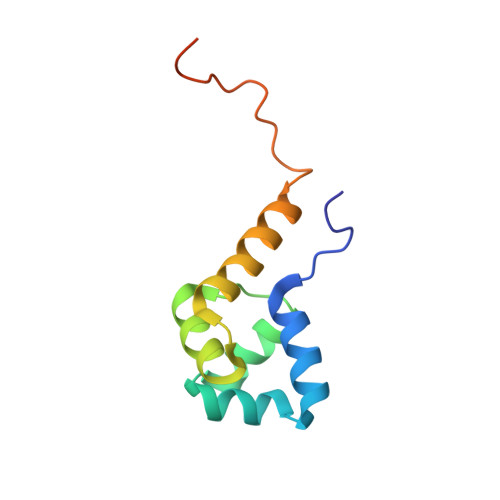
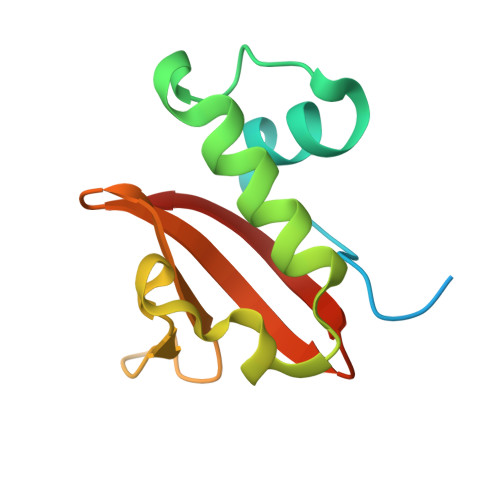
4MCX | pdb_00004mcx

P. vulgaris HIGBA structure, crystal form 2


Experimental Data Snapshot

  • Method: X-RAY DIFFRACTION
  • Resolution: 2.10 Å
  • R-Value Free: 
    0.211 (Depositor), 0.213 (DCC) 
  • R-Value Work: 
    0.173 (Depositor), 0.183 (DCC) 
  • R-Value Observed: 
    0.174 (Depositor) 

Starting Model: experimental
View more details

wwPDB Validation 3D Report Full Report

Validation slider image for 4MCX

This is version 1.2 of the entry. See complete history

Literature

Structure of the Proteus vulgaris HigB-(HigA)2-HigB Toxin-Antitoxin Complex.

Schureck, M.A.Maehigashi, T.Miles, S.J.Marquez, J.Cho, S.E.Erdman, R.Dunham, C.M.

(2014) J Biological Chem 289: 1060-1070

  • DOI: https://doi.org/10.1074/jbc.M113.512095
  • Primary Citation Related Structures: 
    4MCT, 4MCX

  • PubMed Abstract: 

    Bacterial toxin-antitoxin (TA) systems regulate key cellular processes to promote cell survival during periods of stress. During steady-state cell growth, antitoxins typically interact with their cognate toxins to inhibit activity presumably by preventing substrate recognition. We solved two x-ray crystal structures of the Proteus vulgaris tetrameric HigB-(HigA)2-HigB TA complex and found that, unlike most other TA systems, the antitoxin HigA makes minimal interactions with toxin HigB. HigB adopts a RelE family tertiary fold containing a highly conserved concave surface where we predict its active site is located. HigA does not cover the solvent-exposed HigB active site, suggesting that, in general, toxin inhibition is not solely mediated by active site hindrance by its antitoxin. Each HigA monomer contains a helix-turn-helix motif that binds to its own DNA operator to repress transcription during normal cellular growth. This is distinct from antitoxins belonging to other superfamilies that typically only form DNA-binding motifs upon dimerization. We further show that disruption of the HigB-(HigA)2-HigB tetramer to a HigBA heterodimer ablates operator binding. Taken together, our biochemical and structural studies elucidate the novel molecular details of the HigBA TA system.


  • Organizational Affiliation
    • From the Department of Biochemistry, Emory University School of Medicine, Atlanta, Georgia 30322.

Macromolecule Content 

  • Total Structure Weight: 73.83 kDa 
  • Atom Count: 4,606 
  • Modeled Residue Count: 553 
  • Deposited Residue Count: 651 
  • Unique protein chains: 2

Macromolecules

Find similar proteins by:|  3D Structure
Entity ID: 1
MoleculeChains  Sequence LengthOrganismDetailsImage
Antidote protein
A, C, E
104Proteus vulgarisMutation(s): 0 
Gene Names: higA
UniProt
Find proteins for Q7A224 (Proteus vulgaris)
Explore Q7A224 
Go to UniProtKB:  Q7A224
Entity Groups
Sequence Clusters30% Identity50% Identity70% Identity90% Identity95% Identity100% Identity
UniProt GroupQ7A224
Sequence Annotations
Expand
Reference Sequence
Find similar proteins by:|  3D Structure
Entity ID: 2
MoleculeChains  Sequence LengthOrganismDetailsImage
Killer protein
B, D, F
113Proteus vulgarisMutation(s): 0 
Gene Names: higB
EC: 3.1
UniProt
Find proteins for Q7A225 (Proteus vulgaris)
Explore Q7A225 
Go to UniProtKB:  Q7A225
Entity Groups
Sequence Clusters30% Identity50% Identity70% Identity90% Identity95% Identity100% Identity
UniProt GroupQ7A225
Sequence Annotations
Expand
Reference Sequence

Experimental Data & Validation

Experimental Data

  • Method: X-RAY DIFFRACTION
  • Resolution: 2.10 Å
  • R-Value Free:  0.211 (Depositor), 0.213 (DCC) 
  • R-Value Work:  0.173 (Depositor), 0.183 (DCC) 
  • R-Value Observed: 0.174 (Depositor) 
Space Group: P 62
Unit Cell:
Length ( Å )Angle ( ˚ )
a = 120.503α = 90
b = 120.503β = 90
c = 64.45γ = 120
Software Package:
Software NamePurpose
PHASERphasing
PHENIXrefinement
PDB_EXTRACTdata extraction
XDSdata reduction
XDSdata scaling

Structure Validation

View Full Validation Report


Entry History 

Deposition Data

Revision History  (Full details and data files)

  • Version 1.0: 2013-12-11
    Type: Initial release
  • Version 1.1: 2014-01-29
    Changes: Database references
  • Version 1.2: 2023-09-20
    Changes: Data collection, Database references, Refinement description