4LZG | pdb_00004lzg

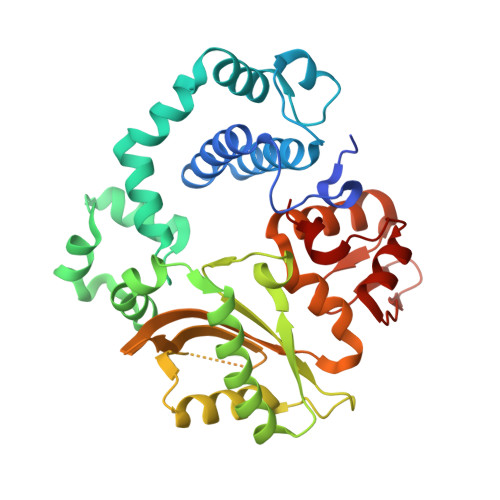
Binary complex of human DNA Polymerase Mu with DNA


Experimental Data Snapshot

  • Method: X-RAY DIFFRACTION
  • Resolution: 1.60 Å
  • R-Value Free: 
    0.205 (Depositor), 0.201 (DCC) 
  • R-Value Work: 
    0.174 (Depositor), 0.173 (DCC) 
  • R-Value Observed: 
    0.175 (Depositor) 

Starting Model: experimental
View more details

wwPDB Validation 3D Report Full Report

Validation slider image for 4LZG

This is version 1.4 of the entry. See complete history

Literature

Sustained active site rigidity during synthesis by human DNA polymerase mu.

Moon, A.F.Pryor, J.M.Ramsden, D.A.Kunkel, T.A.Bebenek, K.Pedersen, L.C.

(2014) Nat Struct Mol Biol 21: 253-260

  • DOI: https://doi.org/10.1038/nsmb.2766
  • Primary Citation Related Structures: 
    4LZD, 4LZG, 4M04, 4M0A

  • PubMed Abstract: 

    DNA polymerase μ (Pol μ) is the only template-dependent human DNA polymerase capable of repairing double-strand DNA breaks (DSBs) with unpaired 3' ends in nonhomologous end joining (NHEJ). To probe this function, we structurally characterized Pol μ's catalytic cycle for single-nucleotide incorporation. These structures indicate that, unlike other template-dependent DNA polymerases, Pol μ shows no large-scale conformational changes in protein subdomains, amino acid side chains or DNA upon dNTP binding or catalysis. Instead, the only major conformational change is seen earlier in the catalytic cycle, when the flexible loop 1 region repositions upon DNA binding. Pol μ variants with changes in loop 1 have altered catalytic properties and are partially defective in NHEJ. The results indicate that specific loop 1 residues contribute to Pol μ's unique ability to catalyze template-dependent NHEJ of DSBs with unpaired 3' ends.


  • Organizational Affiliation
    • Laboratory of Structural Biology, National Institute of Environmental Health Sciences, National Institutes of Health, Research Triangle Park, North Carolina, USA.

Macromolecule Content 

  • Total Structure Weight: 45.39 kDa 
  • Atom Count: 3,535 
  • Modeled Residue Count: 342 
  • Deposited Residue Count: 373 
  • Unique protein chains: 1
  • Unique nucleic acid chains: 3

Macromolecules


Find similar proteins by:|  3D Structure
Entity ID: 1
MoleculeChains  Sequence LengthOrganismDetailsImage
DNA-directed DNA/RNA polymerase mu356Homo sapiensMutation(s): 0 
Gene Names: POLMpolmu
EC: 2.7.7.7
UniProt & NIH Common Fund Data Resources
Find proteins for Q9NP87 (Homo sapiens)
Explore Q9NP87 
Go to UniProtKB:  Q9NP87
PHAROS:  Q9NP87
GTEx:  ENSG00000122678 
Entity Groups
Sequence Clusters30% Identity50% Identity70% Identity90% Identity95% Identity100% Identity
UniProt GroupQ9NP87
Sequence Annotations
Expand
Reference Sequence
Find similar nucleic acids by:  Sequence
Entity ID: 2
MoleculeChains LengthOrganismImage
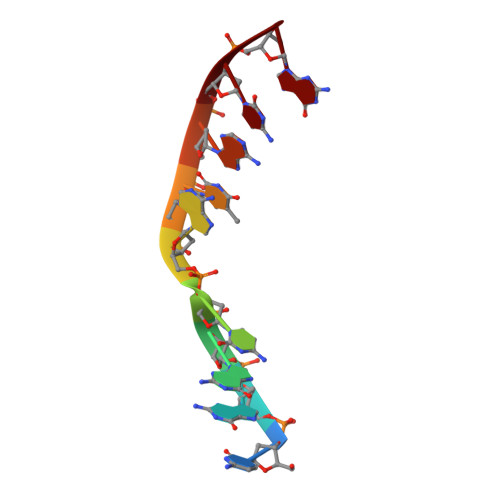
template strandB [auth T]9N/A
Sequence Annotations
Expand
Reference Sequence
Find similar nucleic acids by:  Sequence
Entity ID: 3
MoleculeChains LengthOrganismImage
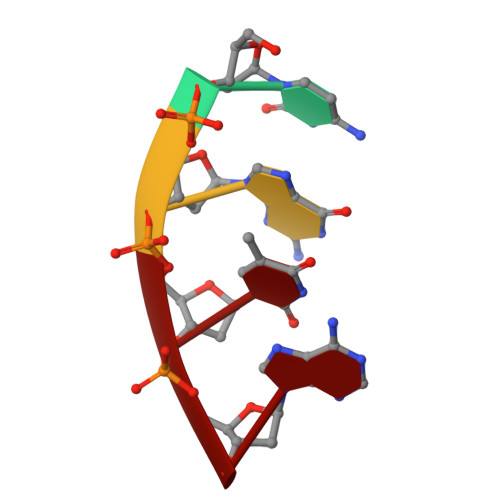
upstream primer strandC [auth P]4N/A
Sequence Annotations
Expand
Reference Sequence
Find similar nucleic acids by:  Sequence
Entity ID: 4
MoleculeChains LengthOrganismImage
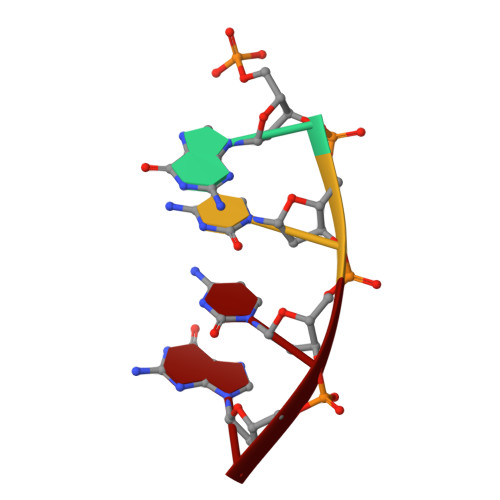
downstream primer strand4N/A
Sequence Annotations
Expand
Reference Sequence

Experimental Data & Validation

Experimental Data

  • Method: X-RAY DIFFRACTION
  • Resolution: 1.60 Å
  • R-Value Free:  0.205 (Depositor), 0.201 (DCC) 
  • R-Value Work:  0.174 (Depositor), 0.173 (DCC) 
  • R-Value Observed: 0.175 (Depositor) 
Space Group: P 21 21 21
Unit Cell:
Length ( Å )Angle ( ˚ )
a = 60.003α = 90
b = 68.514β = 90
c = 110.307γ = 90
Software Package:
Software NamePurpose
SCALEPACKdata scaling
PHASERphasing
PHENIXrefinement
PDB_EXTRACTdata extraction
StructureStudiodata collection
HKL-2000data reduction

Structure Validation

View Full Validation Report


Entry History 

Deposition Data

Revision History  (Full details and data files)

  • Version 1.0: 2014-02-05
    Type: Initial release
  • Version 1.1: 2014-03-05
    Changes: Database references
  • Version 1.2: 2014-03-19
    Changes: Database references
  • Version 1.3: 2024-02-28
    Changes: Data collection, Database references, Derived calculations
  • Version 1.4: 2024-04-03
    Changes: Refinement description