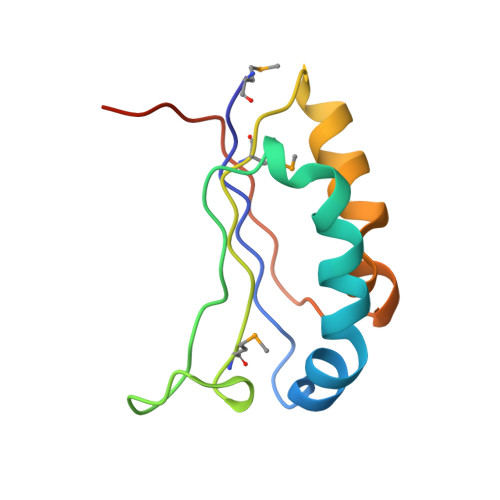
4LBI | pdb_00004lbi

5-chloro-2-hydroxyhydroquinone dehydrochlorinase (TftG) from Burkholderia phenoliruptrix AC1100: Selenomethionyl Apo-form


Experimental Data Snapshot

  • Method: X-RAY DIFFRACTION
  • Resolution: 2.21 Å
  • R-Value Free: 
    0.207 (Depositor), 0.208 (DCC) 
  • R-Value Work: 
    0.170 (Depositor), 0.173 (DCC) 
  • R-Value Observed: 
    0.174 (Depositor) 

wwPDB Validation 3D Report Full Report

Validation slider image for 4LBI

This is version 1.3 of the entry. See complete history

Literature

Catalytic Mechanism of 5-Chlorohydroxyhydroquinone Dehydrochlorinase from the YCII Superfamily of Largely Unknown Function.

Hayes, R.P.Lewis, K.M.Xun, L.Kang, C.

(2013) J Biological Chem 288: 28447-28456

  • DOI: https://doi.org/10.1074/jbc.M113.499368
  • Primary Citation Related Structures: 
    4LBH, 4LBI, 4LBP

  • PubMed Abstract: 

    TftG, 5-chloro-2-hydroxyhydroquinone (5-CHQ) dehydrochlorinase, is involved in the biodegradation of 2,4,5-trichlorophenoxyacetate by Burkholderia phenoliruptrix AC1100. It belongs to the YCII superfamily, a group of proteins with largely unknown function. In this work, we utilized structural and functional studies, including the apo-form and 2,5-dihydroxybenzoquinone binary complex crystal structures, computational analysis, and site-directed mutagenesis, to determine the dehydrochlorination mechanism. The His-Asp dyad, which initiates catalysis, is strongly conserved in YCII-like proteins. In addition, other catalytically important residues such as Pro-76, which orients the His-Asp catalytic dyad; Arg-17 and Ser-56, which form an oxyanion hole; and Asp-9, which stabilizes the oxyanion hole, are among the most highly conserved residues across the YCII superfamily members. The comprehensive characterization of TftG helps not only for identifying effective mechanisms for chloroaromatic dechlorination but also for understanding the functions of YCII superfamily members, which we propose to be lyases.


  • Organizational Affiliation
    • From the Department of Chemistry and.

Macromolecule Content 

  • Total Structure Weight: 45.29 kDa 
  • Atom Count: 3,264 
  • Modeled Residue Count: 376 
  • Deposited Residue Count: 400 
  • Unique protein chains: 1

Macromolecules

Find similar proteins by:|  3D Structure
Entity ID: 1
MoleculeChains  Sequence LengthOrganismDetailsImage
5-chloro-2-hydroxyhydroquinone dehydrochlorinase (TftG)
A, B, C, D
100Burkholderia cepaciaMutation(s): 0 
UniProt
Find proteins for Q45075 (Burkholderia cepacia)
Explore Q45075 
Go to UniProtKB:  Q45075
Entity Groups
Sequence Clusters30% Identity50% Identity70% Identity90% Identity95% Identity100% Identity
UniProt GroupQ45075
Sequence Annotations
Expand
Reference Sequence

Small Molecules

Modified Residues  1 Unique
IDChains TypeFormula2D DiagramParent
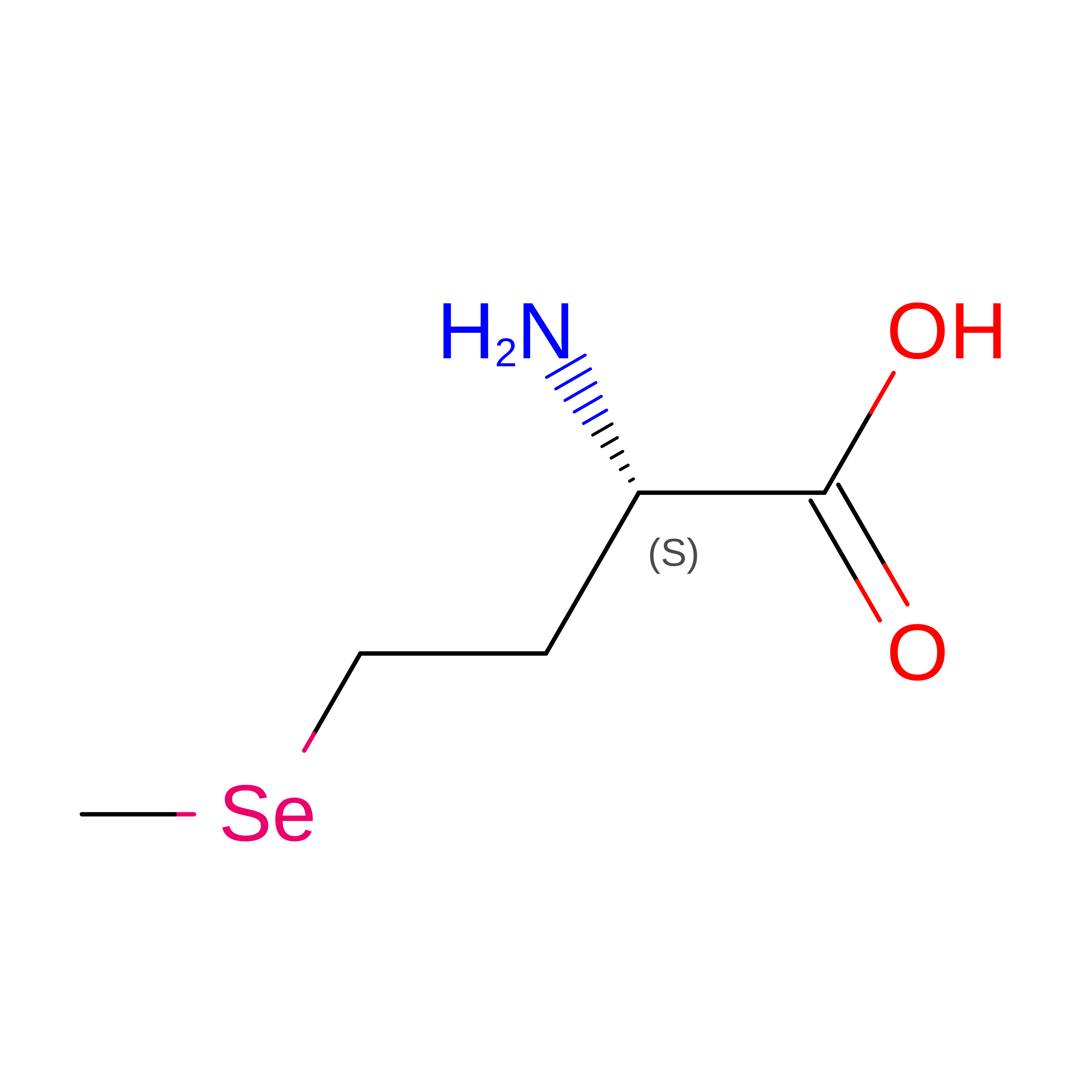
MSE
Query on MSE
A, B, C, D
L-PEPTIDE LINKINGC5 H11 N O2 SeMET

Experimental Data & Validation

Experimental Data

  • Method: X-RAY DIFFRACTION
  • Resolution: 2.21 Å
  • R-Value Free:  0.207 (Depositor), 0.208 (DCC) 
  • R-Value Work:  0.170 (Depositor), 0.173 (DCC) 
  • R-Value Observed: 0.174 (Depositor) 
Space Group: C 2 2 21
Unit Cell:
Length ( Å )Angle ( ˚ )
a = 135.238α = 90
b = 158.01β = 90
c = 50.385γ = 90
Software Package:
Software NamePurpose
CrystalCleardata collection
PHENIXmodel building
PHENIXrefinement
CrystalCleardata reduction
CrystalCleardata scaling
PHENIXphasing

Structure Validation

View Full Validation Report


Entry History 

Deposition Data

Revision History  (Full details and data files)

  • Version 1.0: 2013-08-28
    Type: Initial release
  • Version 1.1: 2013-10-09
    Changes: Database references
  • Version 1.2: 2013-10-23
    Changes: Database references
  • Version 1.3: 2024-11-27
    Changes: Data collection, Database references, Derived calculations, Structure summary