4L9O | pdb_00004l9o

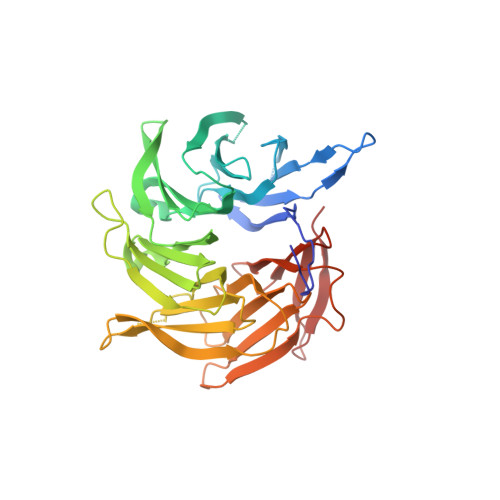
Crystal Structure of the Sec13-Sec16 blade-inserted complex from Pichia pastoris


Experimental Data Snapshot

  • Method: X-RAY DIFFRACTION
  • Resolution: 1.60 Å
  • R-Value Free: 
    0.205 (Depositor), 0.206 (DCC) 
  • R-Value Work: 
    0.173 (Depositor), 0.176 (DCC) 
  • R-Value Observed: 
    0.174 (Depositor) 

Starting Model: experimental
View more details

wwPDB Validation 3D Report Full Report

Validation slider image for 4L9O

This is version 1.3 of the entry. See complete history

Literature

Sec16 influences transitional ER sites by regulating rather than organizing COPII.

Bharucha, N.Liu, Y.Papanikou, E.McMahon, C.Esaki, M.Jeffrey, P.D.Hughson, F.M.Glick, B.S.

(2013) Mol Biol Cell 24: 3406-3419

  • DOI: https://doi.org/10.1091/mbc.E13-04-0185
  • Primary Citation Related Structures: 
    4L9O

  • PubMed Abstract: 

    During the budding of coat protein complex II (COPII) vesicles from transitional endoplasmic reticulum (tER) sites, Sec16 has been proposed to play two distinct roles: negatively regulating COPII turnover and organizing COPII assembly at tER sites. We tested these ideas using the yeast Pichia pastoris. Redistribution of Sec16 to the cytosol accelerates tER dynamics, supporting a negative regulatory role for Sec16. To evaluate a possible COPII organization role, we dissected the functional regions of Sec16. The central conserved domain, which had been implicated in coordinating COPII assembly, is actually dispensable for normal tER structure. An upstream conserved region (UCR) localizes Sec16 to tER sites. The UCR binds COPII components, and removal of COPII from tER sites also removes Sec16, indicating that COPII recruits Sec16 rather than the other way around. We propose that Sec16 does not in fact organize COPII. Instead, regulation of COPII turnover can account for the influence of Sec16 on tER sites.


  • Organizational Affiliation
    • Department of Molecular Genetics and Cell Biology, University of Chicago, Chicago, IL 60637 Department of Molecular Biology, Princeton University, Princeton, NJ 08544.

Macromolecule Content 

  • Total Structure Weight: 77.47 kDa 
  • Atom Count: 5,356 
  • Modeled Residue Count: 641 
  • Deposited Residue Count: 698 
  • Unique protein chains: 1

Macromolecules

Find similar proteins by:|  3D Structure
Entity ID: 1
MoleculeChains  Sequence LengthOrganismDetailsImage
Sec16,Protein transport protein SEC13
A, B
349Komagataella pastorisKomagataella phaffii GS115
This entity is chimeric
Mutation(s): 0 
Gene Names: SEC16SEC13PAS_chr1-3_0057
UniProt
Find proteins for P53024 (Komagataella phaffii (strain GS115 / ATCC 20864))
Explore P53024 
Go to UniProtKB:  P53024
Find proteins for Q45TY0 (Komagataella pastoris)
Explore Q45TY0 
Go to UniProtKB:  Q45TY0
Entity Groups
Sequence Clusters30% Identity50% Identity70% Identity90% Identity95% Identity100% Identity
UniProt GroupsP53024Q45TY0
Sequence Annotations
Expand
Reference Sequence

Small Molecules

Ligands 3 Unique
IDChains Name / Formula / InChI Key2D Diagram3D Interactions
EDO

Query on EDO


Download:Ideal Coordinates CCD File
G [auth A],
H [auth A],
I [auth A],
J [auth A],
K [auth A]
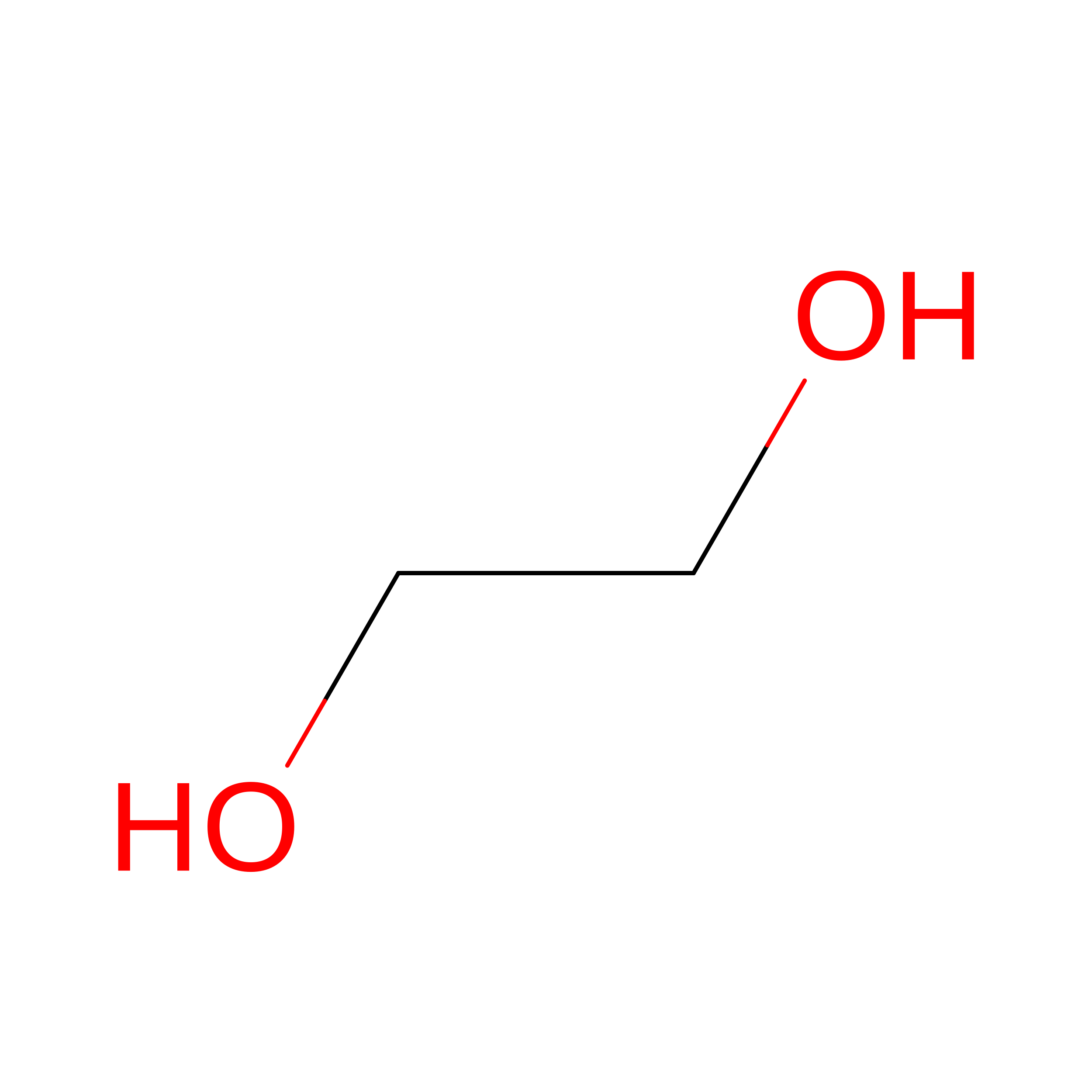
1,2-ETHANEDIOL
C2 H6 O2
LYCAIKOWRPUZTN-UHFFFAOYSA-N
CA

Query on CA


Download:Ideal Coordinates CCD File
C [auth A],
D [auth A],
L [auth B]
CALCIUM ION
Ca
BHPQYMZQTOCNFJ-UHFFFAOYSA-N
CL

Query on CL


Download:Ideal Coordinates CCD File
E [auth A],
F [auth A]
CHLORIDE ION
Cl
VEXZGXHMUGYJMC-UHFFFAOYSA-M

Experimental Data & Validation

Experimental Data

  • Method: X-RAY DIFFRACTION
  • Resolution: 1.60 Å
  • R-Value Free:  0.205 (Depositor), 0.206 (DCC) 
  • R-Value Work:  0.173 (Depositor), 0.176 (DCC) 
  • R-Value Observed: 0.174 (Depositor) 
Space Group: P 1 21 1
Unit Cell:
Length ( Å )Angle ( ˚ )
a = 70.509α = 90
b = 49.32β = 111.7
c = 90.904γ = 90
Software Package:
Software NamePurpose
DENZOdata reduction
SCALEPACKdata scaling
PHASERphasing
PHENIXrefinement
PDB_EXTRACTdata extraction
CBASSdata collection

Structure Validation

View Full Validation Report


Entry History 

Deposition Data

Revision History  (Full details and data files)

  • Version 1.0: 2013-10-02
    Type: Initial release
  • Version 1.1: 2014-02-05
    Changes: Database references
  • Version 1.2: 2017-06-21
    Changes: Database references, Source and taxonomy, Structure summary
  • Version 1.3: 2023-09-20
    Changes: Data collection, Database references, Derived calculations, Refinement description