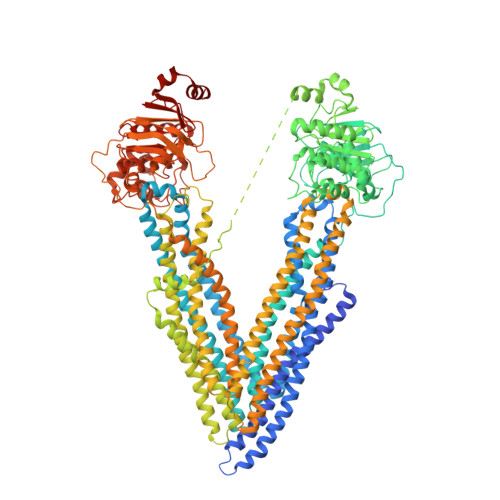
4KSB | pdb_00004ksb

Structures of P-glycoprotein reveal its conformational flexibility and an epitope on the nucleotide-binding domain


Experimental Data Snapshot

  • Method: X-RAY DIFFRACTION
  • Resolution: 3.80 Å
  • R-Value Free: 
    0.357 (Depositor), 0.360 (DCC) 
  • R-Value Work: 
    0.323 (Depositor), 0.326 (DCC) 
  • R-Value Observed: 
    0.325 (Depositor) 

wwPDB Validation 3D Report Full Report

Validation slider image for 4KSB

This is version 1.5 of the entry. See complete history

Literature

Structures of P-glycoprotein reveal its conformational flexibility and an epitope on the nucleotide-binding domain.

Ward, A.B.Szewczyk, P.Grimard, V.Lee, C.W.Martinez, L.Doshi, R.Caya, A.Villaluz, M.Pardon, E.Cregger, C.Swartz, D.J.Falson, P.G.Urbatsch, I.L.Govaerts, C.Steyaert, J.Chang, G.

(2013) Proc Natl Acad Sci U S A 110: 13386-13391

  • DOI: https://doi.org/10.1073/pnas.1309275110
  • Primary Citation Related Structures: 
    4KSB, 4KSC, 4KSD

  • PubMed Abstract: 

    P-glycoprotein (P-gp) is one of the best-known mediators of drug efflux-based multidrug resistance in many cancers. This validated therapeutic target is a prototypic, plasma membrane resident ATP-Binding Cassette transporter that pumps xenobiotic compounds out of cells. The large, polyspecific drug-binding pocket of P-gp recognizes a variety of structurally unrelated compounds. The transport of these drugs across the membrane is coincident with changes in the size and shape of this pocket during the course of the transport cycle. Here, we present the crystal structures of three inward-facing conformations of mouse P-gp derived from two different crystal forms. One structure has a nanobody bound to the C-terminal side of the first nucleotide-binding domain. This nanobody strongly inhibits the ATP hydrolysis activity of mouse P-gp by hindering the formation of a dimeric complex between the ATP-binding domains, which is essential for nucleotide hydrolysis. Together, these inward-facing conformational snapshots of P-gp demonstrate a range of flexibility exhibited by this transporter, which is likely an essential feature for the binding and transport of large, diverse substrates. The nanobody-bound structure also reveals a unique epitope on P-gp.


  • Organizational Affiliation
    • Department of Integrative Structural and Computational Biology, The Scripps Research Institute, La Jolla, CA 92037, USA.

Macromolecule Content 

  • Total Structure Weight: 141.88 kDa 
  • Atom Count: 9,171 
  • Modeled Residue Count: 1,182 
  • Deposited Residue Count: 1,284 
  • Unique protein chains: 1

Macromolecules

Find similar proteins by:|  3D Structure
Entity ID: 1
MoleculeChains  Sequence LengthOrganismDetailsImage
Multidrug resistance protein 1A1,284Mus musculusMutation(s): 0 
Gene Names: Abcb1aAbcb4Mdr1aMdr3Pgy-3Pgy3
EC: 3.6.3.44 (PDB Primary Data), 7.6.2.1 (UniProt), 7.6.2.2 (UniProt)
Membrane Entity: Yes 
UniProt
Find proteins for P21447 (Mus musculus)
Explore P21447 
Go to UniProtKB:  P21447
Entity Groups
Sequence Clusters30% Identity50% Identity70% Identity90% Identity95% Identity100% Identity
UniProt GroupP21447
Sequence Annotations
Expand
Reference Sequence

Experimental Data & Validation

Experimental Data

  • Method: X-RAY DIFFRACTION
  • Resolution: 3.80 Å
  • R-Value Free:  0.357 (Depositor), 0.360 (DCC) 
  • R-Value Work:  0.323 (Depositor), 0.326 (DCC) 
  • R-Value Observed: 0.325 (Depositor) 
Space Group: P 21 21 21
Unit Cell:
Length ( Å )Angle ( ˚ )
a = 87.4α = 90
b = 138.65β = 90
c = 185.13γ = 90
Software Package:
Software NamePurpose
PHENIXrefinement
CNSrefinement
Blu-Icedata collection
MOSFLMdata reduction
SCALAdata scaling
CNSphasing

Structure Validation

View Full Validation Report


Entry History 

Revision History  (Full details and data files)

  • Version 1.0: 2013-07-31
    Type: Initial release
  • Version 1.1: 2013-08-21
    Changes: Database references
  • Version 1.2: 2013-08-28
    Changes: Database references
  • Version 1.3: 2015-09-09
    Changes: Structure summary
  • Version 1.4: 2019-07-17
    Changes: Data collection, Refinement description
  • Version 1.5: 2024-02-28
    Changes: Data collection, Database references