4KDO | pdb_00004kdo

Crystal structure of the hemagglutinin of ferret-transmissible H5N1 virus in complex with human receptor analog LSTc


Experimental Data Snapshot

  • Method: X-RAY DIFFRACTION
  • Resolution: 2.40 Å
  • R-Value Free: 
    0.269 (Depositor), 0.260 (DCC) 
  • R-Value Work: 
    0.237 (Depositor), 0.229 (DCC) 
  • R-Value Observed: 
    0.239 (Depositor) 

wwPDB Validation 3D Report Full Report

Validation slider image for 4KDO

Ligand Structure Quality Assessment 


This is version 2.1 of the entry. See complete history

Literature

Structure and receptor-binding properties of an airborne transmissible avian influenza A virus hemagglutinin H5 (VN1203mut).

Lu, X.Shi, Y.Zhang, W.Zhang, Y.Qi, J.Gao, G.F.

(2013) Protein Cell 4: 502-511

  • DOI: https://doi.org/10.1007/s13238-013-3906-z
  • Primary Citation Related Structures: 
    4KDM, 4KDN, 4KDO, 4KDQ

  • PubMed Abstract: 

    Avian influenza A virus continues to pose a global threat with occasional H5N1 human infections, which is emphasized by a recent severe human infection caused by avian-origin H7N9 in China. Luckily these viruses do not transmit efficiently in human populations. With a few amino acid substitutions of the hemagglutinin H5 protein in the laboratory, two H5 mutants have been shown to obtain an air-borne transmission in a mammalian ferret model. Here in this study one of the mutant H5 proteins developed by Kawaoka's group (VN1203mut) was expressed in a baculovirus system and its receptor-binding properties were assessed. We herein show that the VN1203mut had a dramatically reduced binding affinity for the avian α2,3-linkage receptor compared to wild type but showed no detectable increase in affinity for the human α2,6-linkage receptor, using Surface Plasmon Resonance techonology. Further, the crystal structures of the VN1203mut and its complexes with either human or avian receptors demonstrate that the VN1203mut binds the human receptor in the same binding manner (cis conformation) as seen for the HAs of previously reported 1957 and 1968 pandemic influenza viruses. Our receptor binding and crystallographic data shown here further confirm that the ability to bind the avian receptor has to decrease for a higher human receptor binding affinity. As the Q226L substitution is shown important for obtaining human receptor binding, we suspect that the newly emerged H7N9 binds human receptor as H7 has a Q226L substitution.


  • Organizational Affiliation
    • College of Veterinary Medicine, China Agricultural University, Beijing 100193, China.

Macromolecule Content 

  • Total Structure Weight: 172.33 kDa 
  • Atom Count: 12,373 
  • Modeled Residue Count: 1,491 
  • Deposited Residue Count: 1,491 
  • Unique protein chains: 2

Macromolecules

Find similar proteins by:|  3D Structure
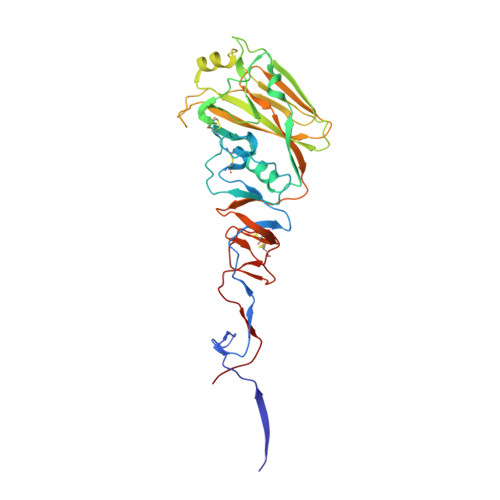
Entity ID: 1
MoleculeChains  Sequence LengthOrganismDetailsImage
HemagglutininA,
B [auth C],
C [auth E]
322Influenza A virus (A/Viet Nam/1203/2004(H5N1))Mutation(s): 4 
Gene Names: HA
UniProt
Find proteins for Q6DQ33 (Influenza A virus (strain A/Vietnam/1203/2004 H5N1))
Explore Q6DQ33 
Go to UniProtKB:  Q6DQ33
Entity Groups
Sequence Clusters30% Identity50% Identity70% Identity90% Identity95% Identity100% Identity
UniProt GroupQ6DQ33
Glycosylation
Glycosylation Sites: 1
Sequence Annotations
Expand
Reference Sequence
Find similar proteins by:|  3D Structure
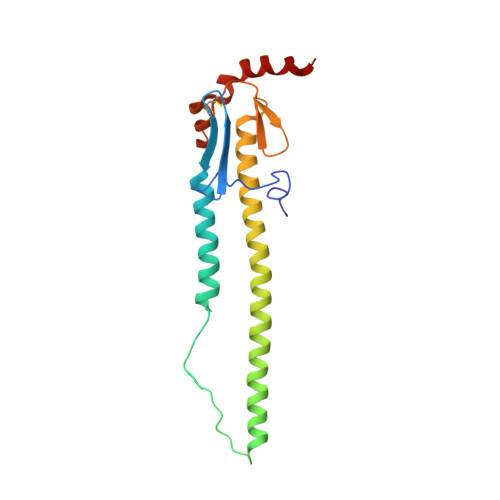
Entity ID: 2
MoleculeChains  Sequence LengthOrganismDetailsImage
HemagglutininD [auth B],
E [auth D],
F
175Influenza A virus (A/Viet Nam/1203/2004(H5N1))Mutation(s): 0 
Gene Names: HA
UniProt
Find proteins for Q6DQ33 (Influenza A virus (strain A/Vietnam/1203/2004 H5N1))
Explore Q6DQ33 
Go to UniProtKB:  Q6DQ33
Entity Groups
Sequence Clusters30% Identity50% Identity70% Identity90% Identity95% Identity100% Identity
UniProt GroupQ6DQ33
Sequence Annotations
Expand
Reference Sequence

Oligosaccharides

Help  
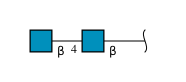
Entity ID: 3
MoleculeChains Length2D Diagram GlycosylationD Interactions
2-acetamido-2-deoxy-beta-D-glucopyranose-(1-4)-2-acetamido-2-deoxy-beta-D-glucopyranose
G, H, J
2N-Glycosylation
Glycosylation Resources
GlyTouCan: G42666HT
GlyCosmos: G42666HT
GlyGen: G42666HT
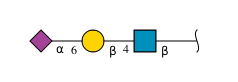
Entity ID: 4
MoleculeChains Length2D Diagram GlycosylationD Interactions
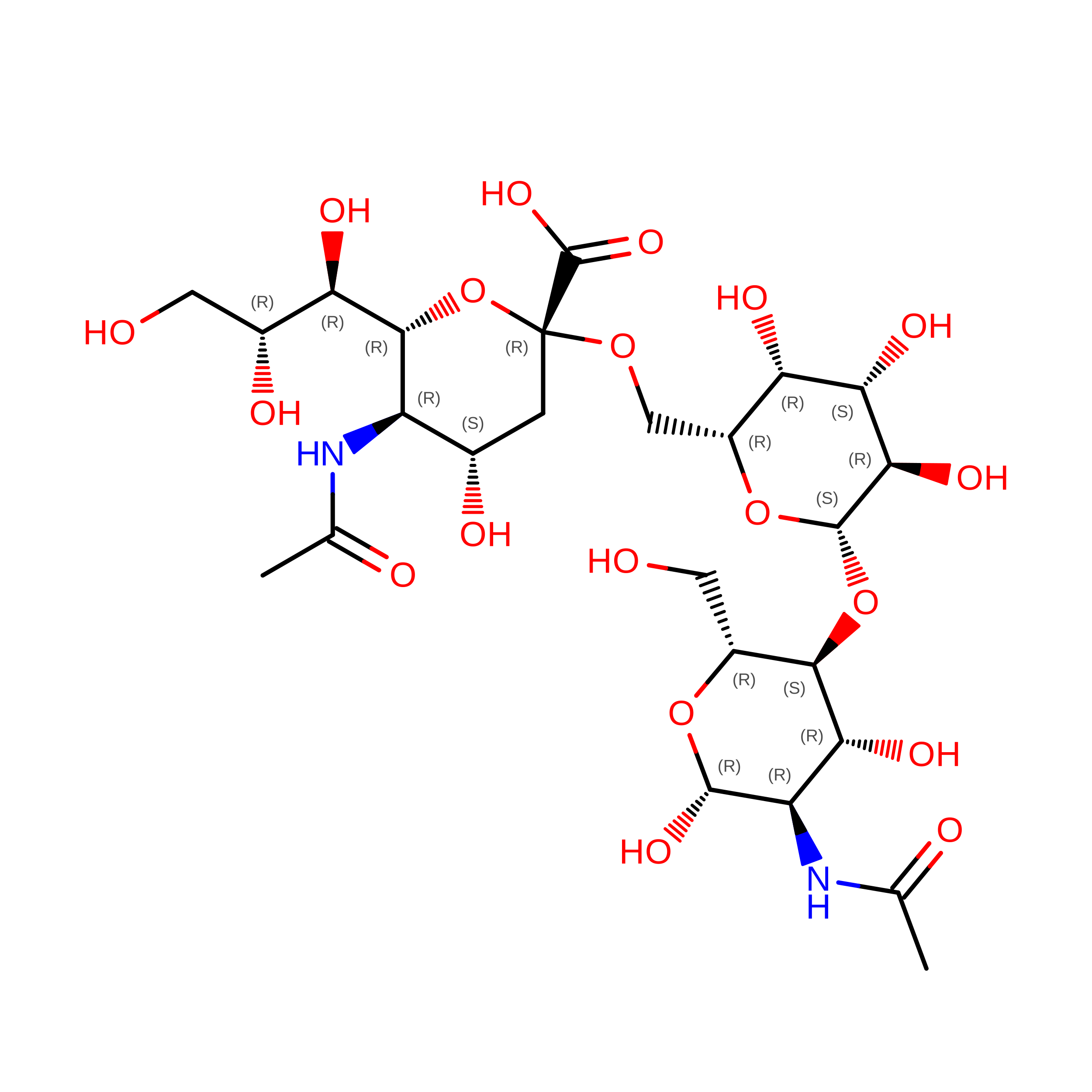
N-acetyl-alpha-neuraminic acid-(2-6)-beta-D-galactopyranose-(1-4)-2-acetamido-2-deoxy-beta-D-glucopyranose
I
3N/A
Glycosylation Resources
GlyTouCan: G73578JC
GlyCosmos: G73578JC
GlyGen: G73578JC

Small Molecules

Ligands 2 Unique
IDChains Name / Formula / InChI Key2D Diagram3D Interactions
SIA

Query on SIA


Download:Ideal Coordinates CCD File
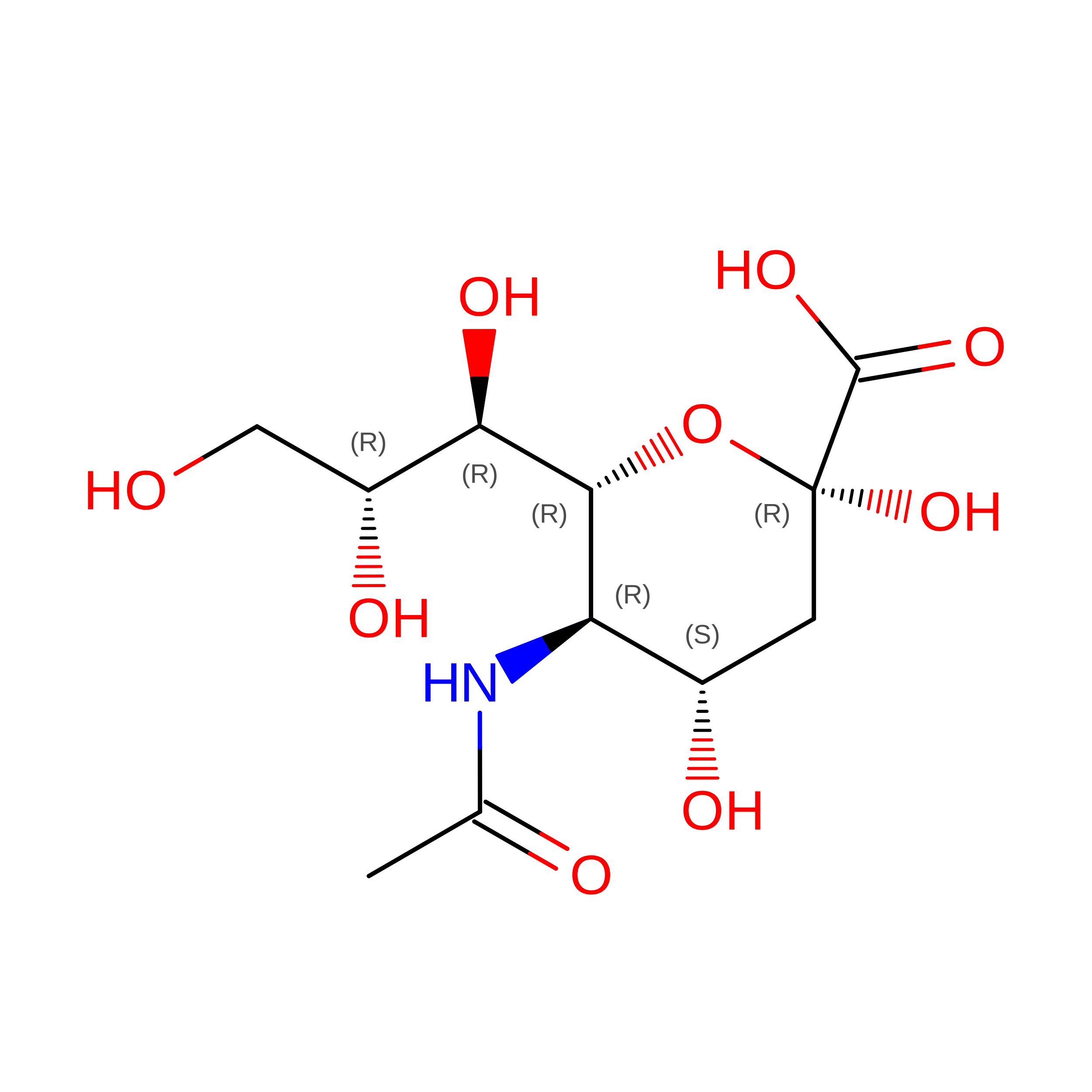
K [auth A]N-acetyl-alpha-neuraminic acid
C11 H19 N O9
SQVRNKJHWKZAKO-YRMXFSIDSA-N
NAG

Query on NAG


Download:Ideal Coordinates CCD File
L [auth C]2-acetamido-2-deoxy-beta-D-glucopyranose
C8 H15 N O6
OVRNDRQMDRJTHS-FMDGEEDCSA-N

Biologically Interesting Molecules (External Reference) 

1 Unique

Experimental Data & Validation

Experimental Data

  • Method: X-RAY DIFFRACTION
  • Resolution: 2.40 Å
  • R-Value Free:  0.269 (Depositor), 0.260 (DCC) 
  • R-Value Work:  0.237 (Depositor), 0.229 (DCC) 
  • R-Value Observed: 0.239 (Depositor) 
Space Group: P 1 21 1
Unit Cell:
Length ( Å )Angle ( ˚ )
a = 67.257α = 90
b = 245.913β = 112.96
c = 69.569γ = 90
Software Package:
Software NamePurpose
ADSCdata collection
PHASERphasing
PHENIXrefinement
HKL-2000data reduction
HKL-2000data scaling

Structure Validation

View Full Validation Report


Ligand Structure Quality Assessment 


Entry History 

Deposition Data

Revision History  (Full details and data files)

  • Version 1.0: 2013-07-24
    Type: Initial release
  • Version 1.1: 2013-09-04
    Changes: Database references
  • Version 1.2: 2014-10-29
    Changes: Structure summary
  • Version 2.0: 2020-07-29
    Type: Remediation
    Reason: Carbohydrate remediation
    Changes: Advisory, Atomic model, Data collection, Database references, Derived calculations, Structure summary
  • Version 2.1: 2024-10-09
    Changes: Data collection, Database references, Structure summary