Download Mendeley
A structural role for the PHP domain in E. coli DNA polymerase III.
Barros, T., Guenther, J., Kelch, B., Anaya, J., Prabhakar, A., O Donnell, M., Kuriyan, J., Lamers, M.H.(2013) BMC Struct Biol 13: 8-8
- PubMed: 23672456 Search on PubMedSearch on PubMed Central
- DOI: https://doi.org/10.1186/1472-6807-13-8
- Primary Citation Related Structures:
4JOM - PubMed Abstract:
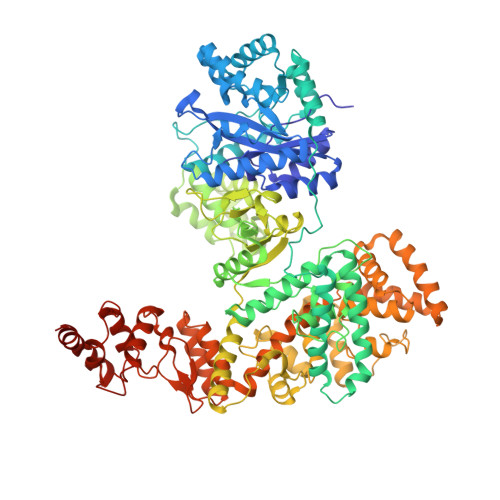
In addition to the core catalytic machinery, bacterial replicative DNA polymerases contain a Polymerase and Histidinol Phosphatase (PHP) domain whose function is not entirely understood. The PHP domains of some bacterial replicases are active metal-dependent nucleases that may play a role in proofreading. In E. coli DNA polymerase III, however, the PHP domain has lost several metal-coordinating residues and is likely to be catalytically inactive. Genomic searches show that the loss of metal-coordinating residues in polymerase PHP domains is likely to have coevolved with the presence of a separate proofreading exonuclease that works with the polymerase. Although the E. coli Pol III PHP domain has lost metal-coordinating residues, the structure of the domain has been conserved to a remarkable degree when compared to that of metal-binding PHP domains. This is demonstrated by our ability to restore metal binding with only three point mutations, as confirmed by the metal-bound crystal structure of this mutant determined at 2.9 Å resolution. We also show that Pol III, a large multi-domain protein, unfolds cooperatively and that mutations in the degenerate metal-binding site of the PHP domain decrease the overall stability of Pol III and reduce its activity. While the presence of a PHP domain in replicative bacterial polymerases is strictly conserved, its ability to coordinate metals and to perform proofreading exonuclease activity is not, suggesting additional non-enzymatic roles for the domain. Our results show that the PHP domain is a major structural element in Pol III and its integrity modulates both the stability and activity of the polymerase.
- Howard Hughes Medical Institute, Department of Molecular and Cell Biology, University of California, Berkeley, CA 94720, USA.
Organizational Affiliation: