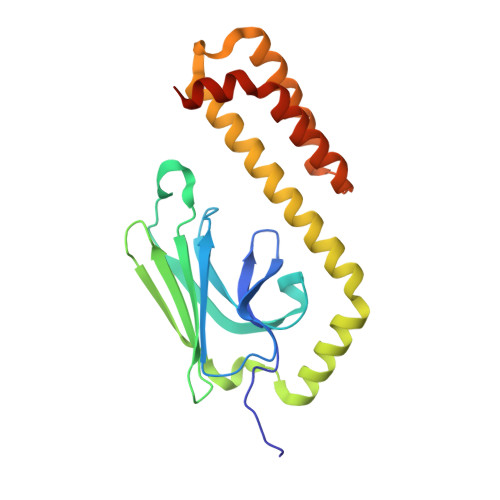
4JNF | pdb_00004jnf

Allosteric opening of the polypeptide-binding site when an Hsp70 binds ATP


Experimental Data Snapshot

  • Method: X-RAY DIFFRACTION
  • Resolution: 1.62 Å
  • R-Value Free: 
    0.216 (Depositor), 0.211 (DCC) 
  • R-Value Work: 
    0.191 (Depositor), 0.184 (DCC) 
  • R-Value Observed: 
    0.192 (Depositor) 

Starting Model: experimental
View more details

wwPDB Validation 3D Report Full Report

Validation slider image for 4JNF

This is version 1.4 of the entry. See complete history

Literature

Allosteric opening of the polypeptide-binding site when an Hsp70 binds ATP.

Qi, R.Sarbeng, E.B.Liu, Q.Le, K.Q.Xu, X.Xu, H.Yang, J.Wong, J.L.Vorvis, C.Hendrickson, W.A.Zhou, L.Liu, Q.

(2013) Nat Struct Mol Biol 20: 900-907

  • DOI: https://doi.org/10.1038/nsmb.2583
  • Primary Citation Related Structures: 
    4JN4, 4JNE, 4JNF

  • PubMed Abstract: 

    The 70-kilodalton (kDa) heat-shock proteins (Hsp70s) are ubiquitous molecular chaperones essential for cellular protein folding and proteostasis. Each Hsp70 has two functional domains: a nucleotide-binding domain (NBD), which binds and hydrolyzes ATP, and a substrate-binding domain (SBD), which binds extended polypeptides. NBD and SBD interact little when in the presence of ADP; however, ATP binding allosterically couples the polypeptide- and ATP-binding sites. ATP binding promotes polypeptide release; polypeptide rebinding stimulates ATP hydrolysis. This allosteric coupling is poorly understood. Here we present the crystal structure of an intact ATP-bound Hsp70 from Escherichia coli at 1.96-Å resolution. The ATP-bound NBD adopts a unique conformation, forming extensive interfaces with an SBD that has changed radically, having its α-helical lid displaced and the polypeptide-binding channel of its β-subdomain restructured. These conformational changes, together with our biochemical assays, provide a structural explanation for allosteric coupling in Hsp70 activity.


  • Organizational Affiliation
    • Department of Physiology and Biophysics, Virginia Commonwealth University, Richmond, Virginia, USA.

Macromolecule Content 

  • Total Structure Weight: 24 kDa 
  • Atom Count: 1,928 
  • Modeled Residue Count: 213 
  • Deposited Residue Count: 221 
  • Unique protein chains: 1

Macromolecules

Find similar proteins by:|  3D Structure
Entity ID: 1
MoleculeChains  Sequence LengthOrganismDetailsImage
Hsp70 CHAPERONE DnaK221Escherichia coli K-12Mutation(s): 3 
UniProt
Find proteins for P0A6Y8 (Escherichia coli (strain K12))
Explore P0A6Y8 
Go to UniProtKB:  P0A6Y8
Entity Groups
Sequence Clusters30% Identity50% Identity70% Identity90% Identity95% Identity100% Identity
UniProt GroupP0A6Y8
Sequence Annotations
Expand
Reference Sequence

Experimental Data & Validation

Experimental Data

  • Method: X-RAY DIFFRACTION
  • Resolution: 1.62 Å
  • R-Value Free:  0.216 (Depositor), 0.211 (DCC) 
  • R-Value Work:  0.191 (Depositor), 0.184 (DCC) 
  • R-Value Observed: 0.192 (Depositor) 
Space Group: P 31 2 1
Unit Cell:
Length ( Å )Angle ( ˚ )
a = 66.98α = 90
b = 66.98β = 90
c = 128.759γ = 120
Software Package:
Software NamePurpose
MAR345data collection
MOLREPphasing
PHENIXrefinement
HKL-2000data reduction
HKL-2000data scaling

Structure Validation

View Full Validation Report


Entry History 

Deposition Data

Revision History  (Full details and data files)

  • Version 1.0: 2013-05-29
    Type: Initial release
  • Version 1.1: 2013-07-10
    Changes: Database references
  • Version 1.2: 2013-08-07
    Changes: Database references
  • Version 1.3: 2017-11-15
    Changes: Refinement description
  • Version 1.4: 2023-09-20
    Changes: Data collection, Database references, Refinement description