4JMG | pdb_00004jmg

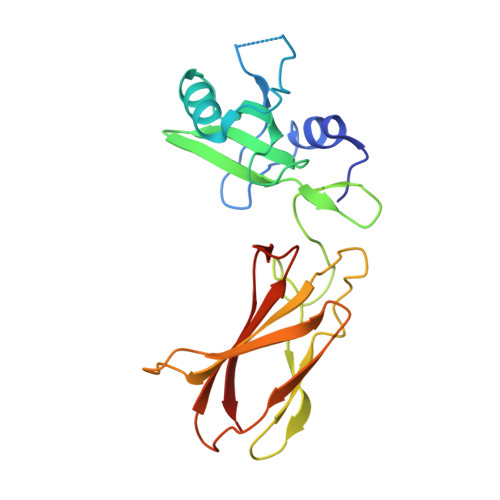
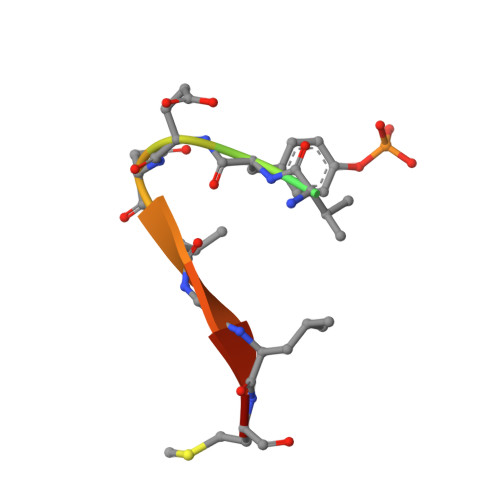
Crystal structure of the synthetic protein in complex with pY peptide


Experimental Data Snapshot

  • Method: X-RAY DIFFRACTION
  • Resolution: 1.40 Å
  • R-Value Free: 
    0.206 (Depositor), 0.209 (DCC) 
  • R-Value Work: 
    0.174 (Depositor), 0.176 (DCC) 
  • R-Value Observed: 
    0.176 (Depositor) 

wwPDB Validation 3D Report Full Report

Validation slider image for 4JMG

This is version 1.3 of the entry. See complete history

Literature

Directed network wiring identifies a key protein interaction in embryonic stem cell differentiation.

Yasui, N.Findlay, G.M.Gish, G.D.Hsiung, M.S.Huang, J.Tucholska, M.Taylor, L.Smith, L.Boldridge, W.C.Koide, A.Pawson, T.Koide, S.

(2014) Mol Cell 54: 1034-1041

  • DOI: https://doi.org/10.1016/j.molcel.2014.05.002
  • Primary Citation Related Structures: 
    4JMG, 4JMH

  • PubMed Abstract: 

    Cell signaling depends on dynamic protein-protein interaction (PPI) networks, often assembled through modular domains each interacting with multiple peptide motifs. This complexity raises a conceptual challenge, namely to define whether a particular cellular response requires assembly of the complete PPI network of interest or can be driven by a specific interaction. To address this issue, we designed variants of the Grb2 SH2 domain ("pY-clamps") whose specificity is highly biased toward a single phosphotyrosine (pY) motif among many potential pYXNX Grb2-binding sites. Surprisingly, directing Grb2 predominantly to a single pY site of the Ptpn11/Shp2 phosphatase, but not other sites tested, was sufficient for differentiation of the essential primitive endoderm lineage from embryonic stem cells. Our data suggest that discrete connections within complex PPI networks can underpin regulation of particular biological events. We propose that this directed wiring approach will be of general utility in functionally annotating specific PPIs.


  • Organizational Affiliation
    • Department of Biochemistry and Molecular Biology, The University of Chicago, Chicago, IL 60637, USA.

Macromolecule Content 

  • Total Structure Weight: 23.77 kDa 
  • Atom Count: 1,776 
  • Modeled Residue Count: 205 
  • Deposited Residue Count: 216 
  • Unique protein chains: 2

Macromolecules

Find similar proteins by:|  3D Structure
Entity ID: 1
MoleculeChains  Sequence LengthOrganismDetailsImage
Clamp Ptpn11_pY580203synthetic constructMutation(s): 0 
Find similar proteins by:  Sequence   |   3D Structure  
Entity ID: 2
MoleculeChains  Sequence LengthOrganismDetailsImage
Tyrosine-protein phosphatase non-receptor type 1113Homo sapiensMutation(s): 0 
Gene Names: PTPN11PTP2CSHPTP2
EC: 3.1.3.48
UniProt & NIH Common Fund Data Resources
Find proteins for Q06124 (Homo sapiens)
Explore Q06124 
Go to UniProtKB:  Q06124
PHAROS:  Q06124
GTEx:  ENSG00000179295 
Entity Groups
Sequence Clusters30% Identity50% Identity70% Identity90% Identity95% Identity100% Identity
UniProt GroupQ06124
Sequence Annotations
Expand
Reference Sequence

Small Molecules

Ligands 1 Unique
IDChains Name / Formula / InChI Key2D Diagram3D Interactions
MG

Query on MG


Download:Ideal Coordinates CCD File
C [auth A]MAGNESIUM ION
Mg
JLVVSXFLKOJNIY-UHFFFAOYSA-N
Modified Residues  1 Unique
IDChains TypeFormula2D DiagramParent
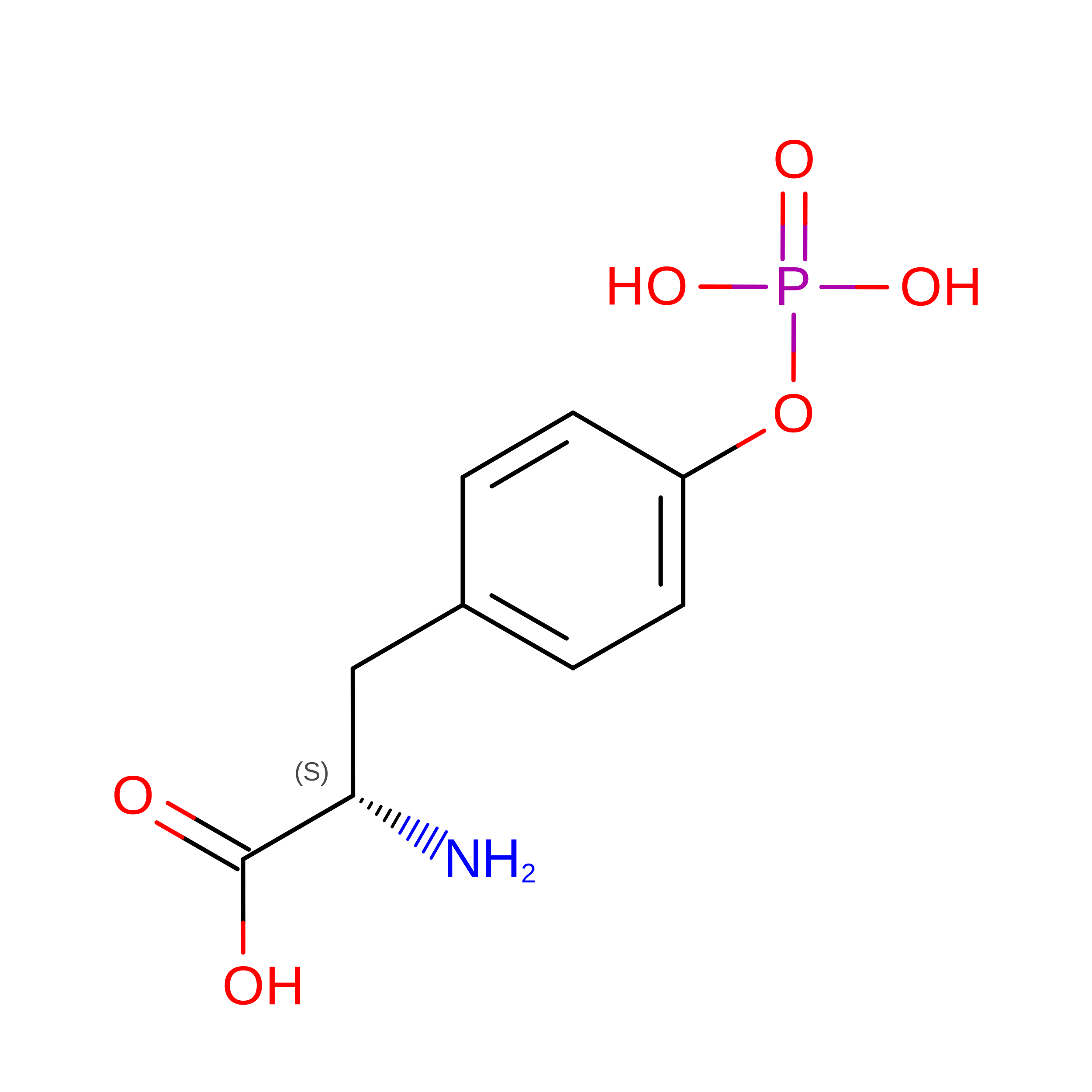
PTR
Query on PTR
B
L-PEPTIDE LINKINGC9 H12 N O6 PTYR

Experimental Data & Validation

Experimental Data

  • Method: X-RAY DIFFRACTION
  • Resolution: 1.40 Å
  • R-Value Free:  0.206 (Depositor), 0.209 (DCC) 
  • R-Value Work:  0.174 (Depositor), 0.176 (DCC) 
  • R-Value Observed: 0.176 (Depositor) 
Space Group: C 1 2 1
Unit Cell:
Length ( Å )Angle ( ˚ )
a = 109.597α = 90
b = 34.402β = 105.22
c = 47.799γ = 90
Software Package:
Software NamePurpose
PHENIXrefinement
MOLREPphasing
HKL-2000data scaling

Structure Validation

View Full Validation Report


Entry History 

Deposition Data

Revision History  (Full details and data files)

  • Version 1.0: 2014-04-23
    Type: Initial release
  • Version 1.1: 2014-07-30
    Changes: Database references
  • Version 1.2: 2014-08-06
    Changes: Data collection
  • Version 1.3: 2024-11-20
    Changes: Data collection, Database references, Derived calculations, Structure summary