4JLR | pdb_00004jlr

Crystal structure of a designed Respiratory Syncytial Virus Immunogen in complex with Motavizumab


Experimental Data Snapshot

  • Method: X-RAY DIFFRACTION
  • Resolution: 2.71 Å
  • R-Value Free: 
    0.249 (Depositor), 0.246 (DCC) 
  • R-Value Work: 
    0.191 (Depositor), 0.192 (DCC) 
  • R-Value Observed: 
    0.194 (Depositor) 

wwPDB Validation 3D Report Full Report

Validation slider image for 4JLR

This is version 1.5 of the entry. See complete history

Literature

Proof of principle for epitope-focused vaccine design.

Correia, B.E.Bates, J.T.Loomis, R.J.Baneyx, G.Carrico, C.Jardine, J.G.Rupert, P.Correnti, C.Kalyuzhniy, O.Vittal, V.Connell, M.J.Stevens, E.Schroeter, A.Chen, M.Macpherson, S.Serra, A.M.Adachi, Y.Holmes, M.A.Li, Y.Klevit, R.E.Graham, B.S.Wyatt, R.T.Baker, D.Strong, R.K.Crowe, J.E.Johnson, P.R.Schief, W.R.

(2014) Nature 507: 201-206

  • DOI: https://doi.org/10.1038/nature12966
  • Primary Citation Related Structures: 
    4JLR, 4L8I, 4N9G

  • PubMed Abstract: 

    Vaccines prevent infectious disease largely by inducing protective neutralizing antibodies against vulnerable epitopes. Several major pathogens have resisted traditional vaccine development, although vulnerable epitopes targeted by neutralizing antibodies have been identified for several such cases. Hence, new vaccine design methods to induce epitope-specific neutralizing antibodies are needed. Here we show, with a neutralization epitope from respiratory syncytial virus, that computational protein design can generate small, thermally and conformationally stable protein scaffolds that accurately mimic the viral epitope structure and induce potent neutralizing antibodies. These scaffolds represent promising leads for the research and development of a human respiratory syncytial virus vaccine needed to protect infants, young children and the elderly. More generally, the results provide proof of principle for epitope-focused and scaffold-based vaccine design, and encourage the evaluation and further development of these strategies for a variety of other vaccine targets, including antigenically highly variable pathogens such as human immunodeficiency virus and influenza.


  • Organizational Affiliation
    • 1] Department of Biochemistry, University of Washington, Seattle, Washington 98195, USA [2] PhD Program in Computational Biology, Instituto Gulbenkian Ciência and Instituto de Tecnologia Química e Biológica, Universidade Nova de Lisboa, Oeiras 2780-157, Portugal [3] Department of Chemical Physiology, The Scripps Research Institute, La Jolla, California 92037, USA.

Macromolecule Content 

  • Total Structure Weight: 123.78 kDa 
  • Atom Count: 7,924 
  • Modeled Residue Count: 1,041 
  • Deposited Residue Count: 1,122 
  • Unique protein chains: 3

Macromolecules

Find similar proteins by:|  3D Structure
Entity ID: 1
MoleculeChains  Sequence LengthOrganismDetailsImage
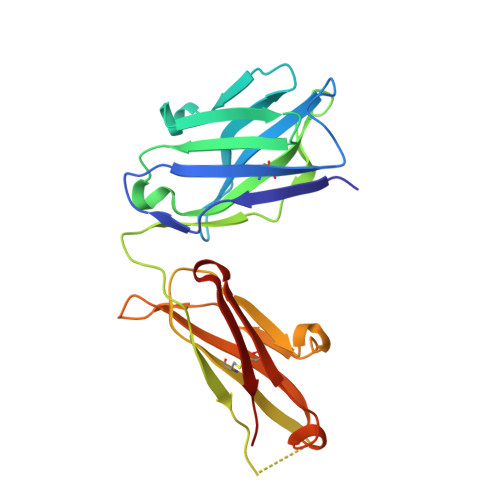
Motavizumab Fab heavy chainA [auth H],
D [auth A]
225Homo sapiensMutation(s): 0 
Find similar proteins by:|  3D Structure
Entity ID: 2
MoleculeChains  Sequence LengthOrganismDetailsImage
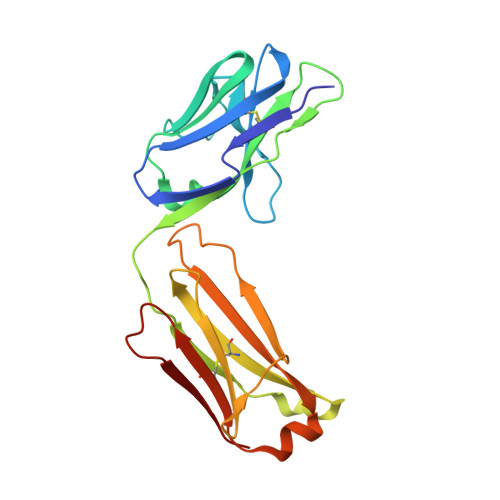
Motavizumab Fab light chainB [auth L],
E [auth B]
213Homo sapiensMutation(s): 0 
Find similar proteins by:|  3D Structure
Entity ID: 3
MoleculeChains  Sequence LengthOrganismDetailsImage
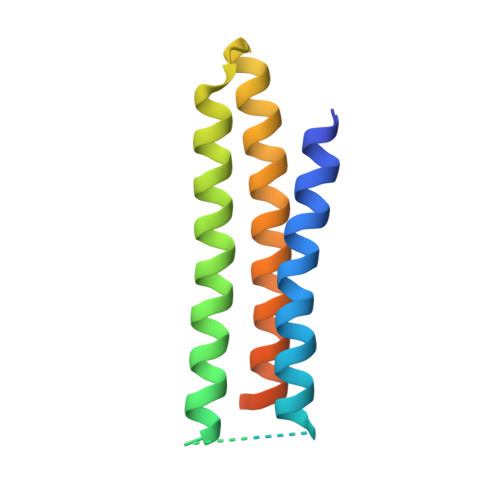
RSV_1Isea designed scaffoldC [auth S],
F [auth C]
123N/AMutation(s): 0 

Small Molecules

Ligands 1 Unique
IDChains Name / Formula / InChI Key2D Diagram3D Interactions
1PE

Query on 1PE


Download:Ideal Coordinates CCD File
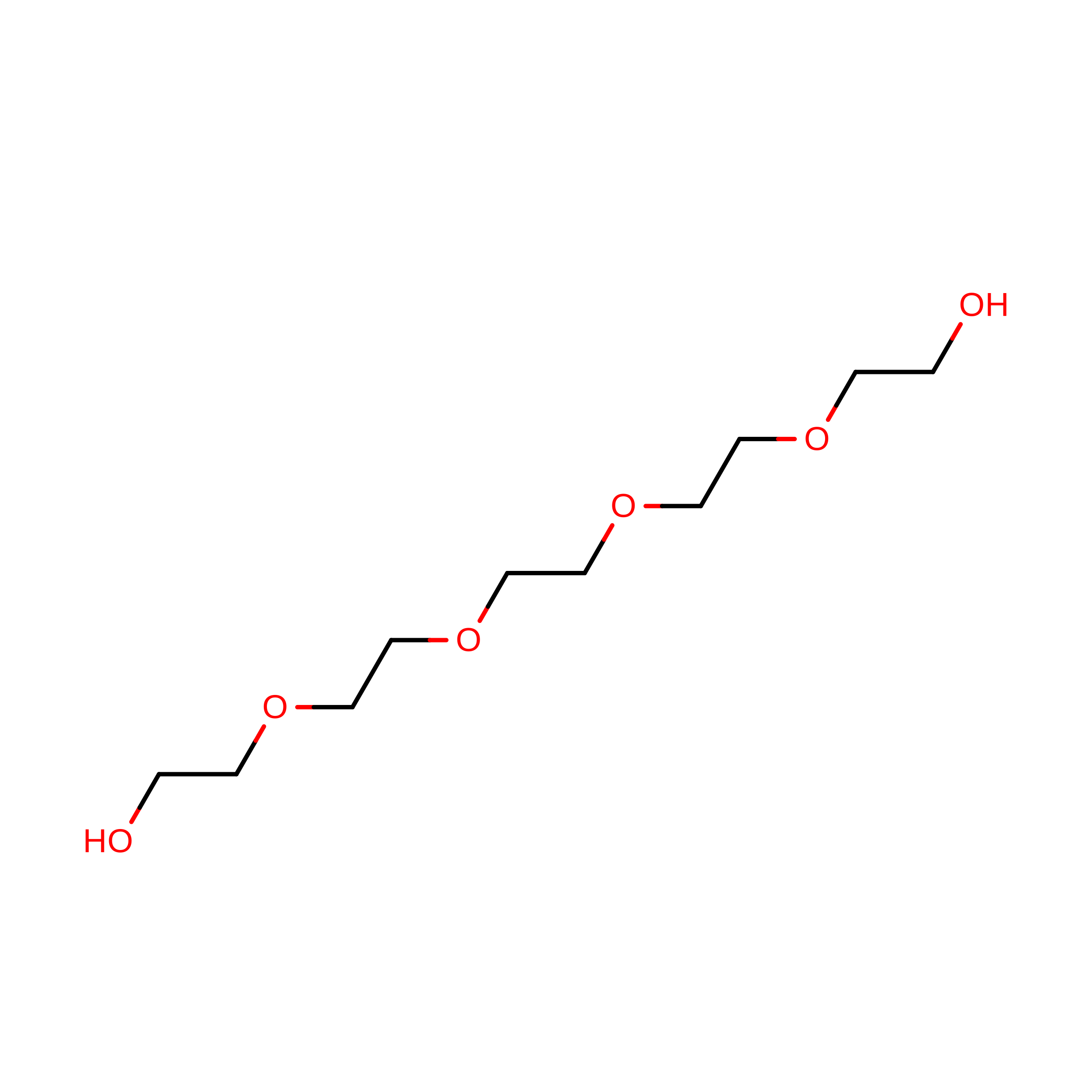
G [auth A]PENTAETHYLENE GLYCOL
C10 H22 O6
JLFNLZLINWHATN-UHFFFAOYSA-N

Experimental Data & Validation

Experimental Data

  • Method: X-RAY DIFFRACTION
  • Resolution: 2.71 Å
  • R-Value Free:  0.249 (Depositor), 0.246 (DCC) 
  • R-Value Work:  0.191 (Depositor), 0.192 (DCC) 
  • R-Value Observed: 0.194 (Depositor) 
Space Group: C 2 2 21
Unit Cell:
Length ( Å )Angle ( ˚ )
a = 149.159α = 90
b = 158.511β = 90
c = 116.049γ = 90
Software Package:
Software NamePurpose
HKL-2000data collection
PHASERphasing
REFMACrefinement
HKL-2000data reduction
SCALEPACKdata scaling

Structure Validation

View Full Validation Report


Entry History 

Deposition Data

Revision History  (Full details and data files)

  • Version 1.0: 2014-02-05
    Type: Initial release
  • Version 1.1: 2014-03-12
    Changes: Database references
  • Version 1.2: 2014-03-26
    Changes: Database references
  • Version 1.3: 2014-04-09
    Changes: Source and taxonomy
  • Version 1.4: 2014-12-17
    Changes: Data collection
  • Version 1.5: 2024-10-30
    Changes: Data collection, Database references, Derived calculations, Structure summary