4JEA | pdb_00004jea

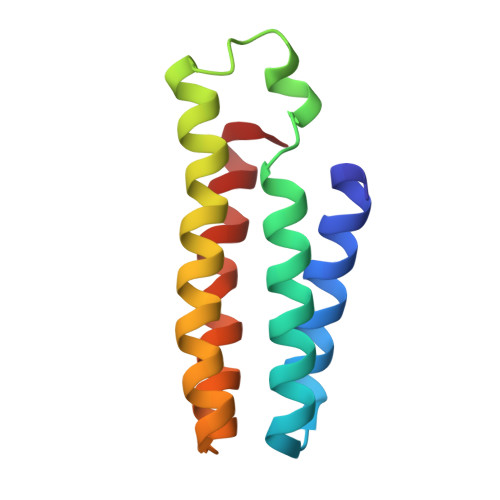
Crystal structure of an engineered Zn-RIDC1 construct with four interfacial disulfide bonds


Experimental Data Snapshot

  • Method: X-RAY DIFFRACTION
  • Resolution: 1.22 Å
  • R-Value Free: 
    0.179 (Depositor), 0.179 (DCC) 
  • R-Value Work: 
    0.131 (Depositor), 0.131 (DCC) 
  • R-Value Observed: 
    0.134 (Depositor) 

Starting Model: experimental
View more details

wwPDB Validation 3D Report Full Report

Validation slider image for 4JEA

Ligand Structure Quality Assessment 


This is version 1.3 of the entry. See complete history

Literature

In Vitro and Cellular Self-Assembly of a Zn-Binding Protein Cryptand via Templated Disulfide Bonds.

Medina-Morales, A.Perez, A.Brodin, J.D.Tezcan, F.A.

(2013) J Am Chem Soc 135: 12013-12022

  • DOI: https://doi.org/10.1021/ja405318d
  • Primary Citation Related Structures: 
    4JE9, 4JEA, 4JEB

  • PubMed Abstract: 

    Simultaneously strong and reversible through redox chemistry, disulfide bonds play a unique and often irreplaceable role in the formation of biological and synthetic assemblies. In an approach inspired by supramolecular chemistry, we report here that engineered noncovalent interactions on the surface of a monomeric protein can template its assembly into a unique cryptand-like protein complex ((C81/C96)RIDC14) by guiding the selective formation of multiple disulfide bonds across different interfaces. Owing to its highly interconnected framework, (C81/C96)RIDC14 is well preorganized for metal coordination in its interior, can support a large internal cavity surrounding the metal sites, and can withstand significant alterations in inner-sphere metal coordination. (C81/C96)RIDC14 self-assembles with high fidelity and yield in the periplasmic space of E. coli cells, where it can successfully compete for Zn(II) binding.


  • Organizational Affiliation
    • Department of Chemistry and Biochemistry, University of California, San Diego, La Jolla, California 92093-0356, USA.

Macromolecule Content 

  • Total Structure Weight: 50.1 kDa 
  • Atom Count: 4,088 
  • Modeled Residue Count: 424 
  • Deposited Residue Count: 424 
  • Unique protein chains: 1

Macromolecules

Find similar proteins by:|  3D Structure
Entity ID: 1
MoleculeChains  Sequence LengthOrganismDetailsImage
soluble cytochrome b562
A, B, C, D
106Escherichia coliMutation(s): 13 
Gene Names: cybC
UniProt
Find proteins for P0ABE7 (Escherichia coli)
Explore P0ABE7 
Go to UniProtKB:  P0ABE7
Entity Groups
Sequence Clusters30% Identity50% Identity70% Identity90% Identity95% Identity100% Identity
UniProt GroupP0ABE7
Sequence Annotations
Expand
Reference Sequence

Small Molecules

Ligands 3 Unique
IDChains Name / Formula / InChI Key2D Diagram3D Interactions
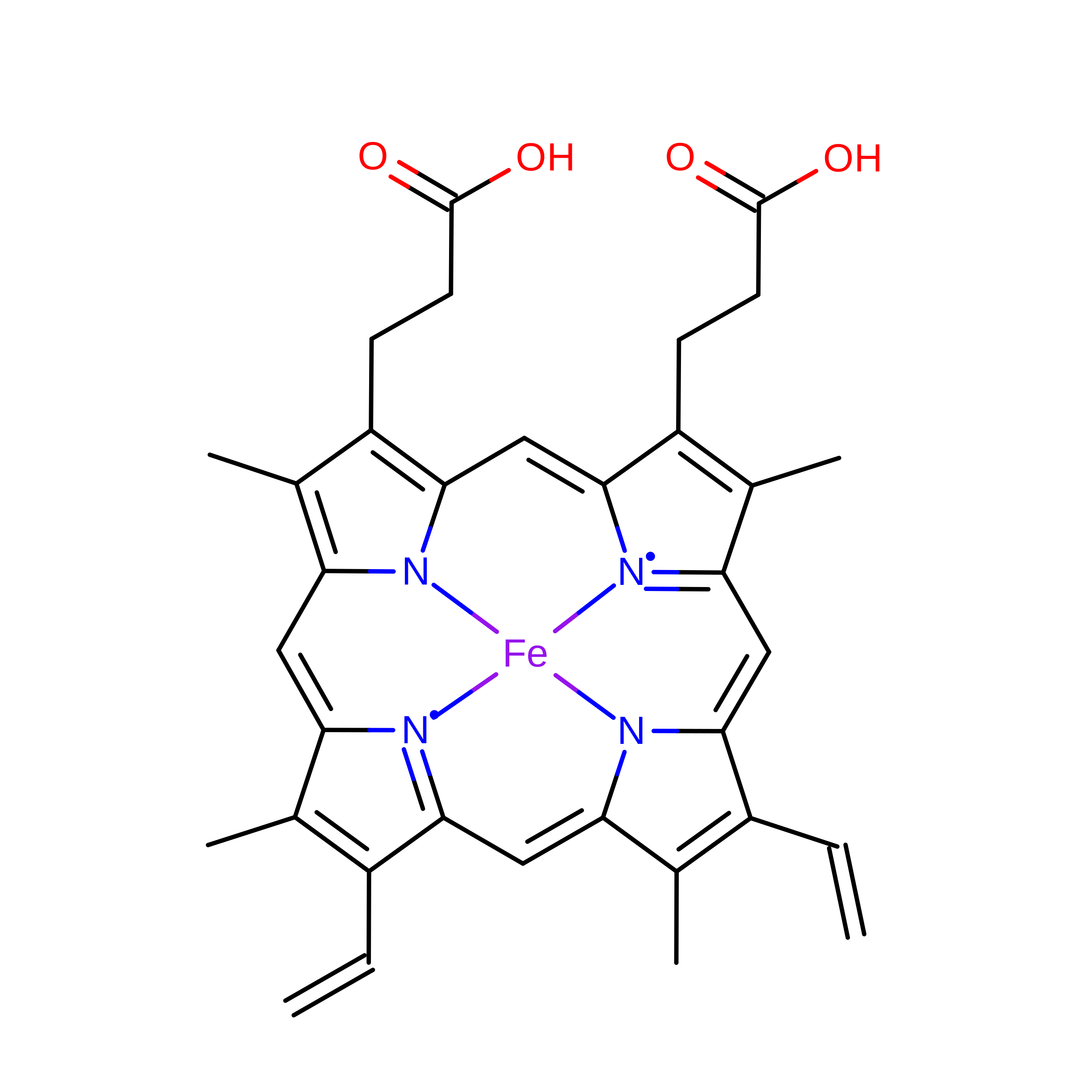
HEM

Query on HEM


Download:Ideal Coordinates CCD File
E [auth A],
H [auth B],
K [auth C],
O [auth D]
PROTOPORPHYRIN IX CONTAINING FE
C34 H32 Fe N4 O4
KABFMIBPWCXCRK-RGGAHWMASA-L
SO4

Query on SO4


Download:Ideal Coordinates CCD File
G [auth A]
J [auth B]
M [auth C]
N [auth C]
Q [auth D]
G [auth A],
J [auth B],
M [auth C],
N [auth C],
Q [auth D],
R [auth D],
S [auth D]
SULFATE ION
O4 S
QAOWNCQODCNURD-UHFFFAOYSA-L
ZN

Query on ZN


Download:Ideal Coordinates CCD File
F [auth A],
I [auth B],
L [auth C],
P [auth D]
ZINC ION
Zn
PTFCDOFLOPIGGS-UHFFFAOYSA-N

Experimental Data & Validation

Experimental Data

  • Method: X-RAY DIFFRACTION
  • Resolution: 1.22 Å
  • R-Value Free:  0.179 (Depositor), 0.179 (DCC) 
  • R-Value Work:  0.131 (Depositor), 0.131 (DCC) 
  • R-Value Observed: 0.134 (Depositor) 
Space Group: P 1 21 1
Unit Cell:
Length ( Å )Angle ( ˚ )
a = 48.85α = 90
b = 64.788β = 98.18
c = 74.177γ = 90
Software Package:
Software NamePurpose
SCALAdata scaling
REFMACrefinement
PDB_EXTRACTdata extraction
MOSFLMdata reduction
PHASERphasing

Structure Validation

View Full Validation Report


Ligand Structure Quality Assessment 


Entry History 

Deposition Data

Revision History  (Full details and data files)

  • Version 1.0: 2013-08-21
    Type: Initial release
  • Version 1.1: 2013-08-28
    Changes: Database references
  • Version 1.2: 2023-09-20
    Changes: Data collection, Database references, Derived calculations, Refinement description
  • Version 1.3: 2024-10-16
    Changes: Structure summary