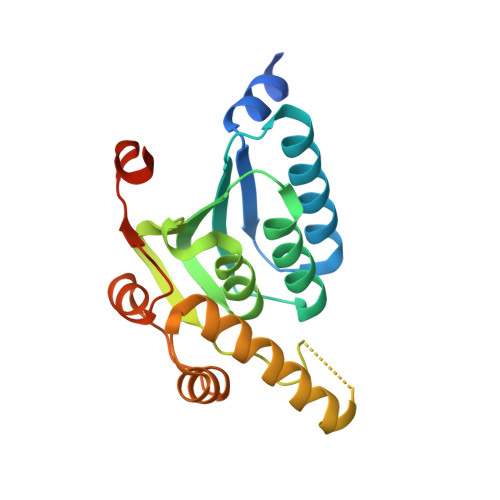
4JCQ | pdb_00004jcq

ClpP1 from Listeria monocytogenes


Experimental Data Snapshot

  • Method: X-RAY DIFFRACTION
  • Resolution: 2.00 Å
  • R-Value Free: 
    0.213 (Depositor), 0.213 (DCC) 
  • R-Value Work: 
    0.192 (Depositor), 0.192 (DCC) 
  • R-Value Observed: 
    0.193 (Depositor) 

Starting Model: experimental
View more details

wwPDB Validation 3D Report Full Report

Validation slider image for 4JCQ

This is version 1.3 of the entry. See complete history

Literature

Structural and functional insights into caseinolytic proteases reveal an unprecedented regulation principle of their catalytic triad.

Zeiler, E.List, A.Alte, F.Gersch, M.Wachtel, R.Poreba, M.Drag, M.Groll, M.Sieber, S.A.

(2013) Proc Natl Acad Sci U S A 110: 11302-11307

  • DOI: https://doi.org/10.1073/pnas.1219125110
  • Primary Citation Related Structures: 
    4JCQ, 4JCR, 4JCT

  • PubMed Abstract: 

    Caseinolytic proteases (ClpPs) are large oligomeric protein complexes that contribute to cell homeostasis as well as virulence regulation in bacteria. Although most organisms possess a single ClpP protein, some organisms encode two or more ClpP isoforms. Here, we elucidated the crystal structures of ClpP1 and ClpP2 from pathogenic Listeria monocytogenes and observe an unprecedented regulation principle by the catalytic triad. Whereas L. monocytogenes (Lm)ClpP2 is both structurally and functionally similar to previously studied tetradecameric ClpP proteins from Escherichia coli and Staphylococcus aureus, heptameric LmClpP1 features an asparagine in its catalytic triad. Mutation of this asparagine to aspartate increased the reactivity of the active site and led to the assembly of a tetradecameric complex. We analyzed the heterooligomeric complex of LmClpP1 and LmClpP2 via coexpression and subsequent labeling studies with natural product-derived probes. Notably, the LmClpP1 peptidase activity is stimulated 75-fold in the complex providing insights into heterooligomerization as a regulatory mechanism. Collectively, our data point toward different preferences for substrates and inhibitors of the two ClpP enzymes and highlight their structural and functional characteristics.


  • Organizational Affiliation
    • Center for Integrated Protein Science Munich (CIPSM), Institute of Advanced Studies, Department Chemie, Lehrstuhl für Organische Chemie II, Technische Universität München, 85747 Garching, Germany.

Macromolecule Content 

  • Total Structure Weight: 635.65 kDa 
  • Atom Count: 40,559 
  • Modeled Residue Count: 4,760 
  • Deposited Residue Count: 5,628 
  • Unique protein chains: 1

Macromolecules

Find similar proteins by:|  3D Structure
Entity ID: 1
MoleculeChains  Sequence LengthOrganismDetailsImage
ATP-dependent Clp protease proteolytic subunit
A,
AA [auth a],
B,
BA [auth b],
C,
D,
E,
F,
G,
H,
I,
J,
K,
L,
M,
N,
O,
P,
Q,
R,
S,
T,
U,
V,
W,
X,
Y,
Z
201Listeria monocytogenes EGD-eMutation(s): 0 
Gene Names: clpPlmo1138
EC: 3.4.21.92
UniProt
Find proteins for Q8Y7Y1 (Listeria monocytogenes serovar 1/2a (strain ATCC BAA-679 / EGD-e))
Explore Q8Y7Y1 
Go to UniProtKB:  Q8Y7Y1
Entity Groups
Sequence Clusters30% Identity50% Identity70% Identity90% Identity95% Identity100% Identity
UniProt GroupQ8Y7Y1
Sequence Annotations
Expand
Reference Sequence

Experimental Data & Validation

Experimental Data

  • Method: X-RAY DIFFRACTION
  • Resolution: 2.00 Å
  • R-Value Free:  0.213 (Depositor), 0.213 (DCC) 
  • R-Value Work:  0.192 (Depositor), 0.192 (DCC) 
  • R-Value Observed: 0.193 (Depositor) 
Space Group: P 1 21 1
Unit Cell:
Length ( Å )Angle ( ˚ )
a = 140.95α = 90
b = 109.06β = 93.16
c = 196.26γ = 90
Software Package:
Software NamePurpose
XDSdata scaling
PHASERphasing
REFMACrefinement
XDSdata reduction
XSCALEdata scaling

Structure Validation

View Full Validation Report


Entry History 

Deposition Data

Revision History  (Full details and data files)

  • Version 1.0: 2013-06-12
    Type: Initial release
  • Version 1.1: 2013-07-17
    Changes: Database references
  • Version 1.2: 2013-07-24
    Changes: Database references
  • Version 1.3: 2023-09-20
    Changes: Data collection, Database references, Refinement description