4IPE | pdb_00004ipe

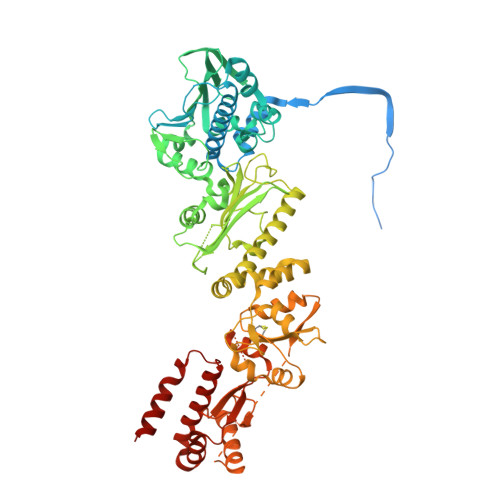
Crystal structure of mitochondrial Hsp90 (TRAP1) with AMPPNP


Experimental Data Snapshot

  • Method: X-RAY DIFFRACTION
  • Resolution: 2.29 Å
  • R-Value Free: 
    0.225 (Depositor), 0.230 (DCC) 
  • R-Value Work: 
    0.180 (Depositor), 0.187 (DCC) 
  • R-Value Observed: 
    0.181 (Depositor) 

wwPDB Validation 3D Report Full Report

Validation slider image for 4IPE

Ligand Structure Quality Assessment 


This is version 1.2 of the entry. See complete history

Literature

Structural asymmetry in the closed state of mitochondrial Hsp90 (TRAP1) supports a two-step ATP hydrolysis mechanism.

Lavery, L.A.Partridge, J.R.Ramelot, T.A.Elnatan, D.Kennedy, M.A.Agard, D.A.

(2014) Mol Cell 53: 330-343

  • DOI: https://doi.org/10.1016/j.molcel.2013.12.023
  • Primary Citation Related Structures: 
    4IPE, 4IVG, 4IYN, 4J0B

  • PubMed Abstract: 

    While structural symmetry is a prevailing feature of homo-oligomeric proteins, asymmetry provides unique mechanistic opportunities. We present the crystal structure of full-length TRAP1, the mitochondrial Hsp90 molecular chaperone, in a catalytically active closed state. The TRAP1 homodimer adopts a distinct, asymmetric conformation, where one protomer is reconfigured via a helix swap at the middle:C-terminal domain (MD:CTD) interface. This interface plays a critical role in client binding. Solution methods validate the asymmetry and show extension to Hsp90 homologs. Point mutations that disrupt unique contacts at each MD:CTD interface reduce catalytic activity and substrate binding and demonstrate that each protomer needs access to both conformations. Crystallographic data on a dimeric NTD:MD fragment suggests that asymmetry arises from strain induced by simultaneous NTD and CTD dimerization. The observed asymmetry provides the potential for an additional step in the ATPase cycle, allowing sequential ATP hydrolysis steps to drive both client remodeling and client release.


  • Organizational Affiliation
    • Howard Hughes Medical Institute and the Department of Biochemistry and Biophysics, University of California, San Francisco, San Francisco, CA 94158, USA.

Macromolecule Content 

  • Total Structure Weight: 165.76 kDa 
  • Atom Count: 9,940 
  • Modeled Residue Count: 1,189 
  • Deposited Residue Count: 1,438 
  • Unique protein chains: 1

Macromolecules

Find similar proteins by:|  3D Structure
Entity ID: 1
MoleculeChains  Sequence LengthOrganismDetailsImage
TNF receptor-associated protein 1
A, B
719Danio rerioMutation(s): 0 
Gene Names: trap1
UniProt
Find proteins for A8WFV1 (Danio rerio)
Explore A8WFV1 
Go to UniProtKB:  A8WFV1
Entity Groups
Sequence Clusters30% Identity50% Identity70% Identity90% Identity95% Identity100% Identity
UniProt GroupA8WFV1
Sequence Annotations
Expand
Reference Sequence

Small Molecules

Ligands 3 Unique
IDChains Name / Formula / InChI Key2D Diagram3D Interactions
ANP

Query on ANP


Download:Ideal Coordinates CCD File
C [auth A],
H [auth B]
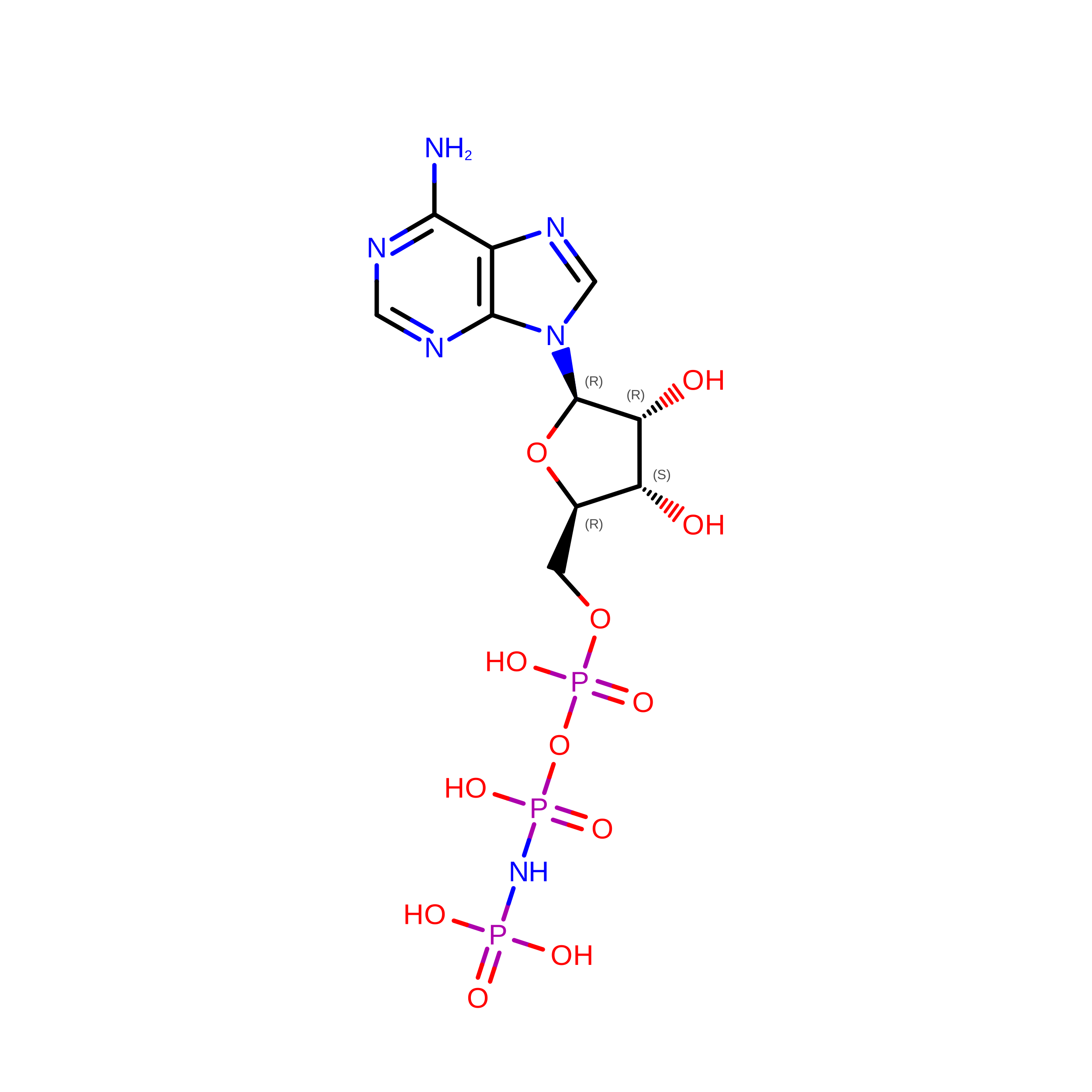
PHOSPHOAMINOPHOSPHONIC ACID-ADENYLATE ESTER
C10 H17 N6 O12 P3
PVKSNHVPLWYQGJ-KQYNXXCUSA-N
CO

Query on CO


Download:Ideal Coordinates CCD File
E [auth A],
F [auth A],
G [auth B],
J [auth B]
COBALT (II) ION
Co
XLJKHNWPARRRJB-UHFFFAOYSA-N
MG

Query on MG


Download:Ideal Coordinates CCD File
D [auth A],
I [auth B]
MAGNESIUM ION
Mg
JLVVSXFLKOJNIY-UHFFFAOYSA-N

Experimental Data & Validation

Experimental Data

  • Method: X-RAY DIFFRACTION
  • Resolution: 2.29 Å
  • R-Value Free:  0.225 (Depositor), 0.230 (DCC) 
  • R-Value Work:  0.180 (Depositor), 0.187 (DCC) 
  • R-Value Observed: 0.181 (Depositor) 
Space Group: C 1 2 1
Unit Cell:
Length ( Å )Angle ( ˚ )
a = 177.977α = 90
b = 96.362β = 134.34
c = 125.153γ = 90
Software Package:
Software NamePurpose
Blu-Icedata collection
PHASERphasing
PHENIXrefinement
HKL-2000data reduction
SCALAdata scaling

Structure Validation

View Full Validation Report


Ligand Structure Quality Assessment 


Entry History 

Deposition Data

Revision History  (Full details and data files)

  • Version 1.0: 2014-01-22
    Type: Initial release
  • Version 1.1: 2014-08-27
    Changes: Database references
  • Version 1.2: 2024-11-27
    Changes: Data collection, Database references, Derived calculations, Structure summary