4IEF | pdb_00004ief

Complex of Porphyromonas gingivalis RgpB pro- and mature domains


Experimental Data Snapshot

  • Method: X-RAY DIFFRACTION
  • Resolution: 2.30 Å
  • R-Value Free: 
    0.225 (Depositor), 0.232 (DCC) 
  • R-Value Work: 
    0.189 (Depositor), 0.192 (DCC) 
  • R-Value Observed: 
    0.191 (Depositor) 

Starting Model: experimental
View more details

wwPDB Validation 3D Report Full Report

Validation slider image for 4IEF

This is version 1.4 of the entry. See complete history

Literature

Porphyromonas gingivalis Virulence Factor Gingipain RgpB Shows a Unique Zymogenic Mechanism for Cysteine Peptidases.

de Diego, I.Veillard, F.T.Guevara, T.Potempa, B.Sztukowska, M.Potempa, J.Gomis-Ruth, F.X.

(2013) J Biological Chem 288: 14287-14296

  • DOI: https://doi.org/10.1074/jbc.M112.444927
  • Primary Citation Related Structures: 
    4IEF

  • PubMed Abstract: 

    Zymogenicity is a regulatory mechanism that prevents inadequate catalytic activity in the wrong context. It plays a central role in maintaining microbial virulence factors in an inactive form inside the pathogen until secretion. Among these virulence factors is the cysteine peptidase gingipain B (RgpB), which is the major virulence factor secreted by the periodontopathogen Porphyromonas gingivalis that attacks host vasculature and defense proteins. The structure of the complex between soluble mature RgpB, consisting of a catalytic domain and an immunoglobulin superfamily domain, and its 205-residue N-terminal prodomain, the largest structurally characterized to date for a cysteine peptidase, reveals a novel fold for the prodomain that is distantly related to sugar-binding lectins. It attaches laterally to the catalytic domain through a large concave surface. The main determinant for latency is a surface "inhibitory loop," which approaches the active-site cleft of the enzyme on its non-primed side in a substrate-like manner. It inserts an arginine (Arg(126)) into the S1 pocket, thus matching the substrate specificity of the enzyme. Downstream of Arg(126), the polypeptide leaves the cleft, thereby preventing cleavage. Moreover, the carbonyl group of Arg(126) establishes a very strong hydrogen bond with the co-catalytic histidine, His(440), pulling it away from the catalytic cysteine, Cys(473), and toward Glu(381), which probably plays a role in orienting the side chain of His(440) during catalysis. The present results provide the structural determinants of zymogenic inhibition of RgpB by way of a novel inhibitory mechanism for peptidases in general and open the field for the design of novel inhibitory strategies in the treatment of human periodontal disease.


  • Organizational Affiliation
    • Proteolysis Laboratory, Molecular Biology Institute of Barcelona, Spanish Research Council (CSIC), Barcelona Science Park, c/Baldiri Reixac, 15-21, 08028 Barcelona, Catalonia, Spain.

Macromolecule Content 

  • Total Structure Weight: 288.87 kDa 
  • Atom Count: 20,046 
  • Modeled Residue Count: 2,466 
  • Deposited Residue Count: 2,596 
  • Unique protein chains: 2

Macromolecules

Find similar proteins by:|  3D Structure
Entity ID: 1
MoleculeChains  Sequence LengthOrganismDetailsImage
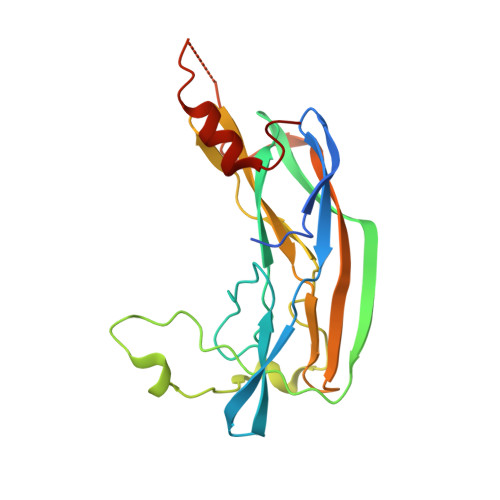
Gingipain R2 Pro-Domain
A, C, E, G
210Porphyromonas gingivalis W83Mutation(s): 0 
Gene Names: PG_0506prtRIIrgp2rgpB
EC: 3.4.22.37
UniProt
Find proteins for P95493 (Porphyromonas gingivalis (strain ATCC BAA-308 / W83))
Explore P95493 
Go to UniProtKB:  P95493
Entity Groups
Sequence Clusters30% Identity50% Identity70% Identity90% Identity95% Identity100% Identity
UniProt GroupP95493
Sequence Annotations
Expand
Reference Sequence
Find similar proteins by:|  3D Structure
Entity ID: 2
MoleculeChains  Sequence LengthOrganismDetailsImage
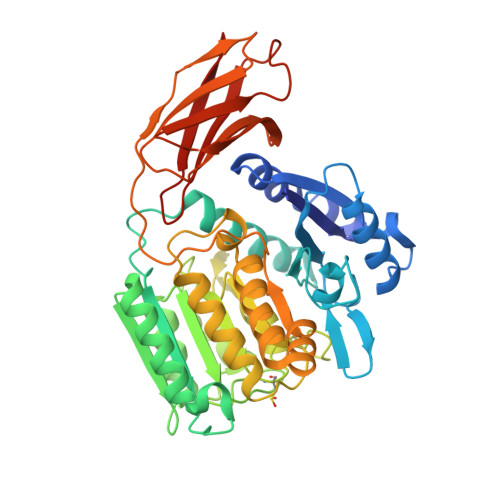
Gingipain R2 Mature Domain
B, D, F, H
439Porphyromonas gingivalis W83Mutation(s): 0 
Gene Names: PG_0506prtRIIrgp2rgpB
EC: 3.4.22.37
UniProt
Find proteins for P95493 (Porphyromonas gingivalis (strain ATCC BAA-308 / W83))
Explore P95493 
Go to UniProtKB:  P95493
Entity Groups
Sequence Clusters30% Identity50% Identity70% Identity90% Identity95% Identity100% Identity
UniProt GroupP95493
Sequence Annotations
Expand
Reference Sequence

Small Molecules

Ligands 7 Unique
IDChains Name / Formula / InChI Key2D Diagram3D Interactions
BA

Query on BA


Download:Ideal Coordinates CCD File
BA [auth H],
J [auth B],
P [auth D],
T [auth F]
BARIUM ION
Ba
XDFCIPNJCBUZJN-UHFFFAOYSA-N
TRS

Query on TRS


Download:Ideal Coordinates CCD File
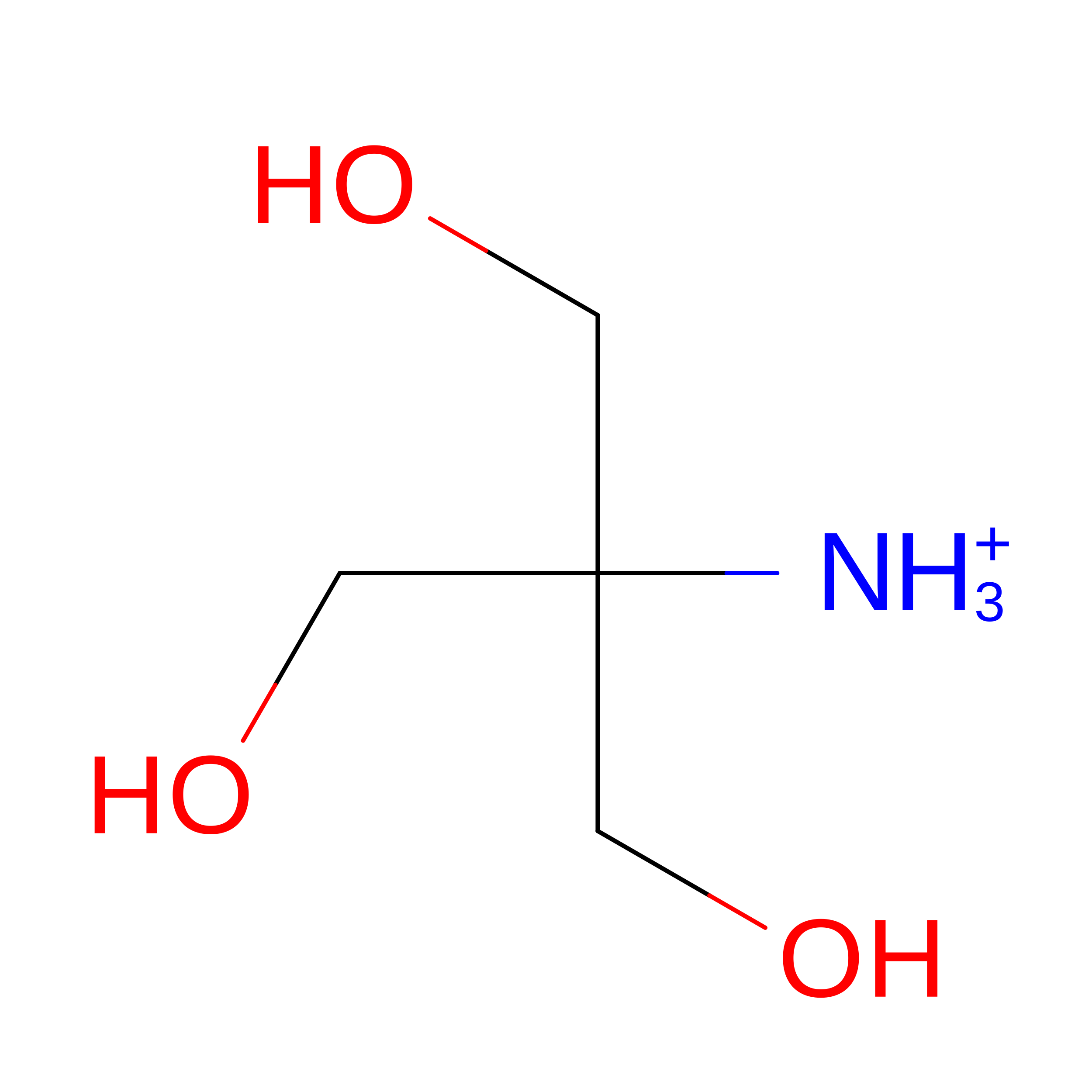
O [auth B]2-AMINO-2-HYDROXYMETHYL-PROPANE-1,3-DIOL
C4 H12 N O3
LENZDBCJOHFCAS-UHFFFAOYSA-O
GOL

Query on GOL


Download:Ideal Coordinates CCD File
GA [auth H]GLYCEROL
C3 H8 O3
PEDCQBHIVMGVHV-UHFFFAOYSA-N
CA

Query on CA


Download:Ideal Coordinates CCD File
CA [auth H]
DA [auth H]
EA [auth H]
K [auth B]
L [auth B]
CA [auth H],
DA [auth H],
EA [auth H],
K [auth B],
L [auth B],
M [auth B],
N [auth B],
Q [auth D],
R [auth D],
S [auth D],
U [auth F],
V [auth F],
W [auth F],
X [auth F]
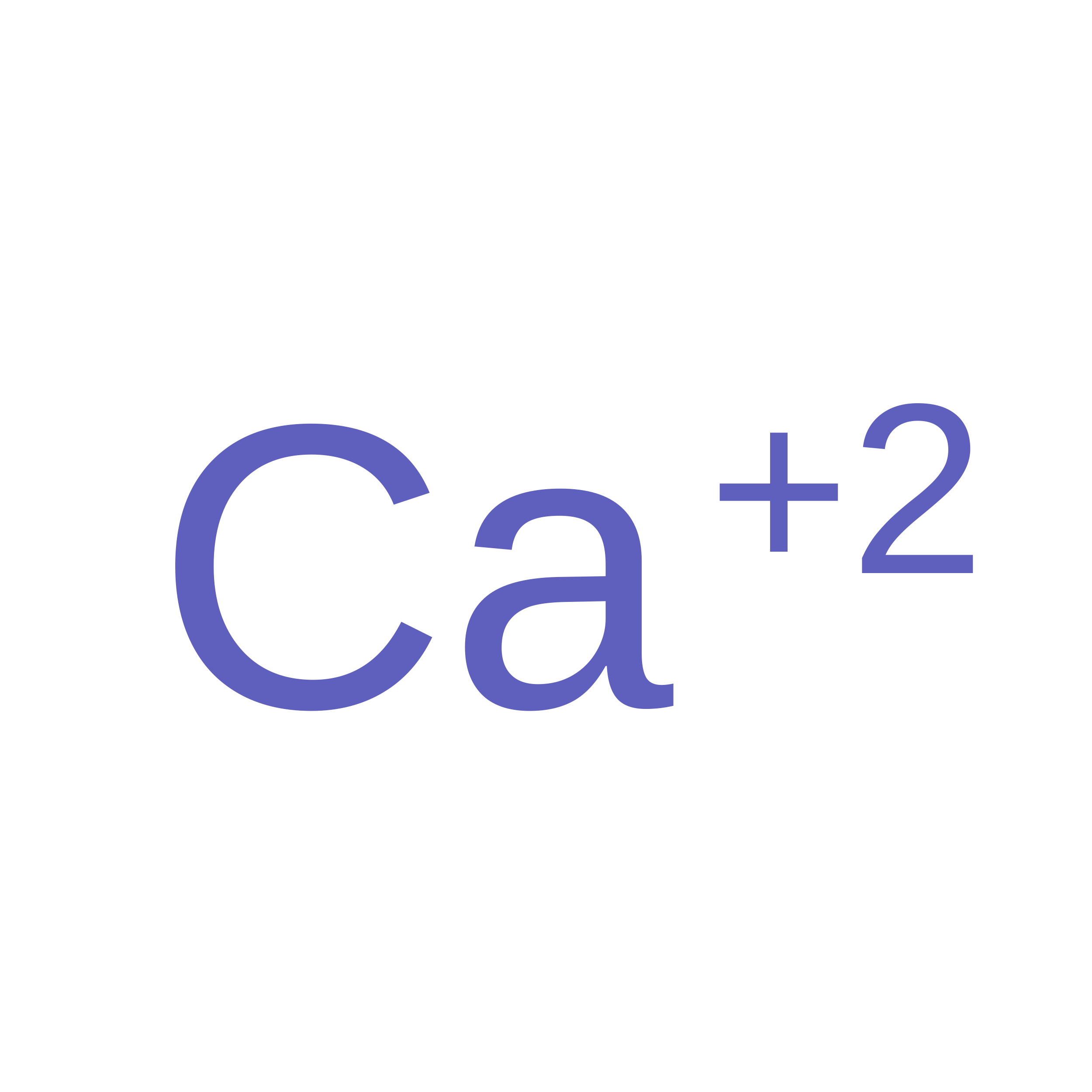
CALCIUM ION
Ca
BHPQYMZQTOCNFJ-UHFFFAOYSA-N
CL

Query on CL


Download:Ideal Coordinates CCD File
I [auth A]CHLORIDE ION
Cl
VEXZGXHMUGYJMC-UHFFFAOYSA-M
MG

Query on MG


Download:Ideal Coordinates CCD File
FA [auth H]MAGNESIUM ION
Mg
JLVVSXFLKOJNIY-UHFFFAOYSA-N
NA

Query on NA


Download:Ideal Coordinates CCD File
AA [auth F],
Y [auth F],
Z [auth F]
SODIUM ION
Na
FKNQFGJONOIPTF-UHFFFAOYSA-N
Modified Residues  1 Unique
IDChains TypeFormula2D DiagramParent
CSD
Query on CSD
B, D, F, H
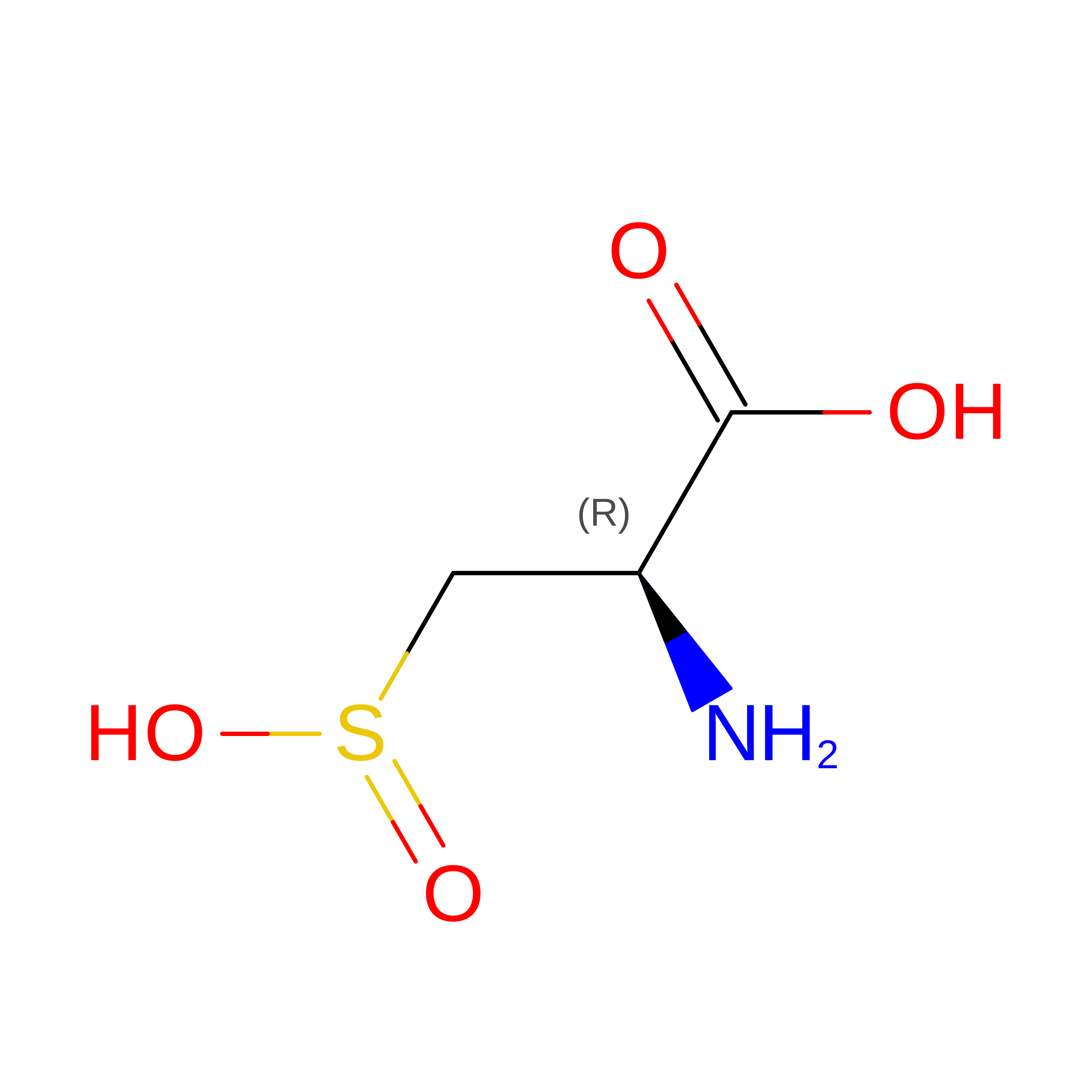
L-PEPTIDE LINKINGC3 H7 N O4 SCYS

Experimental Data & Validation

Experimental Data

  • Method: X-RAY DIFFRACTION
  • Resolution: 2.30 Å
  • R-Value Free:  0.225 (Depositor), 0.232 (DCC) 
  • R-Value Work:  0.189 (Depositor), 0.192 (DCC) 
  • R-Value Observed: 0.191 (Depositor) 
Space Group: P 1 21 1
Unit Cell:
Length ( Å )Angle ( ˚ )
a = 84.42α = 90
b = 133.14β = 90.52
c = 109.83γ = 90
Software Package:
Software NamePurpose
DNAdata collection
PHASERphasing
BUSTERrefinement
XDSdata reduction
XDSdata scaling

Structure Validation

View Full Validation Report


Entry History 

Deposition Data

Revision History  (Full details and data files)

  • Version 1.0: 2013-04-10
    Type: Initial release
  • Version 1.1: 2013-06-19
    Changes: Database references
  • Version 1.2: 2017-03-29
    Changes: Refinement description
  • Version 1.3: 2023-09-20
    Changes: Data collection, Database references, Derived calculations, Refinement description
  • Version 1.4: 2024-10-16
    Changes: Structure summary