4I6F | pdb_00004i6f

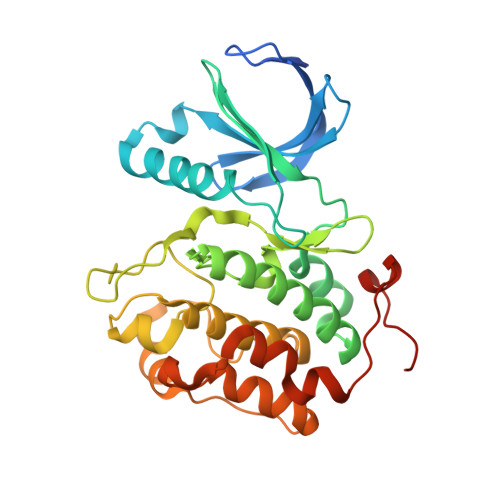
Selective & Brain-Permeable Polo-like Kinase-2 (Plk-2) Inhibitors that Reduce -Synuclein Phosphorylation in Rat Brain


Experimental Data Snapshot

  • Method: X-RAY DIFFRACTION
  • Resolution: 2.90 Å
  • R-Value Free: 
    0.321 (Depositor), 0.343 (DCC) 
  • R-Value Work: 
    0.235 (Depositor), 0.225 (DCC) 
  • R-Value Observed: 
    0.240 (Depositor) 

wwPDB Validation 3D Report Full Report

Validation slider image for 4I6F

Ligand Structure Quality Assessment 


This is version 1.1 of the entry. See complete history

Literature

Selective and brain-permeable polo-like kinase-2 (Plk-2) inhibitors that reduce alpha-synuclein phosphorylation in rat brain.

Aubele, D.L.Hom, R.K.Adler, M.Galemmo, R.A.Bowers, S.Truong, A.P.Pan, H.Beroza, P.Neitz, R.J.Yao, N.Lin, M.Tonn, G.Zhang, H.Bova, M.P.Ren, Z.Tam, D.Ruslim, L.Baker, J.Diep, L.Fitzgerald, K.Hoffman, J.Motter, R.Fauss, D.Tanaka, P.Dappen, M.Jagodzinski, J.Chan, W.Konradi, A.W.Latimer, L.Zhu, Y.L.Sham, H.L.Anderson, J.P.Bergeron, M.Artis, D.R.

(2013) ChemMedChem 8: 1295-1313

  • DOI: https://doi.org/10.1002/cmdc.201300166
  • Primary Citation Related Structures: 
    4I5M, 4I5P, 4I6B, 4I6F, 4I6H

  • PubMed Abstract: 

    Polo-like kinase-2 (Plk-2) has been implicated as the dominant kinase involved in the phosphorylation of α-synuclein in Lewy bodies, which are one of the hallmarks of Parkinson's disease neuropathology. Potent, selective, brain-penetrant inhibitors of Plk-2 were obtained from a structure-guided drug discovery approach driven by the first reported Plk-2-inhibitor complexes. The best of these compounds showed excellent isoform and kinome-wide selectivity, with physicochemical properties sufficient to interrogate the role of Plk-2 inhibition in vivo. One such compound significantly decreased phosphorylation of α-synuclein in rat brain upon oral administration and represents a useful probe for future studies of this therapeutic avenue toward the potential treatment of Parkinson's disease.


  • Organizational Affiliation
    • Molecular Discovery, Elan Pharmaceuticals, 180 Oyster Point Boulevard, South San Francisco, CA 94080, USA.

Macromolecule Content 

  • Total Structure Weight: 36.23 kDa 
  • Atom Count: 2,406 
  • Modeled Residue Count: 285 
  • Deposited Residue Count: 308 
  • Unique protein chains: 1

Macromolecules

Find similar proteins by:|  3D Structure
Entity ID: 1
MoleculeChains  Sequence LengthOrganismDetailsImage
Serine/threonine-protein kinase PLK2308Homo sapiensMutation(s): 7 
Gene Names: PLK2SNK
EC: 2.7.11.21
UniProt & NIH Common Fund Data Resources
Find proteins for Q9NYY3 (Homo sapiens)
Explore Q9NYY3 
Go to UniProtKB:  Q9NYY3
PHAROS:  Q9NYY3
GTEx:  ENSG00000145632 
Entity Groups
Sequence Clusters30% Identity50% Identity70% Identity90% Identity95% Identity100% Identity
UniProt GroupQ9NYY3
Sequence Annotations
Expand
Reference Sequence

Small Molecules

Ligands 1 Unique
IDChains Name / Formula / InChI Key2D Diagram3D Interactions
1C7

Query on 1C7


Download:Ideal Coordinates CCD File
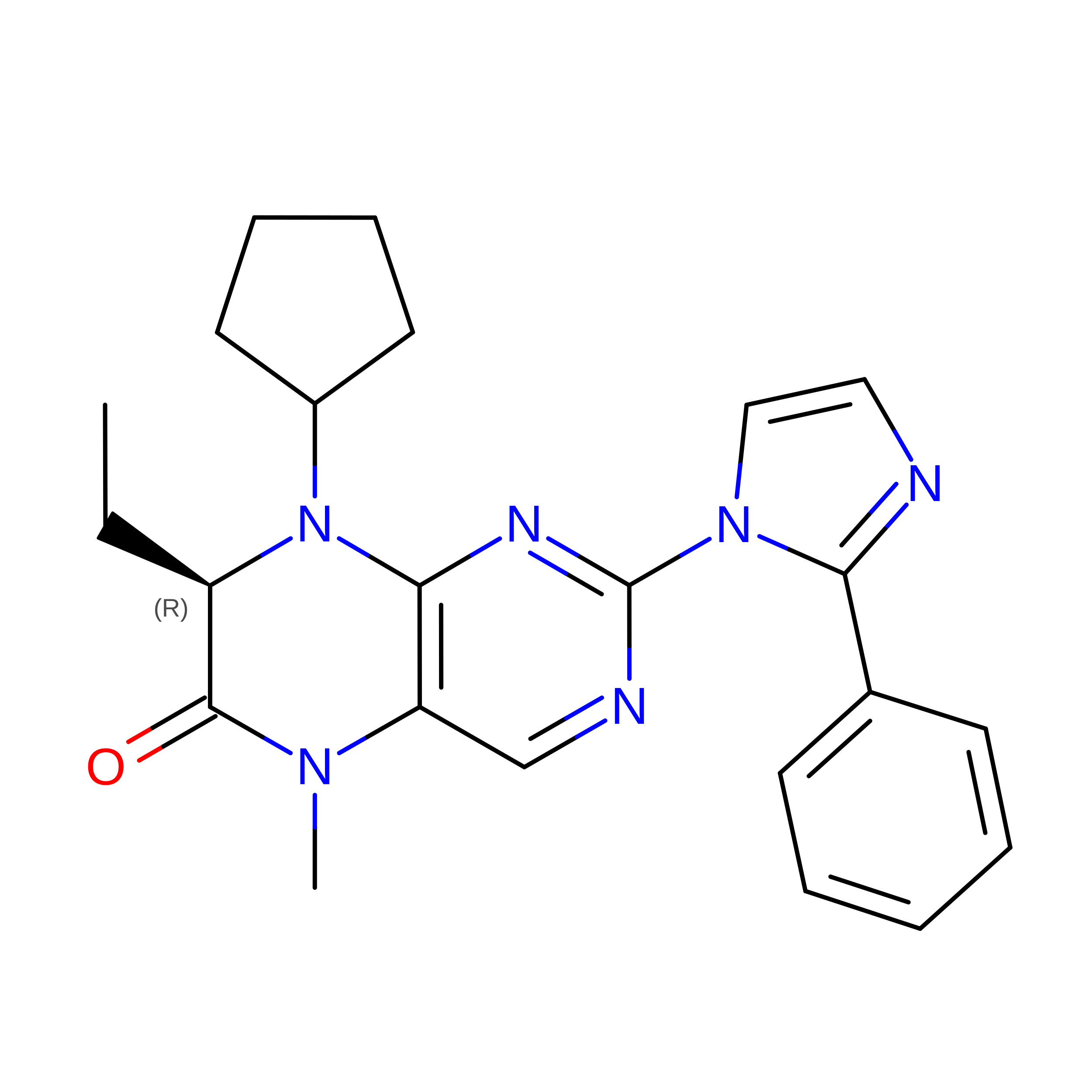
B [auth A](7R)-8-cyclopentyl-7-ethyl-5-methyl-2-(2-phenyl-1H-imidazol-1-yl)-7,8-dihydropteridin-6(5H)-one
C23 H26 N6 O
JMDRAMDTWLAOHD-GOSISDBHSA-N
Binding Affinity Annotations 
IDSourceBinding Affinity
1C7 BindingDB:  4I6F IC50: 5 (nM) from 1 assay(s)

Experimental Data & Validation

Experimental Data

  • Method: X-RAY DIFFRACTION
  • Resolution: 2.90 Å
  • R-Value Free:  0.321 (Depositor), 0.343 (DCC) 
  • R-Value Work:  0.235 (Depositor), 0.225 (DCC) 
  • R-Value Observed: 0.240 (Depositor) 
Space Group: C 1 2 1
Unit Cell:
Length ( Å )Angle ( ˚ )
a = 103.824α = 90
b = 60.123β = 107.14
c = 53.119γ = 90
Software Package:
Software NamePurpose
HKL-2000data collection
AMoREphasing
REFMACrefinement
HKL-2000data reduction
HKL-2000data scaling

Structure Validation

View Full Validation Report


Ligand Structure Quality Assessment 


Entry History 

Deposition Data

  • Released Date: 2013-11-20 
  • Deposition Author(s): Pan, H.

Revision History  (Full details and data files)

  • Version 1.0: 2013-11-20
    Type: Initial release
  • Version 1.1: 2024-02-28
    Changes: Data collection, Database references, Derived calculations