4HXY | pdb_00004hxy

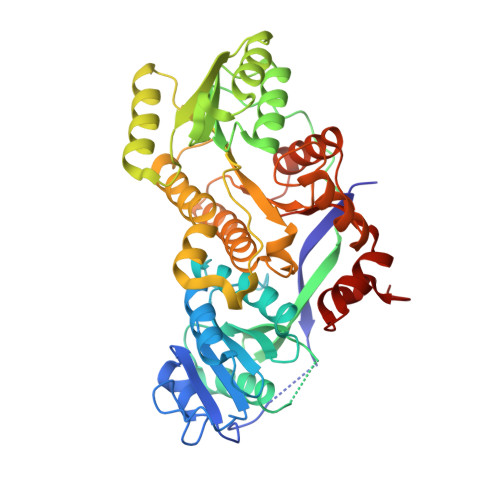
PlmKR1-Ketoreductase from the first module of phoslactomycin biosynthesis in Streptomyces sp. HK803


Experimental Data Snapshot

  • Method: X-RAY DIFFRACTION
  • Resolution: 1.68 Å
  • R-Value Free: 
    0.188 (Depositor), 0.199 (DCC) 
  • R-Value Work: 
    0.155 (Depositor), 0.166 (DCC) 
  • R-Value Observed: 
    0.156 (Depositor) 

wwPDB Validation 3D Report Full Report

Validation slider image for 4HXY

Ligand Structure Quality Assessment 


This is version 2.0 of the entry. See complete history

Literature

Structural and Stereochemical Analysis of a Modular Polyketide Synthase Ketoreductase Domain Required for the Generation of a cis-Alkene.

Bonnett, S.A.Whicher, J.R.Papireddy, K.Florova, G.Smith, J.L.Reynolds, K.A.

(2013) Chem Biol 20: 772-783

  • DOI: https://doi.org/10.1016/j.chembiol.2013.04.014
  • Primary Citation Related Structures: 
    4HXY

  • PubMed Abstract: 

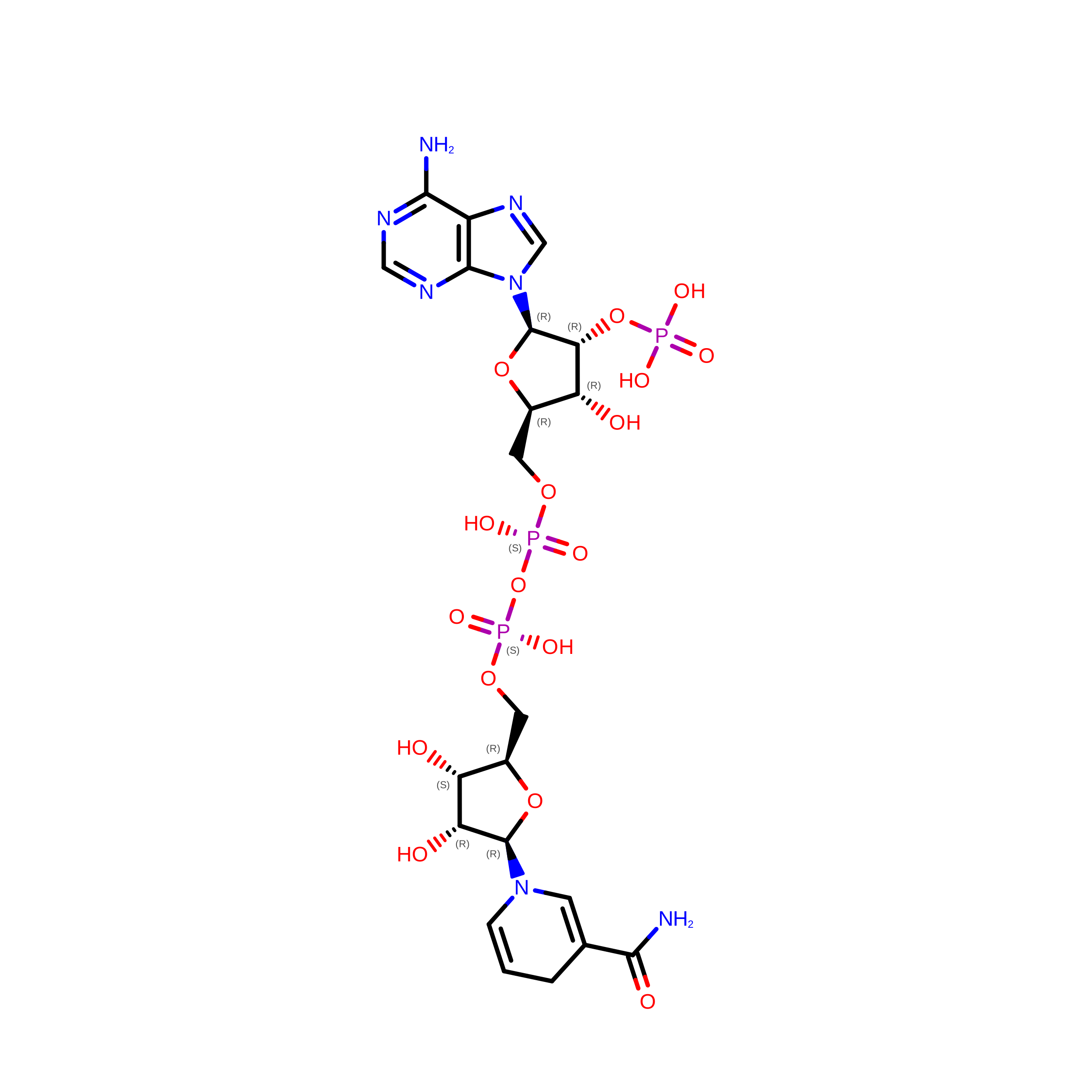
    The formation of an activated cis-3-cyclohexylpropenoic acid by Plm1, the first extension module of the phoslactomycin polyketide synthase, is proposed to occur through an L-3-hydroxyacyl-intermediate as a result of ketoreduction by an A-type ketoreductase (KR). Here, we demonstrate that the KR domain of Plm1 (PlmKR1) catalyzes the formation of an L-3-hydroxyacyl product. The crystal structure of PlmKR1 revealed a well-ordered active site with a nearby Trp residue characteristic of A-type KRs. Structural comparison of PlmKR1 with B-type KRs that produce D-3-hydroxyacyl intermediates revealed significant differences. The active site of cofactor-bound A-type KRs is in a catalysis-ready state, whereas cofactor-bound B-type KRs are in a precatalytic state. Furthermore, the closed lid loop in substrate-bound A-type KRs restricts active site access from all but one direction, which is proposed to control the stereochemistry of ketoreduction.


  • Organizational Affiliation
    • Department of Chemistry, Portland State University, Portland, OR. 97201.

Macromolecule Content 

  • Total Structure Weight: 92.7 kDa 
  • Atom Count: 7,408 
  • Modeled Residue Count: 855 
  • Deposited Residue Count: 876 
  • Unique protein chains: 1

Macromolecules

Find similar proteins by:|  3D Structure
Entity ID: 1
MoleculeChains  Sequence LengthOrganismDetailsImage
Plm1
A, B
438Streptomyces sp. HK803Mutation(s): 0 
Gene Names: plm1
UniProt
Find proteins for Q6V1M8 (Streptomyces sp. HK803)
Explore Q6V1M8 
Go to UniProtKB:  Q6V1M8
Entity Groups
Sequence Clusters30% Identity50% Identity70% Identity90% Identity95% Identity100% Identity
UniProt GroupQ6V1M8
Sequence Annotations
Expand
Reference Sequence

Experimental Data & Validation

Experimental Data

  • Method: X-RAY DIFFRACTION
  • Resolution: 1.68 Å
  • R-Value Free:  0.188 (Depositor), 0.199 (DCC) 
  • R-Value Work:  0.155 (Depositor), 0.166 (DCC) 
  • R-Value Observed: 0.156 (Depositor) 
Space Group: P 1 21 1
Unit Cell:
Length ( Å )Angle ( ˚ )
a = 42.157α = 90
b = 123.398β = 90.27
c = 79.884γ = 90
Software Package:
Software NamePurpose
Blu-Icedata collection
PHASERphasing
REFMACrefinement
HKL-2000data reduction
HKL-2000data scaling

Structure Validation

View Full Validation Report


Ligand Structure Quality Assessment 


Entry History 

Deposition Data

Revision History  (Full details and data files)

  • Version 1.0: 2013-07-10
    Type: Initial release
  • Version 2.0: 2023-11-15
    Changes: Atomic model, Data collection, Database references, Derived calculations