4HXO | pdb_00004hxo

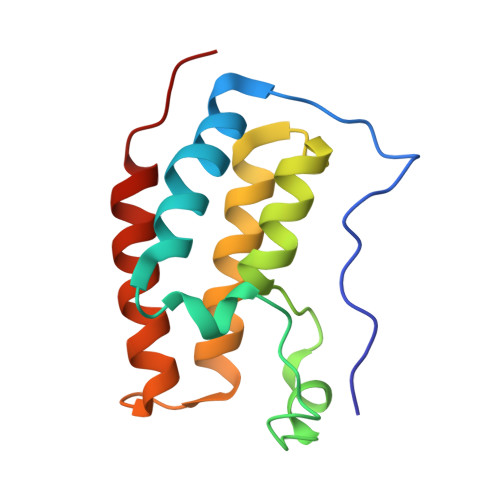
Brd4 Bromodomain 1 complex with 3-{[(3-METHYL-1,2-OXAZOL-5-YL)METHYL]SULFANYL}[1,2,4]TRIAZOLO[4,3-A]PYRIDINE inhibitor


Experimental Data Snapshot

  • Method: X-RAY DIFFRACTION
  • Resolution: 1.76 Å
  • R-Value Free: 
    0.229 (Depositor), 0.220 (DCC) 
  • R-Value Work: 
    0.168 (Depositor) 
  • R-Value Observed: 
    0.170 (Depositor) 

wwPDB Validation 3D Report Full Report

Validation slider image for 4HXO

Ligand Structure Quality Assessment 


This is version 1.4 of the entry. See complete history. 

Literature

Fragment-Based Drug Discovery of 2-Thiazolidinones as Inhibitors of the Histone Reader BRD4 Bromodomain.

Zhao, L., Cao, D., Chen, T., Wang, Y., Miao, Z., Xu, Y., Chen, W., Wang, X., Li, Y., Du, Z., Xiong, B., Li, J., Xu, C., Zhang, N., He, J., Shen, J.

(2013) J Med Chem 56: 3833-3851

  • DOI: https://doi.org/10.1021/jm301793a
  • Primary Citation Related Structures: 
    4HXK, 4HXL, 4HXM, 4HXN, 4HXO, 4HXP, 4HXR, 4HXS

  • PubMed Abstract: 

    Recognizing acetyllysine of histone is a vital process of epigenetic regulation that is mediated by a protein module called bromodomain. To contribute novel scaffolds for developing into bromodomain inhibitors, we utilize a fragment-based drug discovery approach. By successively applying docking and X-ray crystallography, we were able to identify 9 fragment hits from diffracting more than 60 crystals. In the present work, we described four of them and carried out the integrated lead optimization for fragment 8, which bears a 2-thiazolidinone core. After several rounds of structure guided modifications, we assessed the druggability of 2-thiazolidinone by modulating in vitro pharmacokinetic studies and cellular activity assay. The results showed that two potent compounds of 2-thiazolidinones have good metabolic stability. Also, the cellular assay confirmed the activities of 2-thiazolidinones. Together, we hope the identified 2-thiazolidinone chemotype and other fragment hits described herein can stimulate researchers to develop more diversified bromodomain inhibitors.


  • Organizational Affiliation: 
    • Department of Medicinal Chemistry, State Key Laboratory of Drug Research, Shanghai Institute of Materia Medica, Chinese Academy of Sciences , 555 Zuchongzhi Road, Shanghai 201203, China.

Macromolecule Content 

  • Total Structure Weight: 15.13 kDa 
  • Atom Count: 1,148 
  • Modeled Residue Count: 125 
  • Deposited Residue Count: 125 
  • Unique protein chains: 1

Macromolecules

Find similar proteins by:|  3D Structure
Entity ID: 1
MoleculeChains  Sequence LengthOrganismDetailsImage
Bromodomain-containing protein 4125Homo sapiensMutation(s): 0 
Gene Names: BRD4, HUNK1
UniProt & NIH Common Fund Data Resources
Find proteins for O60885 (Homo sapiens)
Explore O60885 
Go to UniProtKB:  O60885
PHAROS:  O60885
GTEx:  ENSG00000141867 
Entity Groups
Sequence Clusters30% Identity50% Identity70% Identity90% Identity95% Identity100% Identity
UniProt GroupO60885
Sequence Annotations
Expand
Reference Sequence

Small Molecules

Ligands 1 Unique
IDChains Name / Formula / InChI Key2D Diagram3D Interactions
1A6

Query on 1A6


Download:Ideal Coordinates CCD File
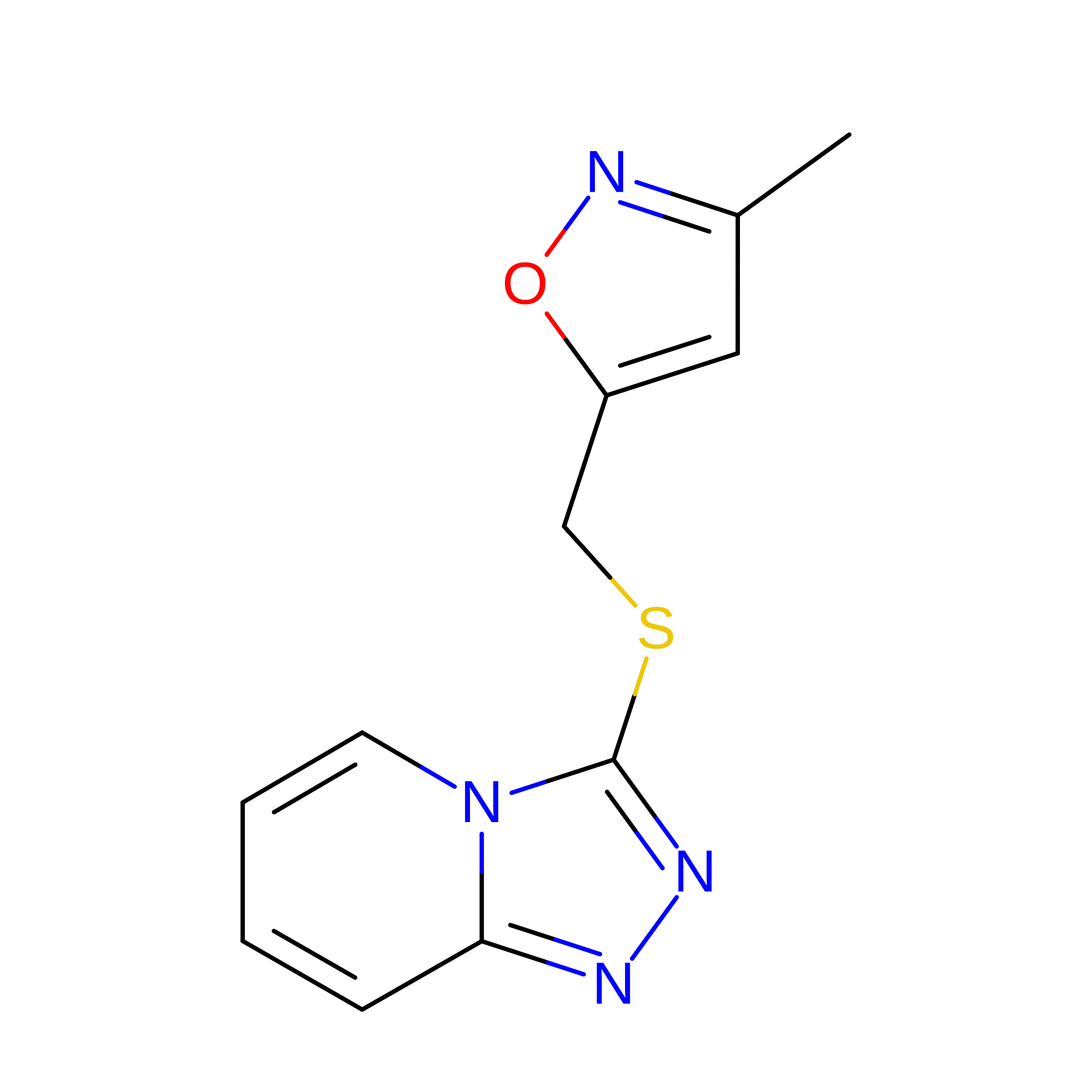
B [auth A]3-{[(3-methyl-1,2-oxazol-5-yl)methyl]sulfanyl}[1,2,4]triazolo[4,3-a]pyridine
C11 H10 N4 O S
OHGHXAMWUPRSET-UHFFFAOYSA-N

Experimental Data & Validation

Experimental Data

  • Method: X-RAY DIFFRACTION
  • Resolution: 1.76 Å
  • R-Value Free:  0.229 (Depositor), 0.220 (DCC) 
  • R-Value Work:  0.168 (Depositor) 
  • R-Value Observed: 0.170 (Depositor) 
Space Group: P 21 21 21
Unit Cell:
Length ( Å )Angle ( ˚ )
a = 32.4α = 90
b = 47.58β = 90
c = 78.32γ = 90
Software Package:
Software NamePurpose
REFMACrefinement
PHASERphasing
PHENIXrefinement
PDB_EXTRACTdata extraction
Blu-Icedata collection
XDSdata reduction
XSCALEdata scaling

Structure Validation

View Full Validation Report


Ligand Structure Quality Assessment 


Entry History 

Deposition Data

Revision History  (Full details and data files)

  • Version 1.0: 2013-04-03
    Type: Initial release
  • Version 1.1: 2013-04-10
    Changes: Structure summary
  • Version 1.2: 2013-06-19
    Changes: Database references
  • Version 1.3: 2019-07-17
    Changes: Data collection, Refinement description
  • Version 1.4: 2024-02-28
    Changes: Data collection, Database references, Derived calculations