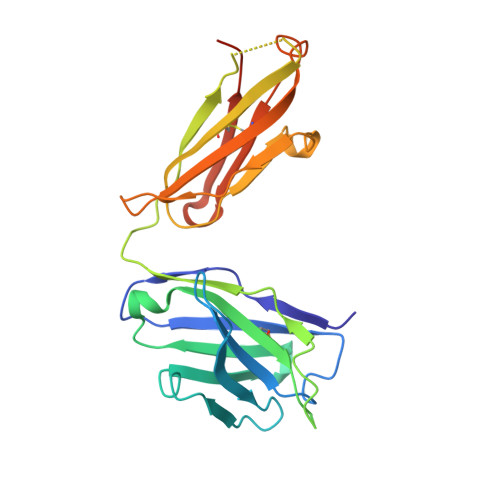
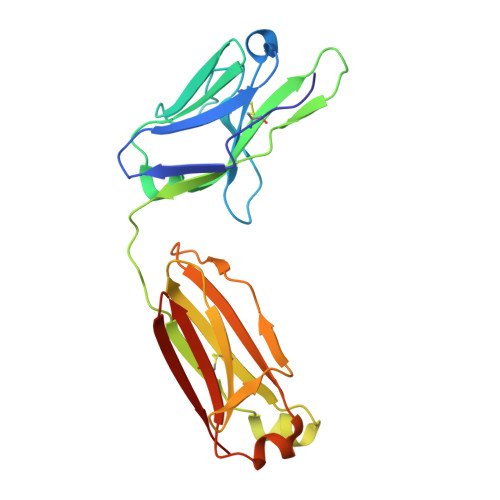
4HK0 | pdb_00004hk0

UCA Fab (unbound) from CH65-CH67 Lineage


Experimental Data Snapshot

  • Method: X-RAY DIFFRACTION
  • Resolution: 2.50 Å
  • R-Value Free: 
    0.258 (Depositor), 0.252 (DCC) 
  • R-Value Work: 
    0.206 (Depositor), 0.203 (DCC) 
  • R-Value Observed: 
    0.209 (Depositor) 

wwPDB Validation 3D Report Full Report

Validation slider image for 4HK0

This is version 1.4 of the entry. See complete history

Literature

Preconfiguration of the antigen-binding site during affinity maturation of a broadly neutralizing influenza virus antibody.

Schmidt, A.G.Xu, H.Khan, A.R.O'Donnell, T.Khurana, S.King, L.R.Manischewitz, J.Golding, H.Suphaphiphat, P.Carfi, A.Settembre, E.C.Dormitzer, P.R.Kepler, T.B.Zhang, R.Moody, M.A.Haynes, B.F.Liao, H.X.Shaw, D.E.Harrison, S.C.

(2013) Proc Natl Acad Sci U S A 110: 264-269

  • DOI: https://doi.org/10.1073/pnas.1218256109
  • Primary Citation Related Structures: 
    4HK0, 4HK3, 4HKB, 4HKX

  • PubMed Abstract: 

    Affinity maturation refines a naive B-cell response by selecting mutations in antibody variable domains that enhance antigen binding. We describe a B-cell lineage expressing broadly neutralizing influenza virus antibodies derived from a subject immunized with the 2007 trivalent vaccine. The lineage comprises three mature antibodies, the unmutated common ancestor, and a common intermediate. Their heavy-chain complementarity determining region inserts into the conserved receptor-binding pocket of influenza HA. We show by analysis of structures, binding kinetics and long time-scale molecular dynamics simulations that antibody evolution in this lineage has rigidified the initially flexible heavy-chain complementarity determining region by two nearly independent pathways and that this preconfiguration accounts for most of the affinity gain. The results advance our understanding of strategies for developing more broadly effective influenza vaccines.


  • Organizational Affiliation
    • Laboratory of Molecular Medicine, Children's Hospital, Harvard Medical School and Howard Hughes Medical Institute, Boston, MA 02115, USA.

Macromolecule Content 

  • Total Structure Weight: 96.81 kDa 
  • Atom Count: 6,548 
  • Modeled Residue Count: 857 
  • Deposited Residue Count: 902 
  • Unique protein chains: 2

Macromolecules

Find similar proteins by:|  3D Structure
Entity ID: 1
MoleculeChains  Sequence LengthOrganismDetailsImage
UCA heavy chain
A, C
237Homo sapiensMutation(s): 0 
Find similar proteins by:|  3D Structure
Entity ID: 2
MoleculeChains  Sequence LengthOrganismDetailsImage
UCA light chain
B, D
214Homo sapiensMutation(s): 0 
UniProt
Find proteins for Q8N355 (Homo sapiens)
Explore Q8N355 
Go to UniProtKB:  Q8N355
Entity Groups
Sequence Clusters30% Identity50% Identity70% Identity90% Identity95% Identity100% Identity
UniProt GroupQ8N355
Sequence Annotations
Expand
Reference Sequence

Experimental Data & Validation

Experimental Data

  • Method: X-RAY DIFFRACTION
  • Resolution: 2.50 Å
  • R-Value Free:  0.258 (Depositor), 0.252 (DCC) 
  • R-Value Work:  0.206 (Depositor), 0.203 (DCC) 
  • R-Value Observed: 0.209 (Depositor) 
Space Group: P 62
Unit Cell:
Length ( Å )Angle ( ˚ )
a = 102.004α = 90
b = 102.004β = 90
c = 163.085γ = 120
Software Package:
Software NamePurpose
DENZOdata reduction
SCALEPACKdata scaling
PHASERphasing
PHENIXrefinement
PDB_EXTRACTdata extraction
HKL-2000data collection
HKL-2000data reduction

Structure Validation

View Full Validation Report


Entry History 

Deposition Data

Revision History  (Full details and data files)

  • Version 1.0: 2012-11-21
    Type: Initial release
  • Version 1.1: 2012-12-05
    Changes: Database references
  • Version 1.2: 2013-01-16
    Changes: Database references
  • Version 1.3: 2017-11-15
    Changes: Refinement description
  • Version 1.4: 2024-11-20
    Changes: Data collection, Database references, Structure summary