4H2M | pdb_00004h2m

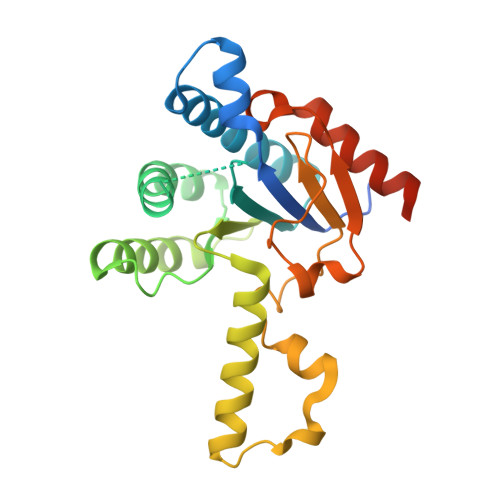
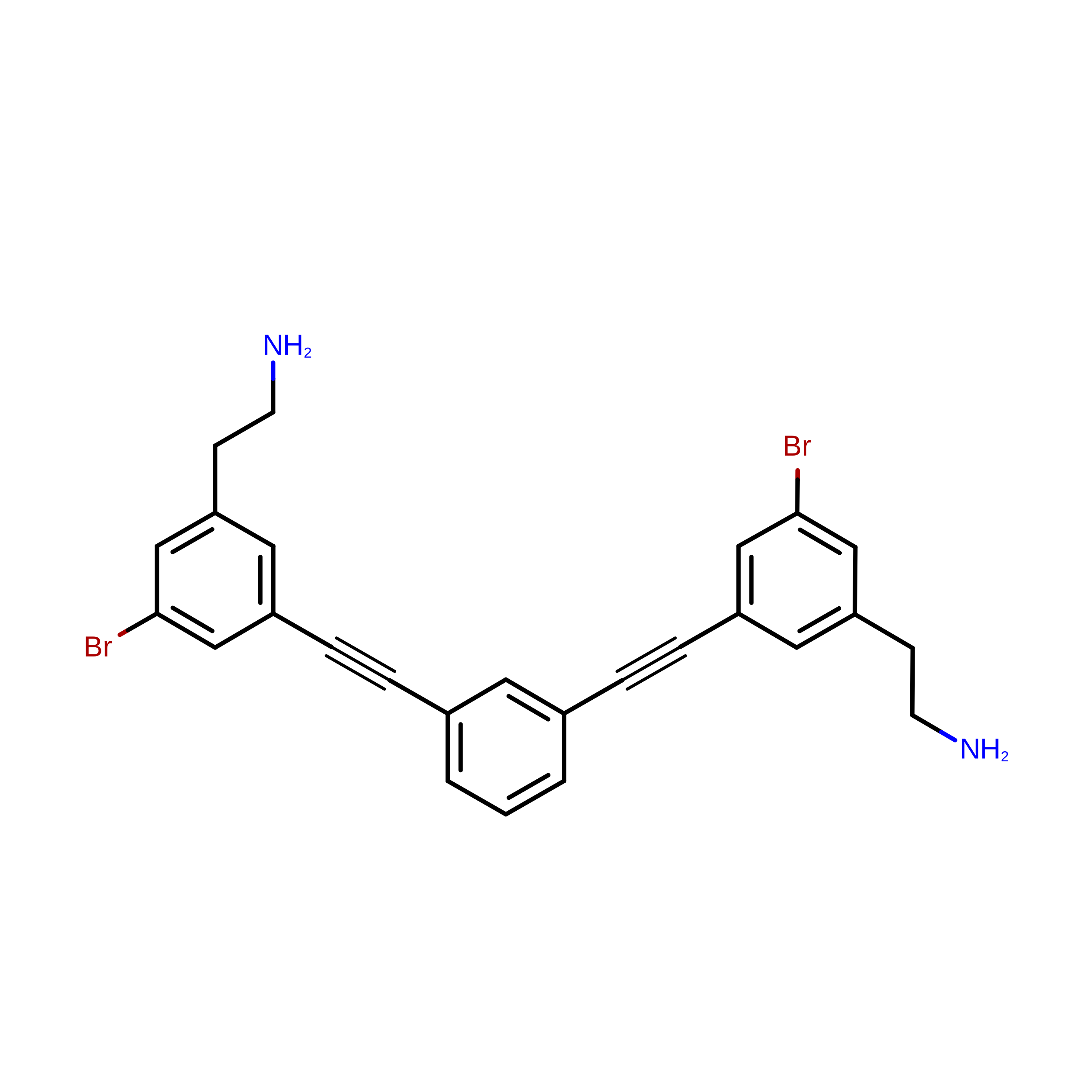
Structure of E. coli undecaprenyl diphosphate synthase in complex with BPH-1408


Experimental Data Snapshot

  • Method: X-RAY DIFFRACTION
  • Resolution: 1.78 Å
  • R-Value Free: 
    0.242 (Depositor), 0.245 (DCC) 
  • R-Value Work: 
    0.204 (Depositor), 0.206 (DCC) 
  • R-Value Observed: 
    0.206 (Depositor) 

Starting Model: experimental
View more details

wwPDB Validation 3D Report Full Report

Validation slider image for 4H2M

Ligand Structure Quality Assessment 


This is version 1.3 of the entry. See complete history

Literature

Antibacterial drug leads targeting isoprenoid biosynthesis.

Zhu, W.Zhang, Y.Sinko, W.Hensler, M.E.Olson, J.Molohon, K.J.Lindert, S.Cao, R.Li, K.Wang, K.Wang, Y.Liu, Y.L.Sankovsky, A.de Oliveira, C.A.Mitchell, D.A.Nizet, V.McCammon, J.A.Oldfield, E.

(2013) Proc Natl Acad Sci U S A 110: 123-128

  • DOI: https://doi.org/10.1073/pnas.1219899110
  • Primary Citation Related Structures: 
    3SGT, 3SGV, 3SGX, 3SH0, 4H2J, 4H2M, 4H2O, 4H38, 4H3A, 4H3C, 4H8E

  • PubMed Abstract: 

    With the rise in resistance to antibiotics such as methicillin, there is a need for new drugs. We report here the discovery and X-ray crystallographic structures of 10 chemically diverse compounds (benzoic, diketo, and phosphonic acids, as well as a bisamidine and a bisamine) that inhibit bacterial undecaprenyl diphosphate synthase, an essential enzyme involved in cell wall biosynthesis. The inhibitors bind to one or more of the four undecaprenyl diphosphate synthase inhibitor binding sites identified previously, with the most active leads binding to site 4, outside the catalytic center. The most potent leads are active against Staphylococcus aureus [minimal inhibitory concentration (MIC)(90) ∼0.25 µg/mL], and one potently synergizes with methicillin (fractional inhibitory concentration index = 0.25) and is protective in a mouse infection model. These results provide numerous leads for antibacterial development and open up the possibility of restoring sensitivity to drugs such as methicillin, using combination therapies.


  • Organizational Affiliation
    • Center for Biophysics and Computational Biology, University of Illinois, Urbana, IL 61801, USA.

Macromolecule Content 

  • Total Structure Weight: 58.01 kDa 
  • Atom Count: 3,520 
  • Modeled Residue Count: 427 
  • Deposited Residue Count: 506 
  • Unique protein chains: 1

Macromolecules

Find similar proteins by:|  3D Structure
Entity ID: 1
MoleculeChains  Sequence LengthOrganismDetailsImage
Undecaprenyl pyrophosphate synthase
A, B
253Escherichia coliMutation(s): 0 
Gene Names: uppSispUrthyaeSb0174JW0169
EC: 2.5.1.31
UniProt
Find proteins for P60472 (Escherichia coli (strain K12))
Explore P60472 
Go to UniProtKB:  P60472
Entity Groups
Sequence Clusters30% Identity50% Identity70% Identity90% Identity95% Identity100% Identity
UniProt GroupP60472
Sequence Annotations
Expand
Reference Sequence

Small Molecules

Ligands 1 Unique
IDChains Name / Formula / InChI Key2D Diagram3D Interactions
0YV

Query on 0YV


Download:Ideal Coordinates CCD File
C [auth A],
D [auth B]
2,2'-{benzene-1,3-diylbis[ethyne-2,1-diyl(5-bromobenzene-3,1-diyl)]}diethanamine
C26 H22 Br2 N2
JSVQCKAPBSOZCB-UHFFFAOYSA-N

Experimental Data & Validation

Experimental Data

  • Method: X-RAY DIFFRACTION
  • Resolution: 1.78 Å
  • R-Value Free:  0.242 (Depositor), 0.245 (DCC) 
  • R-Value Work:  0.204 (Depositor), 0.206 (DCC) 
  • R-Value Observed: 0.206 (Depositor) 
Space Group: P 21 21 21
Unit Cell:
Length ( Å )Angle ( ˚ )
a = 62.83α = 90
b = 68.885β = 90
c = 112.017γ = 90
Software Package:
Software NamePurpose
REFMACrefinement
PDB_EXTRACTdata extraction
HKL-3000data collection
HKL-3000data reduction
HKL-3000data scaling
PHASESphasing

Structure Validation

View Full Validation Report


Ligand Structure Quality Assessment 


Entry History 

Deposition Data

Revision History  (Full details and data files)

  • Version 1.0: 2012-12-19
    Type: Initial release
  • Version 1.1: 2013-01-09
    Changes: Database references
  • Version 1.2: 2013-01-16
    Changes: Database references
  • Version 1.3: 2023-09-20
    Changes: Data collection, Database references, Derived calculations, Refinement description