4H27 | pdb_00004h27

Modulating the function of human serine racemase and human serine dehydratase by protein engineering


Experimental Data Snapshot

  • Method: X-RAY DIFFRACTION
  • Resolution: 1.30 Å
  • R-Value Free: 
    0.168 (Depositor), 0.166 (DCC) 
  • R-Value Work: 
    0.144 (Depositor), 0.141 (DCC) 
  • R-Value Observed: 
    0.146 (Depositor) 

wwPDB Validation 3D Report Full Report

Validation slider image for 4H27

This is version 1.2 of the entry. See complete history

Literature

Modulating the function of human serine racemase and human serine dehydratase by protein engineering.

Wang, C.Y.Ku, S.C.Lee, C.C.Wang, A.H.

(2012) Protein Eng Des Sel 25: 741-749

  • DOI: https://doi.org/10.1093/protein/gzs078
  • Primary Citation Related Structures: 
    4H27

  • PubMed Abstract: 

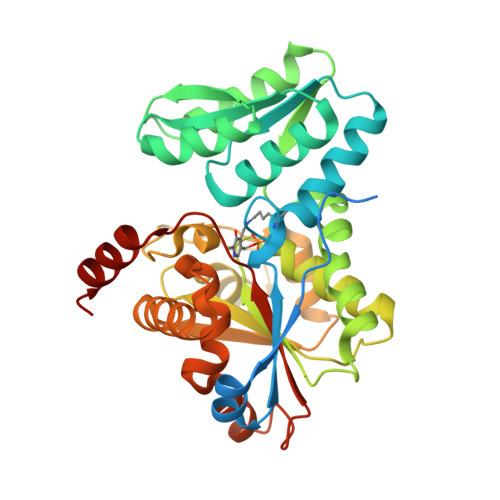
    D-Serine is a co-agonist of N-methyl D-aspartate, a glutamate receptor, which is a major excitatory neurotransmitter receptor in the brain. Human serine racemase (hSR) and serine dehydratase (hSDH) are two important pyridoxal-5'-phosphate-dependent enzymes that synthesize and degrade D-serine, respectively. hSR and hSDH have significant sequence homology (28% identity) and are similar in their structural folds (root-mean-square deviation, 1.12 Å). Sequence alignment and structural comparison between hSR and hSDH reveal that S84 in hSR and A65 in hSDH play important roles in their respective enzyme activities. We surmise that exchange of these two amino acids by introducing S84A hSR and A65S hSDH mutants may result in switching their protein functions. To understand the modulating mechanism of the key residues, mutants S84A in hSR and A65S in hSDH were constructed to monitor the change of activities. The structure of A65S hSDH mutant was determined at 1.3 Å resolution (PDB 4H27), elucidating the role of this critical amino acid. Our study demonstrated S84A hSR mutant behaved like hSDH, whereas A65S hSDH mutant acquired an additional function of using D-serine as a substrate.


  • Organizational Affiliation
    • Institute of Biological Chemistry, Academia Sinica, Taipei 11529, Taiwan.

Macromolecule Content 

  • Total Structure Weight: 39 kDa 
  • Atom Count: 2,846 
  • Modeled Residue Count: 318 
  • Deposited Residue Count: 364 
  • Unique protein chains: 1

Macromolecules

Find similar proteins by:|  3D Structure
Entity ID: 1
MoleculeChains  Sequence LengthOrganismDetailsImage
L-serine dehydratase/L-threonine deaminase364Homo sapiensMutation(s): 1 
Gene Names: SDSSDH
EC: 4.3.1.17 (PDB Primary Data), 4.3.1.19 (PDB Primary Data)
UniProt & NIH Common Fund Data Resources
Find proteins for P20132 (Homo sapiens)
Explore P20132 
Go to UniProtKB:  P20132
PHAROS:  P20132
GTEx:  ENSG00000135094 
Entity Groups
Sequence Clusters30% Identity50% Identity70% Identity90% Identity95% Identity100% Identity
UniProt GroupP20132
Sequence Annotations
Expand
Reference Sequence

Experimental Data & Validation

Experimental Data

  • Method: X-RAY DIFFRACTION
  • Resolution: 1.30 Å
  • R-Value Free:  0.168 (Depositor), 0.166 (DCC) 
  • R-Value Work:  0.144 (Depositor), 0.141 (DCC) 
  • R-Value Observed: 0.146 (Depositor) 
Space Group: I 4 2 2
Unit Cell:
Length ( Å )Angle ( ˚ )
a = 158.502α = 90
b = 158.502β = 90
c = 59.453γ = 90
Software Package:
Software NamePurpose
HKL-2000data collection
AMoREphasing
REFMACrefinement
HKL-2000data reduction
HKL-2000data scaling

Structure Validation

View Full Validation Report


Entry History 

Deposition Data

Revision History  (Full details and data files)

  • Version 1.0: 2012-11-14
    Type: Initial release
  • Version 1.1: 2012-12-12
    Changes: Database references
  • Version 1.2: 2025-03-26
    Changes: Data collection, Database references, Derived calculations, Structure summary