Download Mendeley
Crystal structures of acetate kinases from the eukaryotic pathogens Entamoeba histolytica and Cryptococcus neoformans.
Thaker, T.M., Tanabe, M., Fowler, M.L., Preininger, A.M., Ingram-Smith, C., Smith, K.S., Iverson, T.M.(2013) J Struct Biol 181: 185-189
- PubMed: 23159802 Search on PubMedSearch on PubMed Central
- DOI: https://doi.org/10.1016/j.jsb.2012.11.001
- Primary Citation Related Structures:
4H0O, 4H0P - PubMed Abstract:
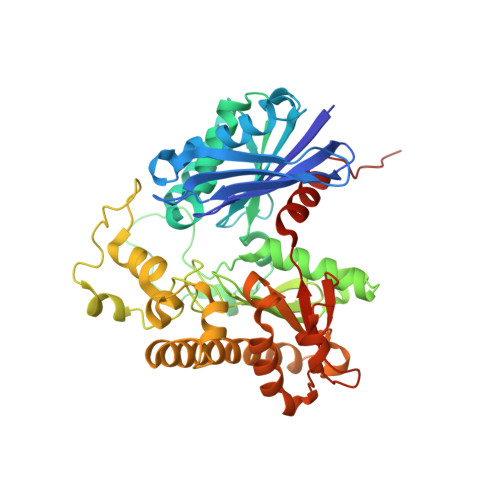
Acetate kinases (ACKs) are members of the acetate and sugar kinase/hsp70/actin (ASKHA) superfamily and catalyze the reversible phosphorylation of acetate, with ADP/ATP the most common phosphoryl acceptor/donor. While prokaryotic ACKs have been the subject of extensive biochemical and structural characterization, there is a comparative paucity of information on eukaryotic ACKs, and prior to this report, no structure of an ACK of eukaryotic origin was available. We determined the structures of ACKs from the eukaryotic pathogens Entamoeba histolytica and Cryptococcus neoformans. Each active site is located at an interdomain interface, and the acetate and phosphate binding pockets display sequence and structural conservation with their prokaryotic counterparts. Interestingly, the E. histolytica ACK has previously been shown to be pyrophosphate (PP(i))-dependent, and is the first ACK demonstrated to have this property. Examination of its structure demonstrates how subtle amino acid substitutions within the active site have converted cosubstrate specificity from ATP to PP(i) while retaining a similar backbone conformation. Differences in the angle between domains surrounding the active site suggest that interdomain movement may accompany catalysis. Taken together, these structures are consistent with the eukaryotic ACKs following a similar reaction mechanism as is proposed for the prokaryotic homologs.
- Department of Biochemistry, Vanderbilt University Medical Center, Nashville, TN 37232, USA.
Organizational Affiliation: