4GYK | pdb_00004gyk

Crystal structure of mutant (D318N) bacillus subtilis family 3 glycoside hydrolase (nagz) in complex with glcnac-murnac (space group P1211)


Experimental Data Snapshot

  • Method: X-RAY DIFFRACTION
  • Resolution: 1.80 Å
  • R-Value Free: 
    0.230 (Depositor), 0.228 (DCC) 
  • R-Value Work: 
    0.171 (Depositor), 0.170 (DCC) 
  • R-Value Observed: 
    0.174 (Depositor) 

Starting Model: experimental
View more details

wwPDB Validation 3D Report Full Report

Validation slider image for 4GYK

This is version 2.1 of the entry. See complete history

Literature

Active Site Plasticity within the Glycoside Hydrolase NagZ Underlies a Dynamic Mechanism of Substrate Distortion.

Bacik, J.P.Whitworth, G.E.Stubbs, K.A.Vocadlo, D.J.Mark, B.L.

(2012) Chem Biol 19: 1471-1482

  • DOI: https://doi.org/10.1016/j.chembiol.2012.09.016
  • Primary Citation Related Structures: 
    4GVF, 4GVG, 4GVH, 4GVI, 4GYJ, 4GYK

  • PubMed Abstract: 

    NagZ is a glycoside hydrolase that participates in peptidoglycan (PG) recycling by removing β-N-acetylglucosamine from PG fragments that are excised from the bacterial cell wall during growth. Notably, the products formed by NagZ, 1,6-anhydroMurNAc-peptides, activate β-lactam resistance in many Gram-negative bacteria, making this enzyme of interest as a potential therapeutic target. Crystal structure determinations of NagZ from Salmonella typhimurium and Bacillus subtilis in complex with natural substrate, trapped as a glycosyl-enzyme intermediate, and bound to product, define the reaction coordinate of the NagZ family of enzymes. The structures, combined with kinetic studies, reveal an uncommon degree of structural plasticity within the active site of a glycoside hydrolase, and unveil how NagZ drives substrate distortion using a highly mobile loop that contains a conserved histidine that has been proposed as the general acid/base.


  • Organizational Affiliation
    • Department of Microbiology, University of Manitoba, Winnipeg, MB R3T 2N2, Canada.

Macromolecule Content 

  • Total Structure Weight: 143.45 kDa 
  • Atom Count: 10,632 
  • Modeled Residue Count: 1,225 
  • Deposited Residue Count: 1,296 
  • Unique protein chains: 1

Macromolecules

Find similar proteins by:|  3D Structure
Entity ID: 1
MoleculeChains  Sequence LengthOrganismDetailsImage
Glycoside Hydrolase NagZ
A, B
648Bacillus subtilis subsp. subtilis str. 168Mutation(s): 1 
Gene Names: BSU01660NagZybbDyzbA
EC: 3.2.1.52
UniProt
Find proteins for P40406 (Bacillus subtilis (strain 168))
Explore P40406 
Go to UniProtKB:  P40406
Entity Groups
Sequence Clusters30% Identity50% Identity70% Identity90% Identity95% Identity100% Identity
UniProt GroupP40406
Sequence Annotations
Expand
Reference Sequence

Oligosaccharides

Help  
Entity ID: 2
MoleculeChains Length2D Diagram GlycosylationD Interactions
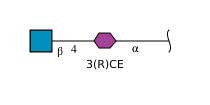
2-acetamido-2-deoxy-beta-D-glucopyranose-(1-4)-N-acetyl-alpha-muramic acid
C, D
2N/A
Glycosylation Resources
GlyTouCan: G88499BX
GlyCosmos: G88499BX

Experimental Data & Validation

Experimental Data

  • Method: X-RAY DIFFRACTION
  • Resolution: 1.80 Å
  • R-Value Free:  0.230 (Depositor), 0.228 (DCC) 
  • R-Value Work:  0.171 (Depositor), 0.170 (DCC) 
  • R-Value Observed: 0.174 (Depositor) 
Space Group: P 1 21 1
Unit Cell:
Length ( Å )Angle ( ˚ )
a = 53.978α = 90
b = 132.154β = 90.21
c = 73.688γ = 90
Software Package:
Software NamePurpose
MxDCdata collection
PHASERphasing
PHENIXrefinement
XDSdata reduction
SCALAdata scaling

Structure Validation

View Full Validation Report


Entry History 

Deposition Data

Revision History  (Full details and data files)

  • Version 1.0: 2012-12-19
    Type: Initial release
  • Version 1.1: 2013-09-18
    Changes: Other
  • Version 1.2: 2014-10-08
    Changes: Structure summary
  • Version 2.0: 2020-07-29
    Type: Remediation
    Reason: Carbohydrate remediation
    Changes: Advisory, Atomic model, Data collection, Database references, Derived calculations, Structure summary
  • Version 2.1: 2023-09-13
    Changes: Advisory, Data collection, Database references, Refinement description, Structure summary