4GXB | pdb_00004gxb

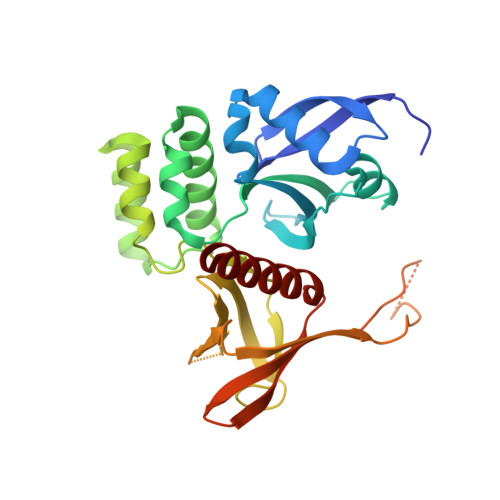
Structure of the SNX17 atypical FERM domain bound to the NPxY motif of P-selectin


Experimental Data Snapshot

  • Method: X-RAY DIFFRACTION
  • Resolution: 1.80 Å
  • R-Value Free: 
    0.204 (Depositor), 0.202 (DCC) 
  • R-Value Work: 
    0.177 (Depositor), 0.176 (DCC) 
  • R-Value Observed: 
    0.178 (Depositor) 

wwPDB Validation 3D Report Full Report

Validation slider image for 4GXB

This is version 1.1 of the entry. See complete history

Literature

Structural basis for endosomal trafficking of diverse transmembrane cargos by PX-FERM proteins.

Ghai, R.Bugarcic, A.Liu, H.Norwood, S.J.Skeldal, S.Coulson, E.J.Li, S.S.Teasdale, R.D.Collins, B.M.

(2013) Proc Natl Acad Sci U S A 110: E643-E652

  • DOI: https://doi.org/10.1073/pnas.1216229110
  • Primary Citation Related Structures: 
    4GXB

  • PubMed Abstract: 

    Transit of proteins through the endosomal organelle following endocytosis is critical for regulating the homeostasis of cell-surface proteins and controlling signal transduction pathways. However, the mechanisms that control these membrane-transport processes are poorly understood. The Phox-homology (PX) domain-containing proteins sorting nexin (SNX) 17, SNX27, and SNX31 have emerged recently as key regulators of endosomal recycling and bind conserved Asn-Pro-Xaa-Tyr-sorting signals in transmembrane cargos via an atypical band, 4.1/ezrin/radixin/moesin (FERM) domain. Here we present the crystal structure of the SNX17 FERM domain bound to the sorting motif of the P-selectin adhesion protein, revealing both the architecture of the atypical FERM domain and the molecular basis for recognition of these essential sorting sequences. We further show that the PX-FERM proteins share a promiscuous ability to bind a wide array of putative cargo molecules, including receptor tyrosine kinases, and propose a model for their coordinated molecular interactions with membrane, cargo, and regulatory proteins.


  • Organizational Affiliation
    • Institute for Molecular Bioscience, The University of Queensland, St. Lucia, QLD 4072, Australia.

Macromolecule Content 

  • Total Structure Weight: 36.37 kDa 
  • Atom Count: 2,619 
  • Modeled Residue Count: 278 
  • Deposited Residue Count: 321 
  • Unique protein chains: 2

Macromolecules

Find similar proteins by:|  3D Structure
Entity ID: 1
MoleculeChains  Sequence LengthOrganismDetailsImage
Sorting nexin-17280Homo sapiensMutation(s): 0 
Gene Names: SNX17
UniProt & NIH Common Fund Data Resources
Find proteins for Q15036 (Homo sapiens)
Explore Q15036 
Go to UniProtKB:  Q15036
PHAROS:  Q15036
GTEx:  ENSG00000115234 
Entity Groups
Sequence Clusters30% Identity50% Identity70% Identity90% Identity95% Identity100% Identity
UniProt GroupQ15036
Sequence Annotations
Expand
Reference Sequence
Find similar proteins by:|  3D Structure
Entity ID: 2
MoleculeChains  Sequence LengthOrganismDetailsImage
P-selectin41Mus musculusMutation(s): 0 
Gene Names: Selp
UniProt
Find proteins for Q01102 (Mus musculus)
Explore Q01102 
Go to UniProtKB:  Q01102
Entity Groups
Sequence Clusters30% Identity50% Identity70% Identity90% Identity95% Identity100% Identity
UniProt GroupQ01102
Sequence Annotations
Expand
Reference Sequence

Small Molecules

Ligands 1 Unique
IDChains Name / Formula / InChI Key2D Diagram3D Interactions
GOL

Query on GOL


Download:Ideal Coordinates CCD File
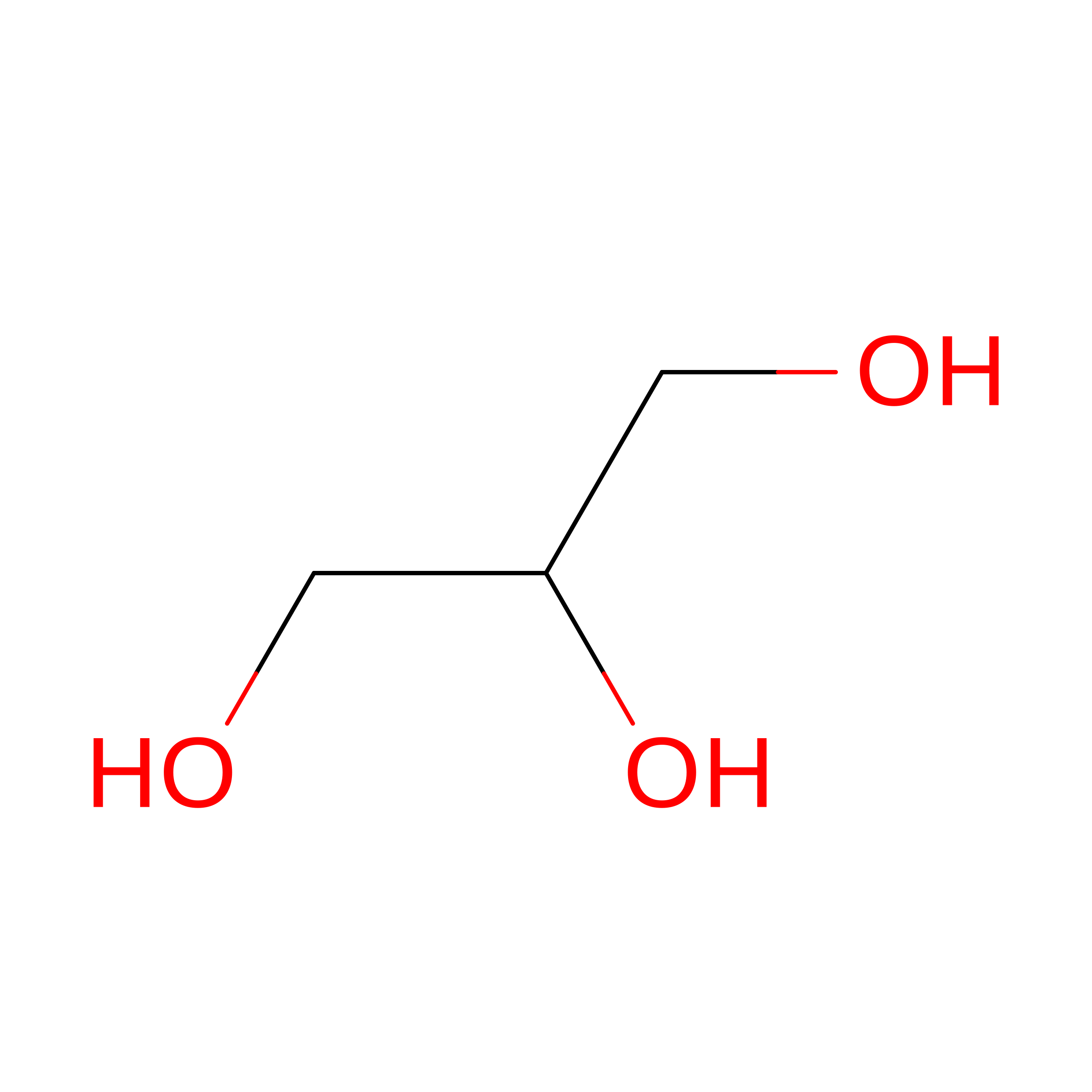
C [auth A]GLYCEROL
C3 H8 O3
PEDCQBHIVMGVHV-UHFFFAOYSA-N

Experimental Data & Validation

Experimental Data

  • Method: X-RAY DIFFRACTION
  • Resolution: 1.80 Å
  • R-Value Free:  0.204 (Depositor), 0.202 (DCC) 
  • R-Value Work:  0.177 (Depositor), 0.176 (DCC) 
  • R-Value Observed: 0.178 (Depositor) 
Space Group: P 31 2 1
Unit Cell:
Length ( Å )Angle ( ˚ )
a = 93.754α = 90
b = 93.754β = 90
c = 91.308γ = 120
Software Package:
Software NamePurpose
Blu-Icedata collection
SOLVEphasing
PHENIXrefinement
MOSFLMdata reduction
SCALAdata scaling

Structure Validation

View Full Validation Report


Entry History 

Deposition Data

Revision History  (Full details and data files)

  • Version 1.0: 2013-03-13
    Type: Initial release
  • Version 1.1: 2024-03-20
    Changes: Data collection, Database references, Derived calculations