Download Mendeley
Computational design of self-assembling cyclic protein homo-oligomers.
Fallas, J.A., Ueda, G., Sheffler, W., Nguyen, V., McNamara, D.E., Sankaran, B., Pereira, J.H., Parmeggiani, F., Brunette, T.J., Cascio, D., Yeates, T.R., Zwart, P., Baker, D.(2017) Nat Chem 9: 353-360
- PubMed: 28338692 Search on PubMedSearch on PubMed Central
- DOI: https://doi.org/10.1038/nchem.2673
- Primary Citation Related Structures:
4GMR, 4GPM, 4HB5, 4HXT, 5HRY, 5HRZ, 5HS0, 5K7V, 5KBA, 5KWD - PubMed Abstract:
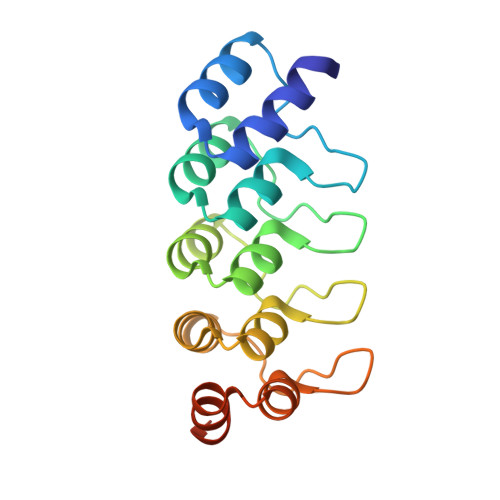
Self-assembling cyclic protein homo-oligomers play important roles in biology, and the ability to generate custom homo-oligomeric structures could enable new approaches to probe biological function. Here we report a general approach to design cyclic homo-oligomers that employs a new residue-pair-transform method to assess the designability of a protein-protein interface. This method is sufficiently rapid to enable the systematic enumeration of cyclically docked arrangements of a monomer followed by sequence design of the newly formed interfaces. We use this method to design interfaces onto idealized repeat proteins that direct their assembly into complexes that possess cyclic symmetry. Of 96 designs that were characterized experimentally, 21 were found to form stable monodisperse homo-oligomers in solution, and 15 (four homodimers, six homotrimers, six homotetramers and one homopentamer) had solution small-angle X-ray scattering data consistent with the design models. X-ray crystal structures were obtained for five of the designs and each is very close to their corresponding computational model.
- Department of Biochemistry, University of Washington, Seattle, Washington 98195, USA.
Organizational Affiliation: