4GMY | pdb_00004gmy

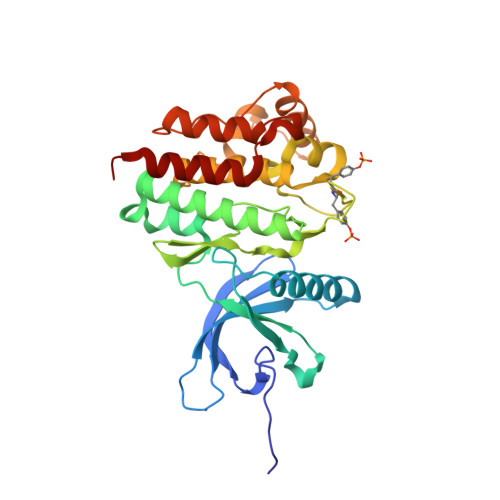
JAK2 kinase (JH1 domain) in complex with 2,6-DICHLORO-N-{2-[(CYCLOPROPYLCARBONYL)AMINO]PYRIDIN-4-YL}BENZAMIDE


Experimental Data Snapshot

  • Method: X-RAY DIFFRACTION
  • Resolution: 2.40 Å
  • R-Value Free: 
    0.233 (Depositor), 0.232 (DCC) 
  • R-Value Work: 
    0.164 (Depositor), 0.169 (DCC) 
  • R-Value Observed: 
    0.167 (Depositor) 

wwPDB Validation 3D Report Full Report

Validation slider image for 4GMY

Ligand Structure Quality Assessment 


This is version 1.2 of the entry. See complete history

Literature

Lead identification of novel and selective TYK2 inhibitors.

Liang, J.Tsui, V.Van Abbema, A.Bao, L.Barrett, K.Beresini, M.Berezhkovskiy, L.Blair, W.S.Chang, C.Driscoll, J.Eigenbrot, C.Ghilardi, N.Gibbons, P.Halladay, J.Johnson, A.Kohli, P.B.Lai, Y.Liimatta, M.Mantik, P.Menghrajani, K.Murray, J.Sambrone, A.Xiao, Y.Shia, S.Shin, Y.Smith, J.Sohn, S.Stanley, M.Ultsch, M.Zhang, B.Wu, L.C.Magnuson, S.

(2013) Eur J Med Chem 67: 175-187

  • DOI: https://doi.org/10.1016/j.ejmech.2013.03.070
  • Primary Citation Related Structures: 
    4GFM, 4GFO, 4GIH, 4GMY, 4GVJ

  • PubMed Abstract: 

    A therapeutic rationale is proposed for the treatment of inflammatory diseases, such as psoriasis and inflammatory bowel diseases (IBD), by selective targeting of TYK2. Hit triage, following a high-throughput screen for TYK2 inhibitors, revealed pyridine 1 as a promising starting point for lead identification. Initial expansion of 3 separate regions of the molecule led to eventual identification of cyclopropyl amide 46, a potent lead analog with good kinase selectivity, physicochemical properties, and pharmacokinetic profile. Analysis of the binding modes of the series in TYK2 and JAK2 crystal structures revealed key interactions leading to good TYK2 potency and design options for future optimization of selectivity.


  • Organizational Affiliation
    • Department of Discovery Chemistry, Genentech, Inc., 1 DNA Way, South San Francisco, CA 94080, United States.

Macromolecule Content 

  • Total Structure Weight: 35.84 kDa 
  • Atom Count: 2,684 
  • Modeled Residue Count: 300 
  • Deposited Residue Count: 302 
  • Unique protein chains: 1

Macromolecules

Find similar proteins by:|  3D Structure
Entity ID: 1
MoleculeChains  Sequence LengthOrganismDetailsImage
Tyrosine-protein kinase JAK2302Homo sapiensMutation(s): 0 
Gene Names: JAK2
EC: 2.7.10.2
UniProt & NIH Common Fund Data Resources
Find proteins for O60674 (Homo sapiens)
Explore O60674 
Go to UniProtKB:  O60674
PHAROS:  O60674
GTEx:  ENSG00000096968 
Entity Groups
Sequence Clusters30% Identity50% Identity70% Identity90% Identity95% Identity100% Identity
UniProt GroupO60674
Sequence Annotations
Expand
Reference Sequence

Small Molecules

Ligands 1 Unique
IDChains Name / Formula / InChI Key2D Diagram3D Interactions
0X5

Query on 0X5


Download:Ideal Coordinates CCD File
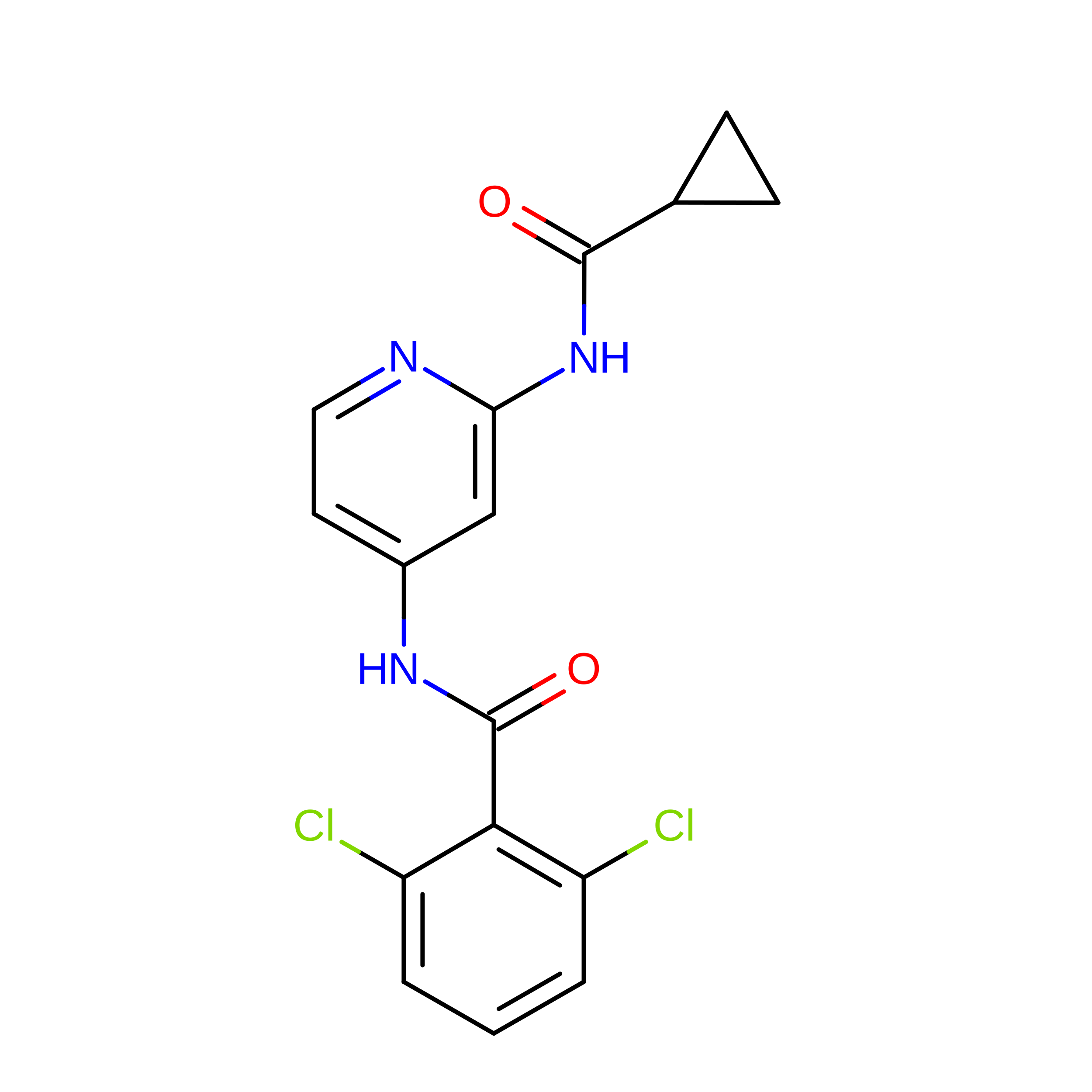
B [auth A]2,6-dichloro-N-{2-[(cyclopropylcarbonyl)amino]pyridin-4-yl}benzamide
C16 H13 Cl2 N3 O2
IAFNAEGXTKTGHN-UHFFFAOYSA-N
Modified Residues  1 Unique
IDChains TypeFormula2D DiagramParent
PTR
Query on PTR
A
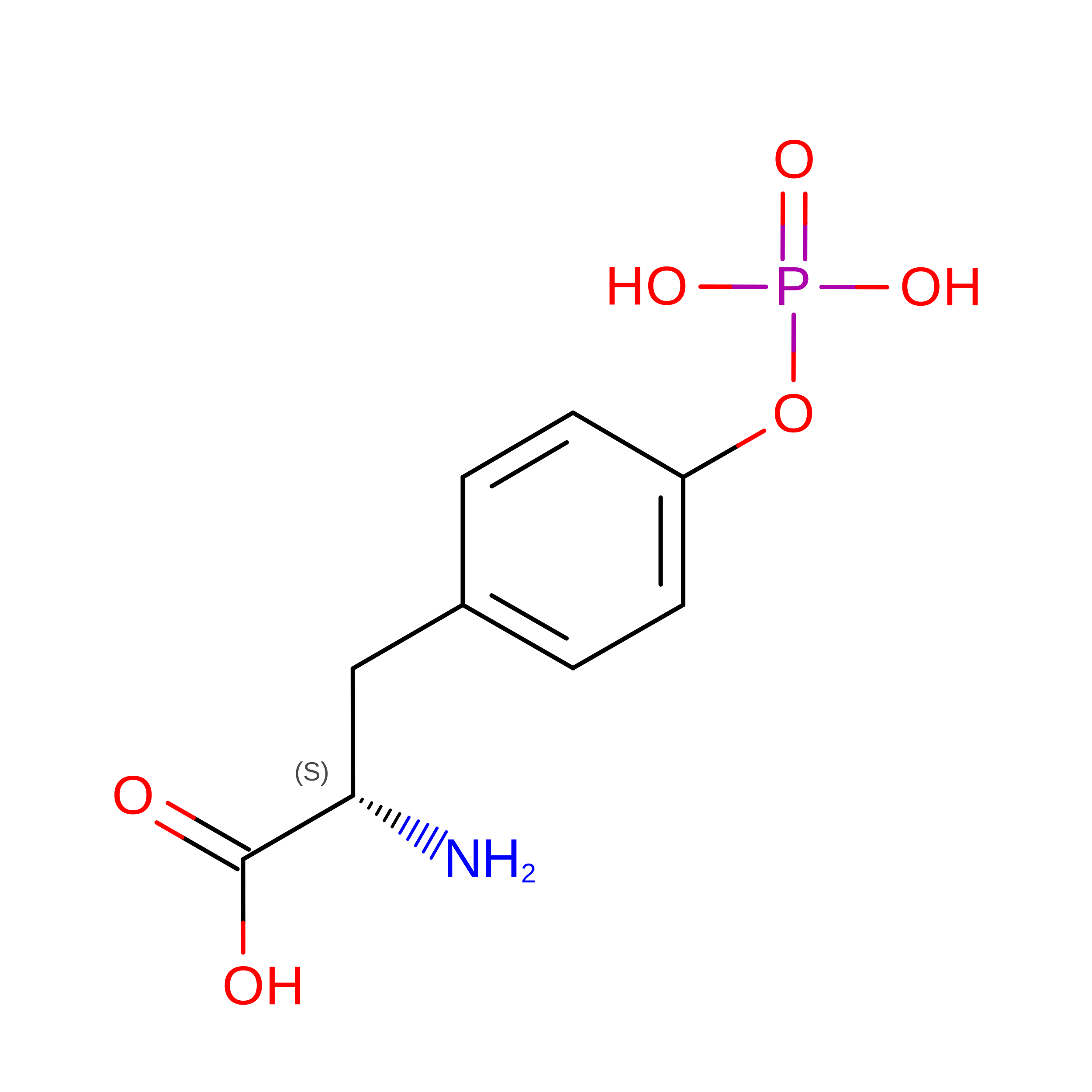
L-PEPTIDE LINKINGC9 H12 N O6 PTYR
Binding Affinity Annotations 
IDSourceBinding Affinity
0X5 BindingDB:  4GMY Ki: 28 (nM) from 1 assay(s)
EC50: 1700 (nM) from 1 assay(s)

Experimental Data & Validation

Experimental Data

  • Method: X-RAY DIFFRACTION
  • Resolution: 2.40 Å
  • R-Value Free:  0.233 (Depositor), 0.232 (DCC) 
  • R-Value Work:  0.164 (Depositor), 0.169 (DCC) 
  • R-Value Observed: 0.167 (Depositor) 
Space Group: C 1 2 1
Unit Cell:
Length ( Å )Angle ( ˚ )
a = 107.532α = 90
b = 69.361β = 98.96
c = 50.468γ = 90
Software Package:
Software NamePurpose
DENZOdata reduction
SCALEPACKdata scaling
PHASERphasing
PHENIXrefinement
PDB_EXTRACTdata extraction
HKL-2000data collection

Structure Validation

View Full Validation Report


Ligand Structure Quality Assessment 


Entry History 

Deposition Data

Revision History  (Full details and data files)

  • Version 1.0: 2013-06-19
    Type: Initial release
  • Version 1.1: 2013-08-07
    Changes: Database references
  • Version 1.2: 2024-11-20
    Changes: Data collection, Database references, Derived calculations, Structure summary