4GA1 | pdb_00004ga1

Structure of the N-terminal domain of Nup358


Experimental Data Snapshot

  • Method: X-RAY DIFFRACTION
  • Resolution: 1.15 Å
  • R-Value Free: 
    0.223 (Depositor), 0.393 (DCC) 
  • R-Value Work: 
    0.193 (Depositor), 0.390 (DCC) 
  • R-Value Observed: 
    0.195 (Depositor) 

wwPDB Validation 3D Report Full Report

Validation slider image for 4GA1

This is version 1.2 of the entry. See complete history

Literature

Crystal structure of the N-terminal domain of Nup358/RanBP2.

Kassube, S.A.Stuwe, T.Lin, D.H.Antonuk, C.D.Napetschnig, J.Blobel, G.Hoelz, A.

(2012) J Mol Biology 423: 752-765

  • DOI: https://doi.org/10.1016/j.jmb.2012.08.026
  • Primary Citation Related Structures: 
    4GA0, 4GA1, 4GA2

  • PubMed Abstract: 

    Key steps in mRNA export are the nuclear assembly of messenger ribonucleoprotein particles (mRNPs), the translocation of mRNPs through the nuclear pore complex (NPC), and the mRNP remodeling events at the cytoplasmic side of the NPC. Nup358/RanBP2 is a constituent of the cytoplasmic filaments of the NPC specific to higher eukaryotes and provides a multitude of binding sites for the nucleocytoplasmic transport machinery. Here, we present the crystal structure of the Nup358 N-terminal domain (NTD) at 0.95Å resolution. The structure reveals an α-helical domain that harbors three central tetratricopeptide repeats (TPRs), flanked on each side by an additional solvating amphipathic α helix. Overall, the NTD adopts an unusual extended conformation that lacks the characteristic peptide-binding groove observed in canonical TPR domains. Strikingly, the vast majority of the NTD surface exhibits an evolutionarily conserved, positive electrostatic potential, and we demonstrate that the NTD possesses the capability to bind single-stranded RNA in solution. Together, these data suggest that the NTD contributes to mRNP remodeling events at the cytoplasmic face of the NPC.


  • Organizational Affiliation
    • Laboratory of Cell Biology, Howard Hughes Medical Institute, The Rockefeller University, 1230 York Avenue, New York, NY 10065, USA.

Macromolecule Content 

  • Total Structure Weight: 17.51 kDa 
  • Atom Count: 1,434 
  • Modeled Residue Count: 143 
  • Deposited Residue Count: 150 
  • Unique protein chains: 1

Macromolecules

Find similar proteins by:|  3D Structure
Entity ID: 1
MoleculeChains  Sequence LengthOrganismDetailsImage
E3 SUMO-PROTEIN LIGASE RANBP2150Pan troglodytesMutation(s): 3 
Gene Names: ENSG00000153201
EC: 2.3.2
UniProt
Find proteins for H2QII6 (Pan troglodytes)
Explore H2QII6 
Go to UniProtKB:  H2QII6
Entity Groups
Sequence Clusters30% Identity50% Identity70% Identity90% Identity95% Identity100% Identity
UniProt GroupH2QII6
Sequence Annotations
Expand
Reference Sequence

Small Molecules

Modified Residues  1 Unique
IDChains TypeFormula2D DiagramParent
MSE
Query on MSE
A
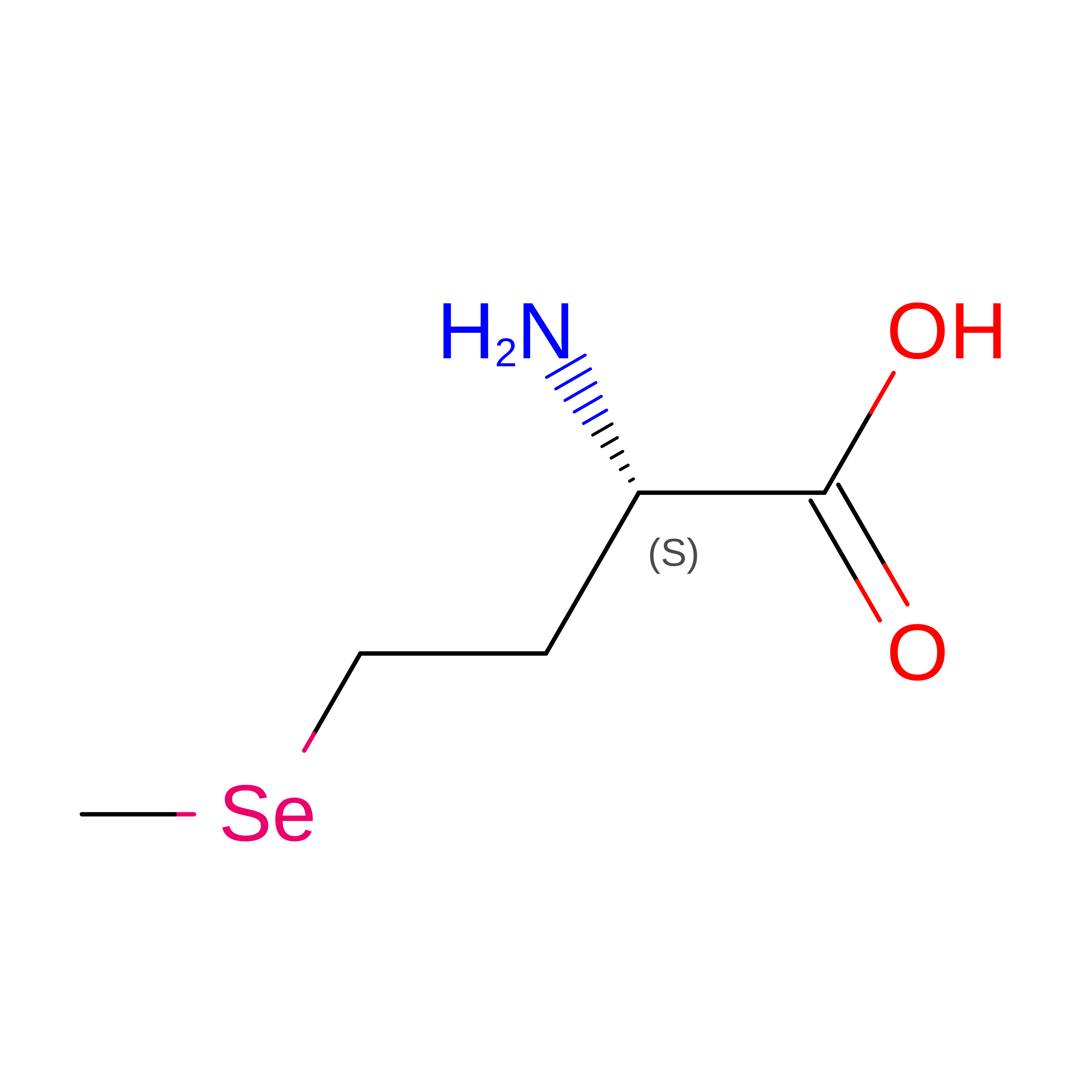
L-PEPTIDE LINKINGC5 H11 N O2 SeMET

Experimental Data & Validation

Experimental Data

  • Method: X-RAY DIFFRACTION
  • Resolution: 1.15 Å
  • R-Value Free:  0.223 (Depositor), 0.393 (DCC) 
  • R-Value Work:  0.193 (Depositor), 0.390 (DCC) 
  • R-Value Observed: 0.195 (Depositor) 
Space Group: P 21 21 2
Unit Cell:
Length ( Å )Angle ( ˚ )
a = 58.387α = 90
b = 83.641β = 90
c = 29.984γ = 90
Software Package:
Software NamePurpose
PHENIXrefinement
PDB_EXTRACTdata extraction
HKL-2000data collection
HKL-2000data reduction
SCALEPACKdata scaling
SHARPphasing

Structure Validation

View Full Validation Report


Entry History 

Deposition Data

Revision History  (Full details and data files)

  • Version 1.0: 2012-09-26
    Type: Initial release
  • Version 1.1: 2013-01-02
    Changes: Database references
  • Version 1.2: 2024-11-20
    Changes: Data collection, Database references, Derived calculations, Structure summary