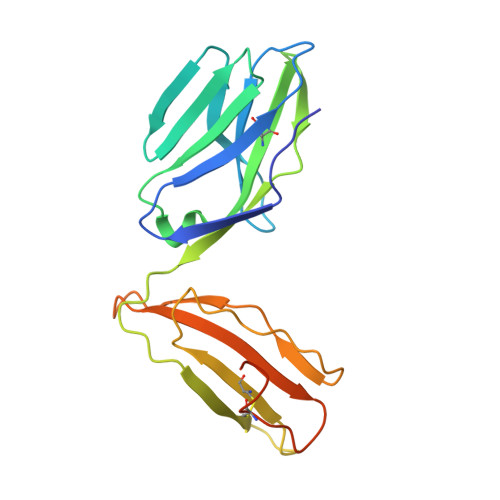
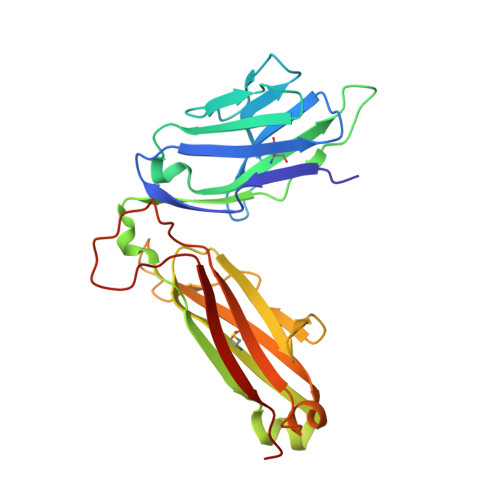
4G8F | pdb_00004g8f

Crystal Structure of clone42 TCR


Experimental Data Snapshot

  • Method: X-RAY DIFFRACTION
  • Resolution: 2.10 Å
  • R-Value Free: 
    0.236 (Depositor), 0.251 (DCC) 
  • R-Value Work: 
    0.203 (Depositor), 0.215 (DCC) 
  • R-Value Observed: 
    0.204 (Depositor) 

Starting Model: experimental
View more details

wwPDB Validation 3D Report Full Report

Validation slider image for 4G8F

This is version 1.5 of the entry. See complete history. 

Literature

A conserved human T cell population targets mycobacterial antigens presented by CD1b.

Van Rhijn, I., Kasmar, A., de Jong, A., Gras, S., Bhati, M., Doorenspleet, M.E., de Vries, N., Godfrey, D.I., Altman, J.D., de Jager, W., Rossjohn, J., Moody, D.B.

(2013) Nat Immunol 14: 706-713

  • DOI: https://doi.org/10.1038/ni.2630
  • Primary Citation Related Structures: 
    4G8E, 4G8F

  • PubMed Abstract: 

    Human T cell antigen receptors (TCRs) pair in millions of combinations to create complex and unique T cell repertoires for each person. Through the use of tetramers to analyze TCRs reactive to the antigen-presenting molecule CD1b, we detected T cells with highly stereotyped TCR α-chains present among genetically unrelated patients with tuberculosis. The germline-encoded, mycolyl lipid-reactive (GEM) TCRs had an α-chain bearing the variable (V) region TRAV1-2 rearranged to the joining (J) region TRAJ9 with few nontemplated (N)-region additions. Analysis of TCRs by high-throughput sequencing, binding and crystallography showed linkage of TCRα sequence motifs to high-affinity recognition of antigen. Thus, the CD1-reactive TCR repertoire is composed of at least two compartments: high-affinity GEM TCRs, and more-diverse TCRs with low affinity for CD1b-lipid complexes. We found high interdonor conservation of TCRs that probably resulted from selection by a nonpolymorphic antigen-presenting molecule and an immunodominant antigen.


  • Organizational Affiliation: 
    • Division of Rheumatology, Immunology and Allergy, Brigham and Women's Hospital, Harvard Medical School, Boston, Massachusetts, USA. i.vanrhijn@uu.nl

Macromolecule Content 

  • Total Structure Weight: 49.96 kDa 
  • Atom Count: 3,654 
  • Modeled Residue Count: 427 
  • Deposited Residue Count: 447 
  • Unique protein chains: 2

Macromolecules

Find similar proteins by:|  3D Structure
Entity ID: 1
MoleculeChains  Sequence LengthOrganismDetailsImage
alpha chain clone 42 TCR204Homo sapiensMutation(s): 0 
UniProt & NIH Common Fund Data Resources
Find proteins for P01848 (Homo sapiens)
Explore P01848 
Go to UniProtKB:  P01848
PHAROS:  P01848
Entity Groups
Sequence Clusters30% Identity50% Identity70% Identity90% Identity95% Identity100% Identity
UniProt GroupP01848
Sequence Annotations
Expand
Reference Sequence
Find similar proteins by:|  3D Structure
Entity ID: 2
MoleculeChains  Sequence LengthOrganismDetailsImage
beta chain clone 42 TCR243Homo sapiensMutation(s): 0 
UniProt
Find proteins for P01850 (Homo sapiens)
Explore P01850 
Go to UniProtKB:  P01850
Entity Groups
Sequence Clusters30% Identity50% Identity70% Identity90% Identity95% Identity100% Identity
UniProt GroupP01850
Sequence Annotations
Expand
Reference Sequence

Experimental Data & Validation

Experimental Data

  • Method: X-RAY DIFFRACTION
  • Resolution: 2.10 Å
  • R-Value Free:  0.236 (Depositor), 0.251 (DCC) 
  • R-Value Work:  0.203 (Depositor), 0.215 (DCC) 
  • R-Value Observed: 0.204 (Depositor) 
Space Group: P 1 21 1
Unit Cell:
Length ( Å )Angle ( ˚ )
a = 46.52α = 90
b = 56.79β = 101.43
c = 85.89γ = 90
Software Package:
Software NamePurpose
XSCALEdata scaling
PHASERphasing
BUSTER-TNTrefinement
PDB_EXTRACTdata extraction
Blu-Icedata collection
XDSdata reduction
BUSTERrefinement

Structure Validation

View Full Validation Report


Entry History 

Deposition Data

Revision History  (Full details and data files)

  • Version 1.0: 2013-05-08
    Type: Initial release
  • Version 1.1: 2013-07-03
    Changes: Database references
  • Version 1.2: 2013-07-10
    Changes: Database references
  • Version 1.3: 2017-10-11
    Changes: Data collection, Refinement description
  • Version 1.4: 2023-09-13
    Changes: Data collection, Database references, Refinement description
  • Version 1.5: 2024-11-27
    Changes: Structure summary