4FYC | pdb_00004fyc

Structural and functional characterizations of a thioredoxin-fold protein from Helicobacter pylori


Experimental Data Snapshot

  • Method: X-RAY DIFFRACTION
  • Resolution: 2.31 Å
  • R-Value Free: 
    0.238 (Depositor), 0.239 (DCC) 
  • R-Value Work: 
    0.191 (Depositor), 0.201 (DCC) 
  • R-Value Observed: 
    0.193 (Depositor) 

Starting Model: experimental
View more details

wwPDB Validation 3D Report Full Report

Validation slider image for 4FYC

This is version 1.2 of the entry. See complete history

Literature

Structural and functional characterization of HP0377, a thioredoxin-fold protein from Helicobacter pylori

Yoon, J.Y.Kim, J.An, D.R.Lee, S.J.Kim, H.S.Im, H.N.Yoon, H.J.Kim, J.Y.Kim, S.J.Han, B.W.Suh, S.W.

(2013) Acta Crystallogr D Biol Crystallogr 69: 735-746

  • DOI: https://doi.org/10.1107/S0907444913001236
  • Primary Citation Related Structures: 
    4FYB, 4FYC

  • PubMed Abstract: 

    Maturation of cytochrome c is carried out in the bacterial periplasm, where specialized thiol-disulfide oxidoreductases provide the correct reduction of oxidized apocytochrome c before covalent haem attachment. HP0377 from Helicobacter pylori is a thioredoxin-fold protein that has been implicated as a component of system II for cytochrome c assembly and shows limited sequence similarity to Escherichia coli DsbC, a disulfide-bond isomerase. To better understand the role of HP0377, its crystal structures have been determined in both reduced and partially oxidized states, which are highly similar to each other. Sedimentation-equilibrium experiments indicate that HP0377 is monomeric in solution. HP0377 adopts a thioredoxin fold but shows distinctive variations as in other thioredoxin-like bacterial periplasmic proteins. The active site of HP0377 closely resembles that of E. coli DsbC. A reductase assay suggests that HP0377 may play a role as a reductase in the biogenesis of holocytochrome c553 (HP1227). Binding experiments indicate that it can form a covalent complex with HP0518, a putative L,D-transpeptidase with a catalytic cysteine residue, via a disulfide bond. Furthermore, physicochemical properties of HP0377 and its R86A variant have been determined. These results suggest that HP0377 may perform multiple functions as a reductase in H. pylori.


  • Organizational Affiliation
    • Department of Chemistry, College of Natural Sciences, Seoul National University, Seoul 151-742, Republic of Korea.

Macromolecule Content 

  • Total Structure Weight: 55.29 kDa 
  • Atom Count: 2,709 
  • Modeled Residue Count: 323 
  • Deposited Residue Count: 482 
  • Unique protein chains: 1

Macromolecules

Find similar proteins by:|  3D Structure
Entity ID: 1
MoleculeChains  Sequence LengthOrganismDetailsImage
Thiol:disulfide interchange protein (DsbC)
A, B
241Helicobacter pylori 26695Mutation(s): 0 
Gene Names: HP_0377
UniProt
Find proteins for O25140 (Helicobacter pylori (strain ATCC 700392 / 26695))
Explore O25140 
Go to UniProtKB:  O25140
Entity Groups
Sequence Clusters30% Identity50% Identity70% Identity90% Identity95% Identity100% Identity
UniProt GroupO25140
Sequence Annotations
Expand
Reference Sequence

Small Molecules

Ligands 1 Unique
IDChains Name / Formula / InChI Key2D Diagram3D Interactions
PG4

Query on PG4


Download:Ideal Coordinates CCD File
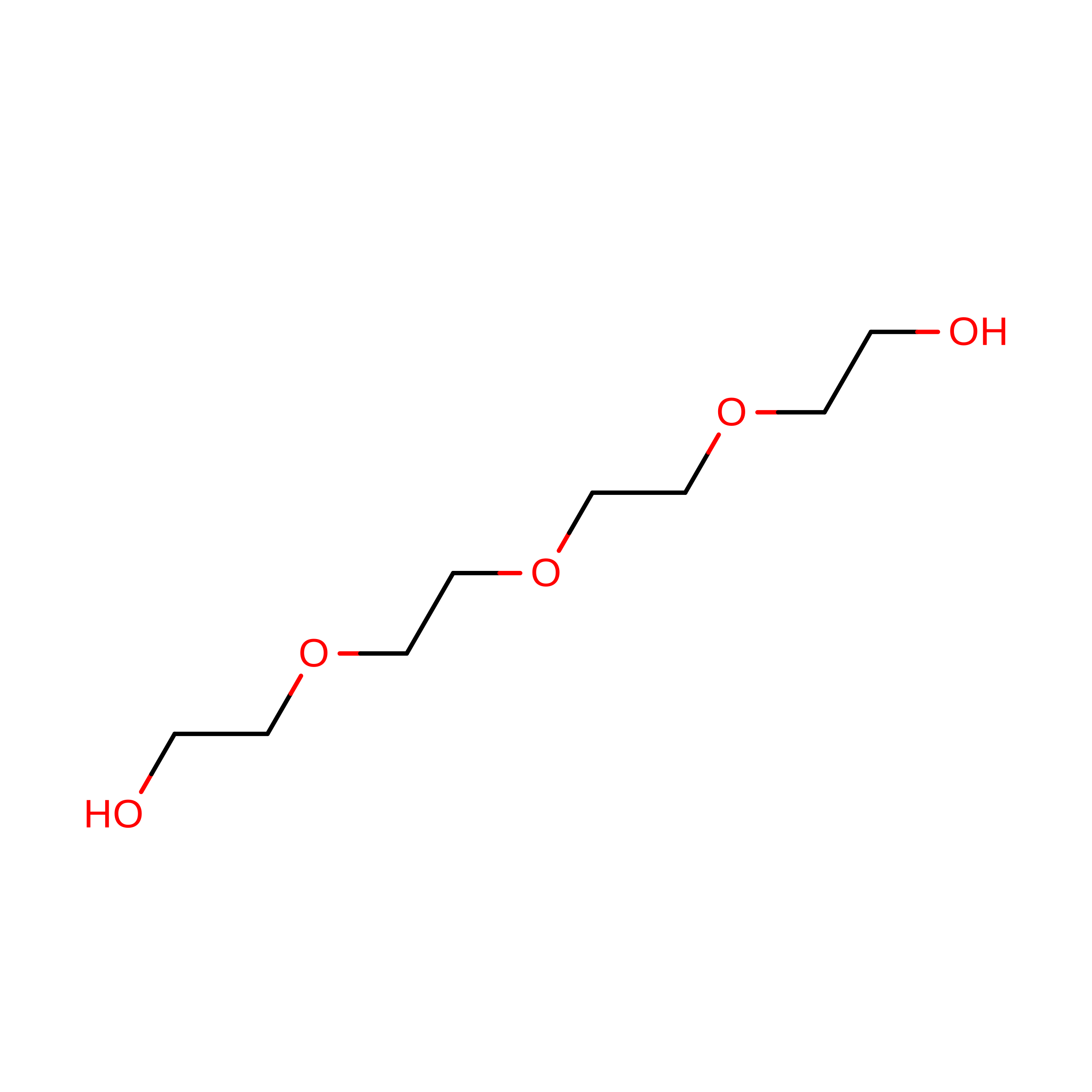
C [auth A]TETRAETHYLENE GLYCOL
C8 H18 O5
UWHCKJMYHZGTIT-UHFFFAOYSA-N

Experimental Data & Validation

Experimental Data

  • Method: X-RAY DIFFRACTION
  • Resolution: 2.31 Å
  • R-Value Free:  0.238 (Depositor), 0.239 (DCC) 
  • R-Value Work:  0.191 (Depositor), 0.201 (DCC) 
  • R-Value Observed: 0.193 (Depositor) 
Space Group: C 1 2 1
Unit Cell:
Length ( Å )Angle ( ˚ )
a = 140.858α = 90
b = 43.953β = 112.29
c = 76.699γ = 90
Software Package:
Software NamePurpose
REFMACrefinement
HKL-2000data reduction
HKL-2000data scaling

Structure Validation

View Full Validation Report


Entry History 

Deposition Data

Revision History  (Full details and data files)

  • Version 1.0: 2013-05-08
    Type: Initial release
  • Version 1.1: 2013-09-11
    Changes: Database references
  • Version 1.2: 2023-11-08
    Changes: Data collection, Database references, Derived calculations, Refinement description