4FGN | pdb_00004fgn

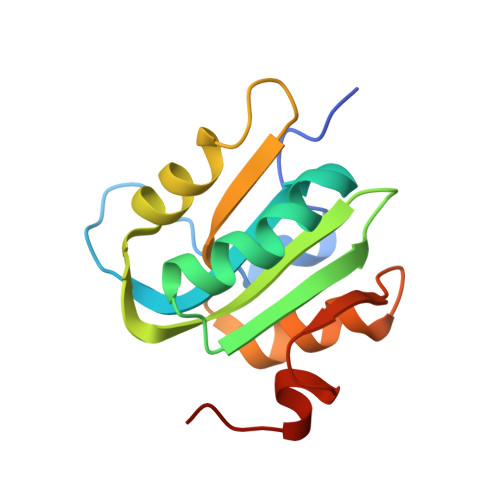
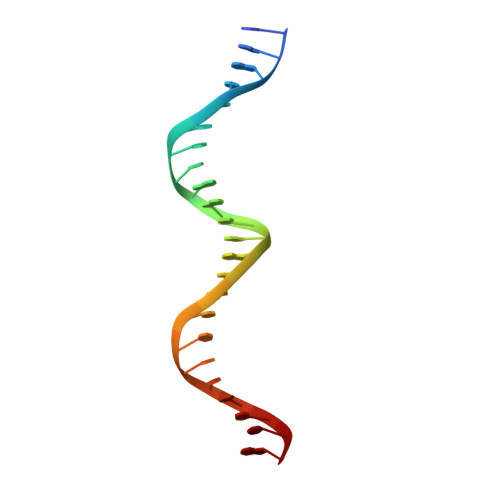
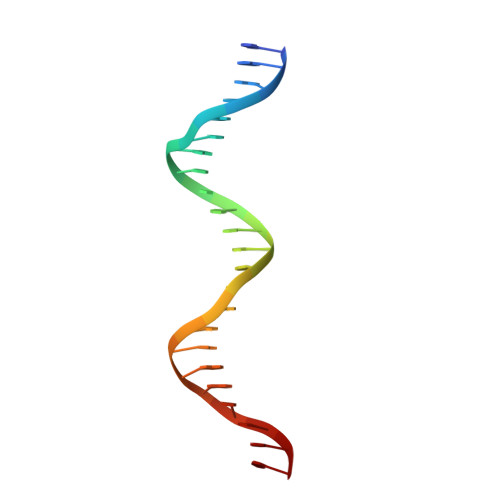
Crystal structure of the SV40 large T-antigen origin bining domain bound to Site I DNA


Experimental Data Snapshot

  • Method: X-RAY DIFFRACTION
  • Resolution: 3.20 Å
  • R-Value Free: 
    0.267 (Depositor), 0.267 (DCC) 
  • R-Value Work: 
    0.188 (Depositor), 0.185 (DCC) 
  • R-Value Observed: 
    0.191 (Depositor) 

Starting Model: experimental
View more details

wwPDB Validation 3D Report Full Report

Validation slider image for 4FGN

This is version 1.2 of the entry. See complete history

Literature

Analysis of the Costructure of the Simian Virus 40 T-Antigen Origin Binding Domain with Site I Reveals a Correlation between GAGGC Spacing and Spiral Assembly.

Meinke, G.Phelan, P.J.Harrison, C.J.Bullock, P.A.

(2013) J Virol 87: 2923-2934

  • DOI: https://doi.org/10.1128/JVI.02549-12
  • Primary Citation Related Structures: 
    4FGN

  • PubMed Abstract: 

    Polyomavirus origins of replication contain multiple occurrences of G(A/G)GGC, the high-affinity binding element for the viral initiator T-antigen (T-ag). The site I regulatory region of simian virus 40, involved in the repression of transcription and the enhancement of DNA replication initiation, contains two GAGGC sequences arranged head to tail and separated by a 7-bp AT-rich sequence. We have solved a 3.2-Å costructure of the SV40 origin-binding domain (OBD) bound to site I. We have also established that T-ag assembly on site I is limited to the formation of a single hexamer. These observations have enabled an analysis of the role(s) of the OBDs bound to the site I pentanucleotides in hexamer formation. Of interest, they reveal a correlation between the OBDs bound to site I and a pair of OBD subunits in the previously described hexameric spiral structure. Based on these findings, we propose that spiral assembly is promoted by pentanucleotide pairs arranged in a head-to-tail manner. Finally, the possibility that spiral assembly by OBD subunits accounts for the heterogeneous distribution of pentanucleotides found in the origins of replication of polyomaviruses is discussed.


  • Organizational Affiliation
    • Department of Biochemistry, Tufts University School of Medicine, Boston, Massachusetts, USA.

Macromolecule Content 

  • Total Structure Weight: 44.6 kDa 
  • Atom Count: 2,967 
  • Modeled Residue Count: 296 
  • Deposited Residue Count: 310 
  • Unique protein chains: 1
  • Unique nucleic acid chains: 2

Macromolecules


Find similar proteins by:|  3D Structure
Entity ID: 1
MoleculeChains  Sequence LengthOrganismDetailsImage
Large T antigen
A, B
132Betapolyomavirus macacaeMutation(s): 0 
EC: 3.6.4 (PDB Primary Data), 5.6.2.4 (UniProt)
UniProt
Find proteins for P03070 (Simian virus 40)
Explore P03070 
Go to UniProtKB:  P03070
Entity Groups
Sequence Clusters30% Identity50% Identity70% Identity90% Identity95% Identity100% Identity
UniProt GroupP03070
Sequence Annotations
Expand
Reference Sequence
Find similar nucleic acids by:  Sequence
Entity ID: 2
MoleculeChains LengthOrganismImage
Site I DNAC [auth Z]23Betapolyomavirus macacae
Sequence Annotations
Expand
Reference Sequence
Find similar nucleic acids by:  Sequence
Entity ID: 3
MoleculeChains LengthOrganismImage
Site I DNAD [auth Y]23Betapolyomavirus macacae
Sequence Annotations
Expand
Reference Sequence

Experimental Data & Validation

Experimental Data

  • Method: X-RAY DIFFRACTION
  • Resolution: 3.20 Å
  • R-Value Free:  0.267 (Depositor), 0.267 (DCC) 
  • R-Value Work:  0.188 (Depositor), 0.185 (DCC) 
  • R-Value Observed: 0.191 (Depositor) 
Space Group: C 2 2 21
Unit Cell:
Length ( Å )Angle ( ˚ )
a = 58.604α = 90
b = 139.672β = 90
c = 132.112γ = 90
Software Package:
Software NamePurpose
CBASSdata collection
PHASERphasing
REFMACrefinement
HKL-2000data reduction
SCALEPACKdata scaling

Structure Validation

View Full Validation Report


Entry History 

Deposition Data

Revision History  (Full details and data files)

  • Version 1.0: 2013-01-23
    Type: Initial release
  • Version 1.1: 2013-02-27
    Changes: Database references
  • Version 1.2: 2023-09-13
    Changes: Data collection, Database references, Refinement description