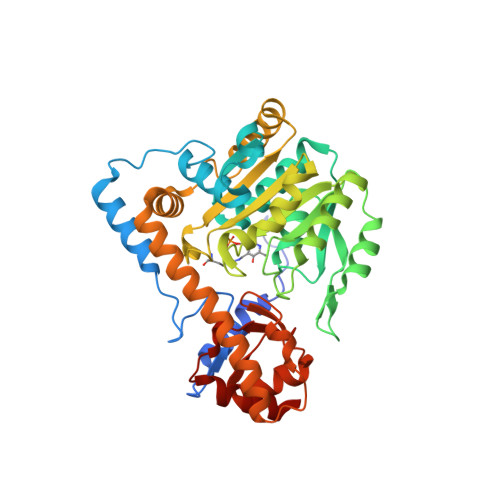
4F5I | pdb_00004f5i

Substrate Specificity Conversion of E. coli Pyridoxal-5'-Phosphate Dependent Aspartate Aminotransferase to Tyrosine Aminotransferase: Chimera P4.


Experimental Data Snapshot

  • Method: X-RAY DIFFRACTION
  • Resolution: 2.20 Å
  • R-Value Free: 
    0.212 (Depositor), 0.205 (DCC) 
  • R-Value Work: 
    0.173 (Depositor), 0.168 (DCC) 
  • R-Value Observed: 
    0.175 (Depositor) 

wwPDB Validation 3D Report Full Report

Validation slider image for 4F5I

This is version 1.3 of the entry. See complete history

Literature

Janus: prediction and ranking of mutations required for functional interconversion of enzymes.

Addington, T.A.Mertz, R.W.Siegel, J.B.Thompson, J.M.Fisher, A.J.Filkov, V.Fleischman, N.M.Suen, A.A.Zhang, C.Toney, M.D.

(2013) J Mol Biology 425: 1378-1389

  • DOI: https://doi.org/10.1016/j.jmb.2013.01.034
  • Primary Citation Related Structures: 
    4F5F, 4F5G, 4F5H, 4F5I, 4F5J, 4F5K, 4F5M

  • PubMed Abstract: 

    Identification of residues responsible for functional specificity in enzymes is a challenging and important problem in protein chemistry. Active-site residues are generally easy to identify, but residues outside the active site are also important to catalysis and their identities and roles are more difficult to determine. We report a method based on analysis of multiple sequence alignments, embodied in our program Janus, for predicting mutations required to interconvert structurally related but functionally distinct enzymes. Conversion of aspartate aminotransferase into tyrosine aminotransferase is demonstrated and compared to previous efforts. Incorporation of 35 predicted mutations resulted in an enzyme with the desired substrate specificity but low catalytic activity. A single round of DNA back-shuffling with wild-type aspartate aminotransferase on this variant generated mutants with tyrosine aminotransferase activities better than those previously realized from rational design or directed evolution. Methods such as this, coupled with computational modeling, may prove invaluable in furthering our understanding of enzyme catalysis and engineering.


  • Organizational Affiliation
    • Department of Chemistry, University of California, Davis, CA 95616, USA.

Macromolecule Content 

  • Total Structure Weight: 89.83 kDa 
  • Atom Count: 7,009 
  • Modeled Residue Count: 800 
  • Deposited Residue Count: 812 
  • Unique protein chains: 1

Macromolecules

Find similar proteins by:|  3D Structure
Entity ID: 1
MoleculeChains  Sequence LengthOrganismDetailsImage
Aspartate aminotransferase
A, B
406Escherichia coli K-12Mutation(s): 16 
Gene Names: AATaspCb0928JW0911
EC: 2.6.1.1
UniProt
Find proteins for P00509 (Escherichia coli (strain K12))
Explore P00509 
Go to UniProtKB:  P00509
Entity Groups
Sequence Clusters30% Identity50% Identity70% Identity90% Identity95% Identity100% Identity
UniProt GroupP00509
Sequence Annotations
Expand
Reference Sequence

Small Molecules

Ligands 1 Unique
IDChains Name / Formula / InChI Key2D Diagram3D Interactions
MPD

Query on MPD


Download:Ideal Coordinates CCD File
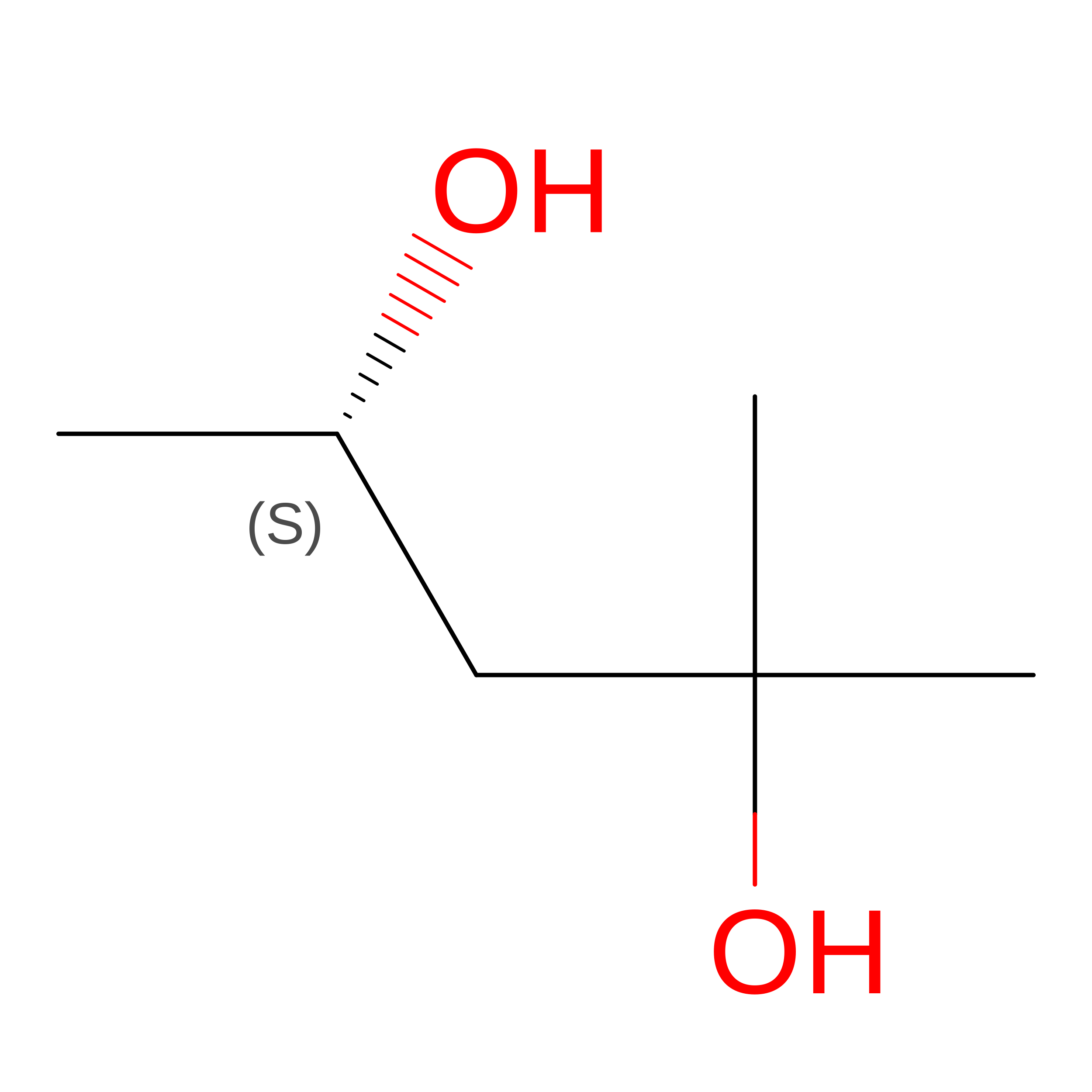
C [auth B](4S)-2-METHYL-2,4-PENTANEDIOL
C6 H14 O2
SVTBMSDMJJWYQN-YFKPBYRVSA-N
Modified Residues  1 Unique
IDChains TypeFormula2D DiagramParent
LLP
Query on LLP
A, B
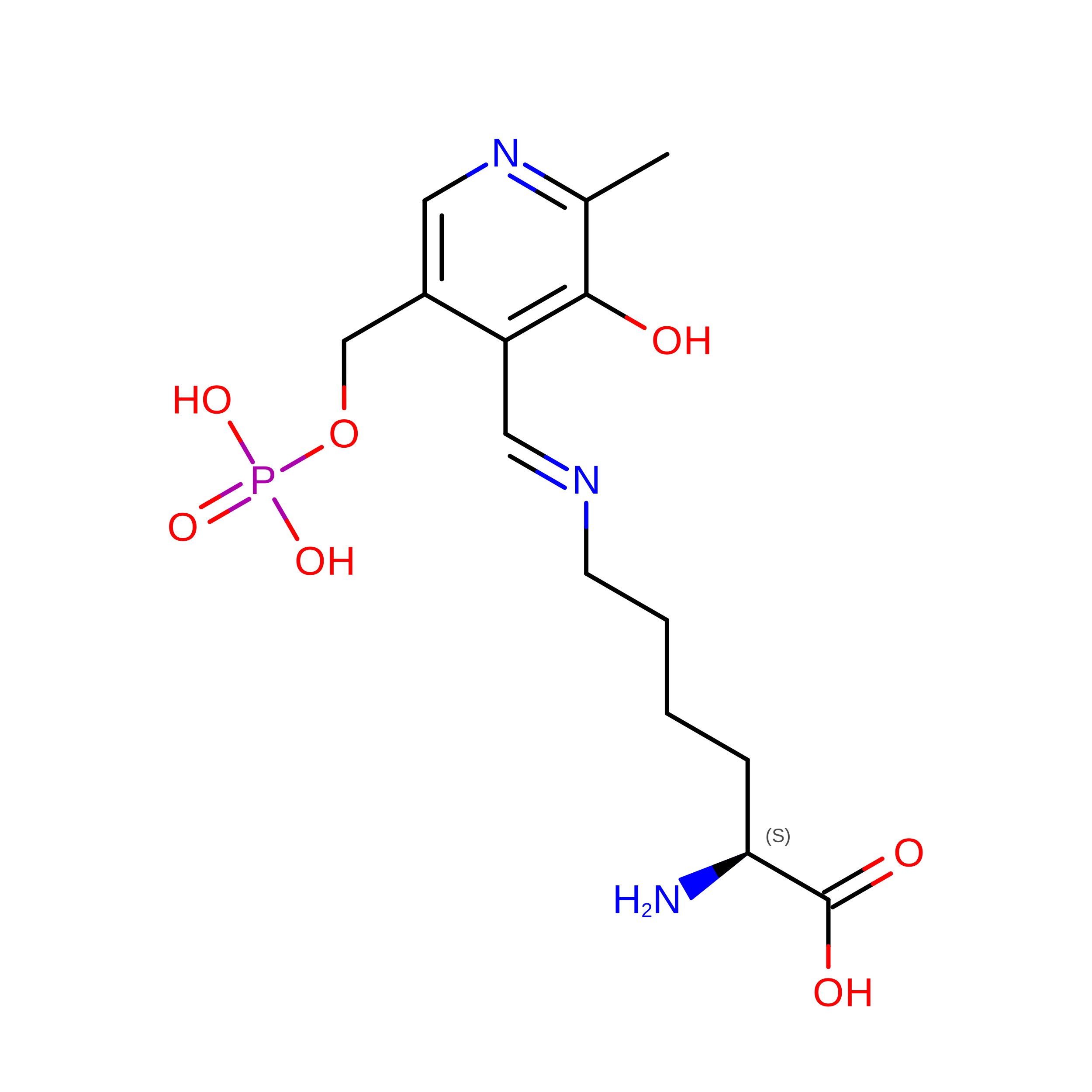
L-PEPTIDE LINKINGC14 H22 N3 O7 PLYS

Experimental Data & Validation

Experimental Data

  • Method: X-RAY DIFFRACTION
  • Resolution: 2.20 Å
  • R-Value Free:  0.212 (Depositor), 0.205 (DCC) 
  • R-Value Work:  0.173 (Depositor), 0.168 (DCC) 
  • R-Value Observed: 0.175 (Depositor) 
Space Group: P 21 21 21
Unit Cell:
Length ( Å )Angle ( ˚ )
a = 59.959α = 90
b = 103.065β = 90
c = 138.834γ = 90
Software Package:
Software NamePurpose
PROTEUM PLUSdata collection
PHASERphasing
PHENIXrefinement
PROTEUM PLUSdata reduction
PROTEUM PLUSdata scaling

Structure Validation

View Full Validation Report


Entry History 

Deposition Data

Revision History  (Full details and data files)

  • Version 1.0: 2013-02-13
    Type: Initial release
  • Version 1.1: 2013-02-27
    Changes: Database references
  • Version 1.2: 2013-04-24
    Changes: Database references
  • Version 1.3: 2025-03-26
    Changes: Data collection, Database references, Derived calculations, Structure summary